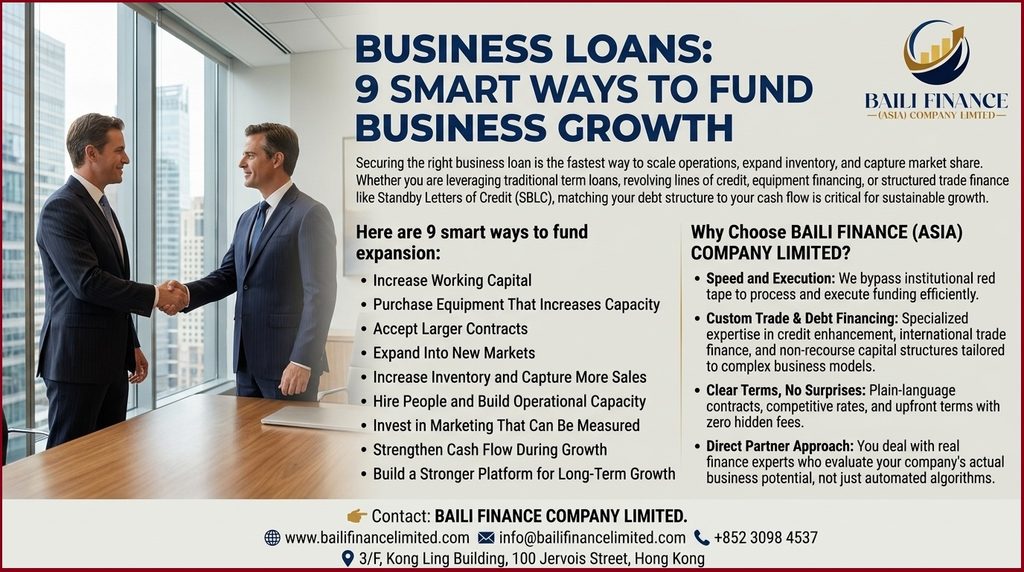
Headline: 9 Smart Ways Business Loans Fund Growth
Access to suitable business loans can determine how effectively a company manages working capital, purchases equipment, accepts larger contracts, expands into new markets, or responds to changing customer demand. However, securing business financing isn’t simply about finding a lender willing to provide money. The stronger approach involves identifying the right funding structure, calculating the true cost of borrowing, preparing credible financial information, and ensuring that repayment obligations align with projected business cash flow.
For small businesses, established companies, contractors, exporters, importers, manufacturers, traders, and project developers, the financing requirement can vary significantly. Some businesses need short-term working capital. Others need long-term business expansion loans, equipment financing, project finance, trade finance, or structured corporate funding.
At BAILI FINANCE (ASIA) COMPANY LIMITED, business loan solutions are presented as part of a broader financing offering that includes corporate lending, structured finance, trade finance, project financing, and other funding structures. The company states that its business loan solutions support enterprises seeking working capital, expansion funding, and medium- to long-term financial support.
The central question, therefore, isn’t simply, “How much can my business borrow?” It’s “What financing structure can support the business without creating unnecessary pressure on cash flow?”
Keywords: business loans for growth, business expansion loans, working capital loans, business working capital financing, equipment financing, commercial financing, corporate financing, business funding solutions, business finance options, financing for business expansion, business loan requirements, how to get a business loan, how business loans work, types of business loans, business loan financing, business financing options, business capital, business funding for expansion, financing for small businesses, SME business loans, commercial lending, structured business finance, trade finance, project finance
What Is a Business Loan?
A business loan is financing provided to a company, business owner, partnership, or other eligible commercial entity for a defined business purpose. Depending on the lender and structure, the borrower may repay the facility through scheduled instalments, interest payments, fees, or other agreed arrangements.
Business loans can finance many legitimate commercial requirements, including:
- Working capital
- Inventory purchases
- Equipment and machinery
- Business expansion
- Commercial property
- Construction
- Trade transactions
- Import and export activities
- Contract execution
- Debt restructuring
- Acquisitions
- Project development
- Operational expenses
- Technology investment
The structure matters because not every financing product suits every business.
A company experiencing a temporary cash-flow gap may need a short-term facility. A manufacturer purchasing expensive machinery may require asset or equipment financing. An established company entering a new market may require a larger corporate facility with a longer repayment period.
Therefore, business financing should start with the commercial requirement rather than the advertised loan amount.
WHY BUSINESSES NEED AND USE LOANS
Businesses take loans for one primary reason: timing. Revenue and expenses rarely align, and waiting to earn cash before spending it often means missing opportunities or dying outright.
Here is why companies actually borrow:
- Survival and Cash Flow Gaps: Payroll, rent, and inventory suppliers must be paid today. Customers often pay 30 to 90 days later. Loans bridge the period between paying expenses and receiving revenue.
- Capital Investments: Essential assets—machinery, delivery vehicles, real estate, software—require large sums upfront. Borrowing allows a business to use the equipment immediately to generate income while paying off the cost over time.
- Growth and Expansion: Opening a second location, hiring a sales team, or buying extra stock before a peak season takes capital. Waiting to fund growth purely through savings allows competitors to capture the market first.
- Strategic Leverage: Taking on manageable debt keeps existing ownership intact. Raising equity means selling off a percentage of the company; borrowing lets owners keep full control of their business.
Debt is a financial leverage tool. Used properly, it accelerates growth and prevents cash droughts; used poorly, it compounds risk and kills the business.
9 SMART WAYS BUSINESS LOANS FUND GROWTH
Business loans can do more than cover a temporary cash shortage. Used with a clear commercial purpose, the right financing can help a company increase production, purchase equipment, strengthen working capital, accept larger contracts, enter new markets, and build capacity for sustainable growth.
The important point is that borrowing doesn’t automatically create growth. How the capital is deployed determines whether debt becomes a productive business investment or an unnecessary financial burden.
Across Ghana and other markets, lenders offer different financing structures for working capital, business expansion, equipment, trade, contracts, property, and other commercial needs. For example, Ghanaian financial institutions currently offer term loans, overdrafts, invoice discounting, asset finance, LPO financing and other facilities designed around specific business requirements.
For business owners considering financing, here are nine practical ways business loans can support growth.
1. Increase Working Capital
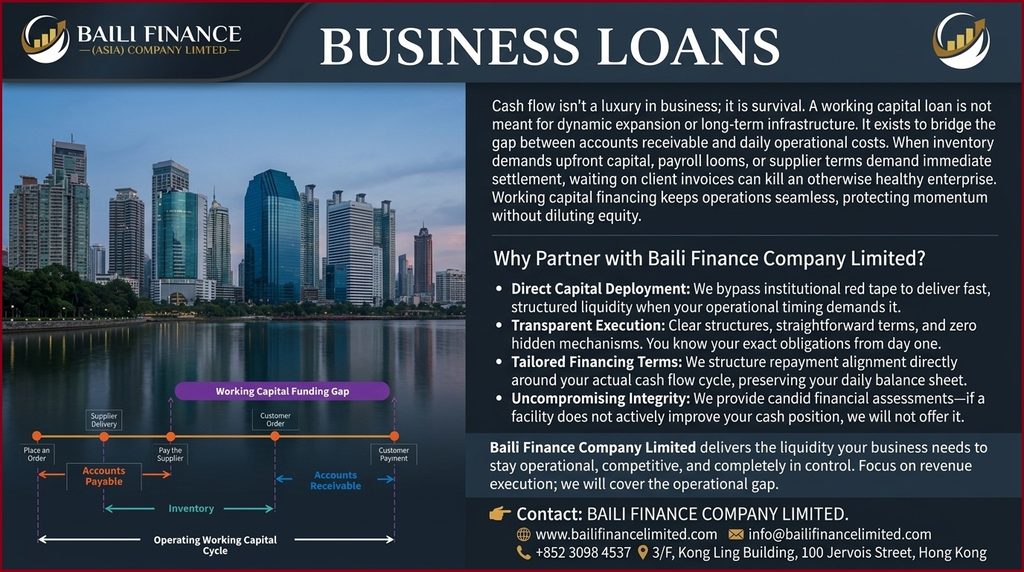
Working capital is one of the most common reasons businesses seek financing.
A company can have strong sales and still experience a cash-flow gap. Customers may take 30, 60 or 90 days to pay invoices while suppliers, employees, landlords and service providers require payment much sooner.
A working capital loan can help bridge that timing difference.
The funds may support:
- Inventory purchases
- Payroll
- Supplier payments
- Rent and operating expenses
- Transportation
- Production costs
- Receivables gaps
- Short-term contractual obligations
For example, Ghana’s Agricultural Development Bank offers commercial and SME financing for working capital, while other Ghanaian lenders provide overdrafts and receivables-based facilities for similar cash-flow requirements.
The objective should be to maintain business continuity while expected operating cash converts into available cash.
The growth advantage
Maintaining adequate working capital can allow a company to keep fulfilling orders rather than turning away customers because cash isn’t available at the right time.
However, working capital borrowing should have a defined repayment source. If a business repeatedly borrows to cover permanent operating losses, the problem isn’t simply a lack of financing. The underlying business model may require attention.
2. Purchase Equipment That Increases Capacity
Equipment can directly affect production capacity, operating efficiency and revenue potential.
A manufacturing company, for example, may receive orders that exceed its current production capacity. Without additional machinery, it may have to reject some of that demand.
Business financing can provide the capital required to acquire:
- Manufacturing machinery
- Commercial vehicles
- Construction equipment
- Agricultural equipment
- Technology systems
- Generators
- Medical equipment
- Warehouse equipment
- Production tools
Equipment financing is already a recognized business-financing category. Stanbic Bank Ghana, for example, offers vehicle and asset financing for movable assets and equipment, while business term loans can be used for defined transactions or assets.
The key question should be:
Will the asset generate enough additional economic value to justify its financing cost?
If a machine costs $200,000 and is expected to generate an additional $500,000 in annual gross revenue, management still needs to calculate operating costs, maintenance, financing costs and the actual incremental cash flow.
Borrowing should follow that analysis.
3. Accept Larger Contracts
Sometimes the biggest barrier to business growth isn’t demand.
It’s the capital required to fulfil the demand.
A company may win a large purchase order but lack sufficient cash to buy inventory, hire temporary workers, transport goods or begin production.
This creates an important opportunity for contract-based financing.
For example, FirstBank Ghana’s LPO Financing Facility is designed for registered businesses that need funding to execute job orders. Its published terms state that eligible financing can provide up to 70% of a supply order, subject to the facility’s requirements.
This type of financing can allow a company to pursue contracts that would otherwise exceed its available working capital.
A simple example
Imagine a distributor receives a confirmed supply contract worth GHS 1 million.
The company has the suppliers and operational capacity but only GHS 250,000 available.
Instead of rejecting the contract, the company could explore an appropriate contract-financing structure.
If approved, the financing provides the working capital required to fulfil the order. The customer then pays according to the contract, and the proceeds can contribute to repayment.
The commercial logic is straightforward:
Contract → financing → fulfilment → customer payment → repayment → retained profit.
Of course, actual financing terms, eligibility and risk assessment vary by lender.
4. Expand Into New Markets
Growth often requires investment before new revenue arrives.
A business entering another city, country or customer segment may need to spend money on:
- Market development
- Staff
- Distribution
- Warehousing
- Inventory
- Licensing
- Technology
- Marketing
- Local operations
- Customer acquisition
A business expansion loan can provide some of the capital required to establish that additional capacity.
But expansion should be based on evidence rather than optimism.
Before borrowing for a new market, management should examine:
- Market size
- Customer demand
- Competition
- Pricing
- Distribution costs
- Regulatory requirements
- Expected sales
- Gross margins
- Operating expenses
- Break-even period
The financing should then be matched to the expected cash-flow cycle.
Standard Chartered Ghana, for example, describes its term loans as structured borrowing for specific transactions or assets and offers short-, medium- and long-term structures for business cash and expansion requirements.
A longer-term expansion project generally shouldn’t depend entirely on very short-term borrowing.
5. Increase Inventory and Capture More Sales
Inventory can create revenue, but insufficient inventory can restrict revenue.
A retailer may lose customers because popular products are unavailable. A wholesaler may miss a major order because it cannot purchase enough stock. A manufacturer may need more raw materials to fulfil a confirmed contract.
Inventory financing can address this type of requirement.
The business borrows to purchase inventory, sells the inventory, receives customer payments and uses the resulting cash flow to meet the financing obligation.
Ghana’s Agricultural Development Bank, for example, lists inventory financing as a facility for stocking products and supporting supplier payments.
But inventory financing requires discipline
More inventory doesn’t automatically mean more profit.
Businesses should monitor:
- Inventory turnover
- Gross margin
- Storage costs
- Obsolescence
- Customer demand
- Supplier terms
- Sales velocity
- Financing costs
Borrowing to purchase products that remain unsold for months can create a cash-flow problem rather than solve one.
The strongest use of inventory financing is usually tied to identifiable demand and realistic sales projections.
6. Hire People and Build Operational Capacity
People are another form of growth investment.
A company may have enough customer demand to expand but lack the employees required to deliver the work.
Additional financing can support recruitment and training where there is a clear commercial justification.
For example, a technology company that wins three new contracts may need additional developers. A construction company may require more skilled workers. A logistics company may need drivers and operational staff.
The decision should be based on expected incremental revenue and cash flow.
If hiring five employees costs $20,000 per month, management needs a credible basis for expecting the additional workforce to produce sufficient economic value.
The calculation shouldn’t simply be:
“We have more work, so we need more employees.”
It should be:
“We have identified demand worth X, and the additional workforce is expected to produce Y in revenue and Z in contribution margin.”
That distinction helps prevent businesses from using debt to increase costs without increasing productive capacity.
7. Invest in Marketing That Can Be Measured
Marketing can support growth when it generates commercially valuable customers.
A business loan may finance a marketing campaign, digital advertising, sales infrastructure, customer acquisition programme, or brand-development initiative.
But marketing funded by debt requires stronger discipline than ordinary promotional spending.
Management should establish measurable indicators such as:
- Cost per lead
- Customer acquisition cost
- Conversion rate
- Average transaction value
- Customer lifetime value
- Gross margin
- Revenue generated
- Return on advertising spend
Suppose a company invests $50,000 in a campaign.
If the campaign generates $300,000 in additional revenue but the gross margin is only 10%, the business generates $30,000 in gross profit before considering other costs.
The financing decision therefore shouldn’t be based on revenue alone.
Profitability and cash flow matter.
Where marketing expenditure can be linked to measurable revenue generation, financing may be easier to justify. Where the outcome is highly uncertain, borrowing may create unnecessary repayment pressure.
8. Strengthen Cash Flow During Growth
Growth can temporarily put pressure on cash flow.
This sounds counterintuitive, but it happens frequently.
Consider a company that normally generates $100,000 in monthly sales.
It wins a new contract and expects monthly sales to rise to $250,000.
That sounds positive.
However, the company may need to purchase significantly more inventory, increase payroll, transport additional products and extend credit to customers before receiving payment.
Revenue rises, but cash requirements rise first.
A business loan, overdraft or revolving facility may help bridge that period.
Ghanaian lenders currently offer several structures designed around cash-flow and working-capital needs, including overdrafts, term loans, revolving short-term loans and invoice discounting.
This is where financial planning becomes essential.
Management should prepare a monthly cash-flow forecast showing:
- Opening cash balance
- Expected customer receipts
- Supplier payments
- Payroll
- Taxes
- Rent
- Loan repayments
- Capital expenditure
- Other operating expenses
- Closing cash balance
The objective is to identify the exact funding gap rather than borrow an arbitrary amount.
9. Build a Stronger Platform for Long-Term Growth
The most effective business financing doesn’t only solve today’s problem.
It can help create a stronger operating platform for future growth.
A company may use financing to:
- Upgrade its technology
- Improve production efficiency
- Build distribution capacity
- Acquire productive assets
- Establish additional locations
- Strengthen inventory management
- Complete major contracts
- Improve its financial infrastructure
- Develop new revenue channels
Over time, disciplined borrowing and repayment can also help a business establish a stronger credit profile, depending on the jurisdiction, lender and reporting arrangements.
However, debt should remain proportional to the company’s ability to repay.
Growth isn’t the same as borrowing
A company shouldn’t borrow simply because financing is available.
Instead, management should identify an opportunity where borrowed capital has a reasonable prospect of producing sufficient additional cash flow to cover:
Operating costs + financing costs + repayment obligations + acceptable profit.
That is the foundation of responsible business borrowing.
A Practical Business Loan Growth Example
Consider a distribution company that has operated profitably for several years.
The company receives a new supply contract worth GHS 2 million.
Its current cash reserves are GHS 500,000.
The contract requires GHS 1.2 million in inventory and operating expenditure before the customer makes payment.
The business therefore faces an estimated GHS 700,000 funding gap.
Rather than requesting a generic loan, management prepares a financing proposal showing:
- The signed supply contract
- Supplier quotations
- Customer payment terms
- Historical financial statements
- Existing liabilities
- Bank statements
- Projected cash flow
- Expected gross margin
- Proposed repayment source
The financing requirement becomes easier to understand because the company has connected the requested capital to a specific commercial transaction.
If financing is approved on suitable terms, the company can fulfil the contract, generate revenue, receive payment and repay the facility.
This is fundamentally different from borrowing simply to cover recurring losses.
How to Know Whether a Business Loan Is Worth It
Before applying for business financing, ask five questions.
1. What will the money produce?
Identify the specific economic outcome.
Will it produce more sales, reduce costs, increase capacity, or protect an existing revenue stream?
2. How quickly will the investment generate cash?
A project that takes five years to generate meaningful cash shouldn’t normally be financed using a facility that requires repayment within a few months.
3. What is the total financing cost?
Consider interest, arrangement fees, legal expenses, valuation fees, insurance, administrative charges and other applicable costs.
4. What is the repayment source?
Don’t rely solely on projected revenue.
Identify the actual cash flow that will service the debt.
5. What happens if the plan underperforms?
Stress-test the business.
What happens if:
- Sales fall by 20%?
- Customers pay 60 days late?
- Costs increase by 15%?
- The project is delayed?
- The expected contract isn’t renewed?
A responsible financing decision includes downside planning.
Business Loans Should Finance Productive Growth
The strongest case for business borrowing is usually straightforward.
The business has a defined opportunity.
The opportunity requires capital.
The capital can be deployed productively.
The expected cash flow can support repayment.
The financing cost is reasonable relative to the expected economic return.
The company has a credible plan if conditions change.
That is the difference between productive business debt and debt that simply postpones a financial problem.
Business loans can support working capital, expansion, equipment purchases, inventory, contracts, marketing, staffing and operational improvements. Current lending products in the world demonstrate that financing can be structured around different business requirements rather than treated as a single generic product.
For companies evaluating larger or more complex financing requirements, the next step is to define the transaction clearly and determine which financing structure fits the business.

Types of Business Loans
Understanding the main categories can help business owners choose financing more rationally.
Term Loans
A term loan provides a specified amount for an agreed period. The borrower normally makes scheduled repayments according to the financing agreement.
Term loans can suit businesses with a defined capital requirement and predictable repayment capacity.
Working Capital Loans
Working capital facilities are designed around operational liquidity.
They can support payroll, inventory, supplier payments, receivables cycles, and other short-term business requirements.
Business Lines of Credit
A business line of credit can provide access to capital up to an agreed limit. Depending on the structure, the borrower may draw funds when required and repay them according to the facility terms.
This can be useful when funding requirements fluctuate rather than occur as one large expenditure.
Equipment Financing
Equipment financing supports the acquisition of machinery, vehicles, technology, and other productive assets.
The lender may evaluate the business, the equipment, the transaction economics, and the expected repayment source.
Commercial Real Estate Loans
Businesses purchasing, developing, refinancing, or improving commercial property may require dedicated property financing.
These facilities generally involve larger amounts and longer repayment periods than ordinary working-capital facilities.
Trade Finance Facilities
Trade finance can support eligible import, export, supplier, purchase-order, and international transaction requirements.
Businesses should understand the underlying transaction before selecting a financing structure because trade finance isn’t simply interchangeable with a conventional business loan.
Structured Finance
Structured finance can become relevant when a conventional loan doesn’t adequately address the transaction.
The structure may incorporate multiple sources of capital, financial instruments, assets, contracts, guarantees, or other credit-support arrangements.
This requires detailed due diligence and professional financial structuring.
How Lenders Assess Business Loan Applications
A lender needs evidence that the proposed financing has a credible commercial purpose and a reasonable repayment source.
The assessment can include several factors.
Revenue and Cash Flow
Revenue demonstrates commercial activity, but revenue alone doesn’t prove repayment capacity.
A lender may examine:
- Historical revenue
- Gross profit
- Operating expenses
- Net income
- Cash flow
- Receivables
- Payables
- Existing debt
- Projected revenue
- Debt-service capacity
A profitable business can still experience liquidity problems. Conversely, a company with strong contracts may require temporary funding before revenue reaches its bank account.
Credit History
Business and personal credit information can influence financing decisions, depending on the structure, jurisdiction, lender, and business type.
A stronger credit profile may improve financing options, although it doesn’t guarantee approval.
Business Plan
A credible business plan explains how the company generates revenue, who its customers are, what the funding will achieve, and how the borrower expects to repay the financing.
For larger transactions, lenders may also require detailed financial models, contracts, corporate documents, project information, and supporting evidence.
The U.S. Small Business Administration, for example, states that lenders consider factors including credit history, the amount and intended use of funds, and the borrower’s ability to repay.
Collateral and Guarantees
Some financing arrangements require collateral, guarantees, or other forms of credit support.
The requirement depends on the lender, transaction size, borrower profile, jurisdiction, and financing structure.
Businesses shouldn’t assume that every business loan requires the same form of security.
What Documents Are Usually Required?
Preparation can significantly improve the financing process.
Depending on the transaction, lenders may request:
- Certificate of incorporation
- Business registration documents
- Identification documents
- Tax records
- Bank statements
- Management accounts
- Audited financial statements
- Business plan
- Cash-flow projections
- Existing loan agreements
- Major customer contracts
- Supplier agreements
- Purchase orders
- Project documents
- Asset information
- Proof of business address
- Details of beneficial ownership
For structured transactions, additional documentation may be required.
BAILI FINANCE states that its client review process can involve corporate information, transaction details, due diligence, and supporting documentation before financing terms are presented.
The practical lesson is simple: prepare before applying.
Submitting incomplete information can delay assessment and may make a straightforward transaction appear unnecessarily complicated.
How to Calculate the True Cost of a Business Loan
The interest rate is important, but it isn’t the only cost.
Businesses should examine:
Total financing cost = interest + arrangement fees + legal costs + valuation costs + administrative fees + other applicable charges
The exact components vary by lender and transaction.
Key Cost Components to Examine
- Interest Expenses: The ongoing interest charged over the loan tenure (fixed or variable).
- Mandatory Lender Fees: Initial arrangement, origination, underwriting, or administrative fees.
- Third-Party Professional Fees: Mandatory legal retainer costs, property or business valuation charges, and audit fees.
- Ongoing & Hidden Charges: Early repayment penalties, late payment fees, monthly account maintenance charges, or exit fees.
The Headline Rate Trap
A business loan featuring a lower headline interest rate can easily end up more expensive than a higher-rate alternative if it carries substantial arrangement or administrative fees.
Best Practice: When comparing loan offers, always calculate the Effective Annual Rate (EAR) or Annual Percentage Rate (APR)—or your jurisdiction’s equivalent standardized rate metric—to assess the true annual borrowing cost on an apples-to-apples basis.
External Sources:
U.S. Small Business Administration – 7(a) Loans Guide
ICC Uniform Rules for Demand Guarantees (URDG 758) & ISP98: BIS – Guidelines on
How to Choose the Right Business Loan
Choosing a financing facility should follow a structured process.
Step 1: Define the Funding Requirement
Don’t start with:
“How much money can I get?”
Start with:
“How much capital does this transaction actually require?”
If the business needs $300,000, borrowing $600,000 without a clear deployment strategy can increase financing costs and repayment pressure.
Step 2: Define the Purpose
Document exactly how the funds will be used.
For example:
- $100,000 for inventory
- $150,000 for equipment
- $50,000 for working capital
This creates a clear funding rationale.
Step 3: Establish the Repayment Source
The repayment source should be credible and identifiable.
Possible sources include:
- Operating cash flow
- Contract proceeds
- Receivables
- Asset sale
- Project revenue
- Refinancing
- Investment proceeds
Step 4: Compare Financing Structures
Compare:
- Interest rate
- Effective cost
- Loan duration
- Repayment frequency
- Grace period
- Collateral
- Guarantees
- Fees
- Early repayment terms
- Default provisions
- Currency
- Governing law
- Disbursement conditions
Step 5: Review the Contract
Never rely solely on verbal explanations.
Read the financing agreement and understand every material obligation before signing.
For complex transactions, independent legal and financial advice can be appropriate.
Real-World Example: SBA 7(a) Business Financing
The U.S. Small Business Administration’s 7(a) program provides a useful real-world example of how business financing can be structured around specific commercial requirements.
According to the SBA, 7(a) loans can support working capital, real estate, machinery and equipment, furniture, fixtures, supplies, certain debt refinancing, and changes of ownership. The program has historically provided financing of up to $5 million under its standard framework, subject to applicable rules and eligibility requirements.
The important lesson isn’t that every business should pursue an SBA loan. It is that loan suitability depends on the purpose, eligibility criteria, repayment capacity, and financing structure.
The SBA also provides a lender-matching process that allows eligible businesses to describe their needs, compare potential lenders, and proceed with an application.
This demonstrates a fundamental principle of business finance: the financing product should correspond to the business requirement.
Case Study: Funding a Manufacturing Expansion
The following is an illustrative case study designed to demonstrate how a business financing decision can be evaluated. It isn’t a claim about a specific BAILI FINANCE client.
A mid-sized manufacturing company has secured a new supply contract worth $4 million over 18 months.
The company has the production capacity, workforce, and customer relationship required to fulfil the contract. However, it needs $800,000 to purchase additional raw materials, upgrade production equipment, and manage the timing gap between supplier payments and customer receipts.
The company initially considers taking a large unsecured loan.
After reviewing the transaction, management identifies three separate requirements:
- Equipment financing for production upgrades.
- Working capital for the receivables cycle.
- Trade-related financing for supplier obligations.
Instead of treating the entire requirement as one generic business loan, the company evaluates a structured financing approach.
The projected contract cash flows become an important part of the repayment analysis.
Management also prepares:
- The signed customer contract
- Historical financial statements
- Current bank statements
- Supplier quotations
- Equipment invoices
- Cash-flow projections
- Existing debt information
- Corporate registration documents
The financing request becomes more credible because the company can demonstrate both the purpose of the funds and the expected repayment source.
The lesson is important: a well-prepared financing proposal doesn’t merely request capital. It explains the commercial logic behind the capital requirement.
Business Loans and International Financing
International businesses often face additional considerations.
Cross-border financing can involve:
- Currency exposure
- Multiple jurisdictions
- International banking relationships
- Foreign exchange risk
- Trade documentation
- Compliance requirements
- Know-your-customer procedures
- Anti-money-laundering controls
- Contractual obligations
- International payment mechanisms
Businesses should therefore conduct appropriate due diligence before entering a cross-border financing arrangement.
BAILI FINANCE describes itself as a Hong Kong-registered financial services company serving an international client base and offering business loans alongside trade finance, structured finance, bank guarantees, SBLC-related services, and other financing solutions.
For complex international transactions, the quality of documentation and transaction structure can be as important as the amount of capital being requested.
Business Loans, SBLCs and Structured Funding
Some commercial transactions require more than a conventional loan.
A Standby Letter of Credit (SBLC) is a banking instrument that can provide financial assurance to a beneficiary if the applicant fails to meet specified contractual or financial obligations.
It isn’t automatically a business loan.
However, in eligible structured-finance transactions, financial instruments can form part of a broader financing arrangement.
BAILI FINANCE states that it supports SBLC and bank-guarantee solutions as well as non-recourse funding structures and business financing.
Businesses considering SBLC-backed or instrument-based financing should conduct independent due diligence, verify the issuing bank and transaction documentation, understand every fee and obligation, and obtain appropriate professional advice.
Never treat a financial instrument as a substitute for proper credit assessment.
Common Business Loan Mistakes
Borrowing More Than the Business Needs
Excess capital can create unnecessary interest expense and repayment obligations.
Ignoring Cash Flow
Revenue isn’t the same as available cash.
Loan repayments must be supported by actual liquidity.
Choosing Based Only on Interest Rate
Fees, security requirements, maturity, repayment frequency, currency, and other contractual terms can materially affect the overall cost.
Using Short-Term Debt for Long-Term Assets
Financing a long-lived asset with very short-term debt can create avoidable refinancing and liquidity pressure.
Submitting Weak Documentation
Incomplete financial records can slow the assessment process.
Failing to Plan for Downside Scenarios
A sound financing plan should consider what happens if sales decline, customers pay late, costs increase, or a project experiences delays.
Accepting Unclear Terms
If a fee, repayment condition, security requirement, or financing mechanism isn’t clear, ask for written clarification before proceeding.
How to Improve Your Chances of Securing Business Financing
Businesses can take several practical steps before approaching a lender.
Maintain accurate financial records.
Keep accounting records current and consistent.
Separate personal and business finances.
Clear financial separation makes commercial performance easier to evaluate.
Monitor existing debt.
Know your outstanding principal, interest rates, maturity dates, and repayment obligations.
Build a credible business case.
Explain why the financing is required and what it should accomplish.
Prepare realistic projections.
Avoid unsupported revenue assumptions.
Document contracts.
Customer contracts, purchase orders, supplier agreements, and project documents can help establish the commercial basis for financing.
Know your numbers.
Be able to explain revenue, gross margin, operating costs, working capital, debt service, and projected cash flow.
Compare financing options.
Don’t accept the first offer without understanding the alternatives.
Why Professional Financing Advice Matters
A business loan affects more than the immediate cash position.
It can influence:
- Working capital
- Profitability
- Debt-service capacity
- Balance-sheet strength
- Ownership structure
- Asset security
- Future borrowing capacity
- Business continuity
For that reason, financing decisions deserve the same discipline applied to major commercial contracts.
At BAILI FINANCE, the stated approach is to review financing requirements and structure solutions around the client’s transaction, business profile, and funding objectives. Its financing offering covers business loans as well as corporate, project, trade, and structured finance.
No financing provider can responsibly guarantee approval without reviewing the actual transaction. Suitability, documentation, credit assessment, compliance, and repayment capacity remain fundamental.

Frequently Asked Questions About Business Loans
1. What is the best business loan for a small business?
There isn’t one business loan that is best for every company. The appropriate facility depends on the funding purpose, amount required, repayment source, business profile, credit position, collateral, cash flow, and financing terms.
2. What can a business loan be used for?
Depending on the lender and facility, business loans may support working capital, inventory, equipment, expansion, property, trade transactions, project costs, acquisitions, and other legitimate commercial purposes.
3. Can a new business get a business loan?
A new business may qualify for certain forms of financing, but requirements can be more demanding because the company has limited operating history. Lenders may place greater emphasis on the owner’s experience, business plan, available capital, collateral, contracts, projected cash flow, and repayment capacity.
4. What documents are needed for a business loan?
Requirements vary, but lenders commonly request company registration documents, identification, financial statements, bank statements, tax information, business plans, cash-flow projections, contracts, and information about existing liabilities.
5. How much business financing can a company obtain?
The amount depends on the lender, jurisdiction, transaction, business financial position, repayment capacity, collateral, and intended use of funds. A larger loan isn’t necessarily better if the business cannot comfortably support the repayment obligations.
6. Can business loans be used for working capital?
Yes. Working capital is a common purpose for business financing. The facility can help manage timing differences between business expenses and incoming customer payments, subject to the lender’s terms.
7. What is the difference between a business loan and trade finance?
A business loan can provide general commercial funding, while trade finance is typically structured around specific trade transactions such as imports, exports, supplier payments, purchase orders, or international commercial contracts.
8. Does BAILI FINANCE provide business loans?
BAILI FINANCE (ASIA) COMPANY LIMITED states that it provides business loan solutions for enterprises seeking working capital, expansion funding, and medium- to long-term financial support. Financing remains subject to assessment, documentation, transaction suitability, and applicable terms.
9. Should I take a business loan to expand my company?
Borrowing can support expansion when the expected commercial return and projected cash flow justify the financing cost and repayment obligations. Before borrowing, calculate the expected revenue, expenses, financing costs, downside risks, and repayment capacity.
Final Thoughts: Borrow With a Clear Commercial Purpose
Business loans can provide the capital required to maintain operations, purchase productive assets, fulfil contracts, enter new markets, and pursue strategic growth.
However, successful business financing starts with discipline.
Define the requirement. Establish the purpose. Calculate the total cost. Prepare the documentation. Assess the repayment source. Compare financing structures. Review the legal terms. Then make the financing decision.
For companies seeking more than a standard lending product, structured business finance may provide additional options, particularly where the transaction involves international trade, projects, corporate expansion, financial instruments, or complex capital requirements.
BAILI FINANCE (ASIA) COMPANY LIMITED states that it works with businesses across different sectors and jurisdictions and provides business loans alongside corporate finance, trade finance, project finance, structured finance, and other funding solutions.
Ready to Discuss Your Financing Requirement?
If your company needs business funding, working capital, expansion finance, project financing, corporate lending, trade finance, or a structured financing solution, don’t make the decision based on a headline loan amount alone.
Bring the transaction, funding requirement, business purpose, and repayment strategy to a professional financing discussion.
Contact BAILI FINANCE (ASIA) COMPANY LIMITED and request an initial assessment of your financing requirement.
Tell the team:
- How much capital you require
- What the funds will finance
- Where your business operates
- Your expected repayment source
- Whether you have contracts, assets, collateral, or financial instruments
- Your preferred financing timeline
The earlier your financing requirement is properly defined, the easier it becomes to determine which funding structure may be appropriate.
Start the conversation today.
Visit BAILI FINANCE for Business Loans & Financing Solutions
Business Finance | Corporate Finance | Trade Finance | Project Finance | Structured Finance
Intermediaries/Consultants/Brokers are welcome to bring their clients 100% protected. Our brokers receive 2% commission for referral. We assist Clients and brokers in their attempt to secure funding by working on their funding requests that may require innovative financing. In complete confidence, we will work together for the benefits of all parties involved.
#BusinessLoans #BusinessFinance #BusinessFunding #WorkingCapital #CorporateFinance #TradeFinance #ProjectFinance #SMEFinance #BusinessGrowth #StructuredFinance