Headline: Stop Choosing SBLC Providers Without Due Diligence
Businesses seeking trusted SBLC financing providers need more than a company that promises fast funding, high leverage, or immediate monetization. A Standby Letter of Credit can support international trade, project finance, credit enhancement, contractual obligations, and structured financing. However, the instrument doesn’t automatically create cash or guarantee financing.
The quality of the issuing bank, SBLC wording, transaction structure, financing institution, compliance process, and underlying commercial purpose all matter.
The International Chamber of Commerce describes an SBLC as an independent undertaking that provides an assurance of payment to a beneficiary. The ICC also recognizes its potential role as a credit-enhancement instrument when the issuing institution has suitable credit standing.
For companies considering SBLC financing providers, SBLC monetization companies, standby letter of credit financing, bank guarantee providers, or structured finance firms, the first objective should therefore be verification.
The right provider should explain the transaction clearly, identify the relevant parties, document the funding structure, and subject the proposed transaction to appropriate due diligence.
Keywords: trusted SBLC financing providers, legitimate SBLC financing providers, best SBLC financing companies, reliable SBLC provider for business, SBLC financing for companies, standby letter of credit financing, SBLC-backed business financing, SBLC monetization providers, legitimate SBLC monetization companies, SBLC funding for project finance, SBLC financing for international trade, non-recourse SBLC funding, SBLC financing without traditional collateral, bank guarantee and SBLC provider, trusted standby letter of credit provider, SBLC provider for project funding, SBLC financing for working capital, international SBLC financing, corporate SBLC financing solutions
What Is SBLC Financing?
An SBLC, or Standby Letter of Credit, is a bank-issued undertaking designed to support a financial or contractual obligation.
Under the ICC’s International Standby Practices, an SBLC can operate as an irrevocable, independent, documentary, and binding undertaking when issued subject to those rules. Its obligations depend on the terms of the standby and the documents required for a complying presentation.
In practical terms, an SBLC gives a beneficiary additional payment assurance.
For example, suppose a company enters into an international supply agreement. The supplier wants stronger payment protection before manufacturing and shipping equipment. The buyer may arrange an SBLC from an acceptable bank in favor of the supplier.
If the buyer fails to meet the defined obligation and the beneficiary presents the documents required by the SBLC, the issuing bank may have an obligation to honor the complying demand.
That structure differs from ordinary business financing.
An SBLC isn’t automatically a loan.
It isn’t automatically an investment.
It isn’t automatically cash collateral.
And it doesn’t guarantee that a financing institution will approve a funding request.
This distinction is fundamental when evaluating legitimate SBLC financing providers.
Why Businesses Use SBLC Financing
Companies may consider SBLC-backed structures when a transaction requires additional financial assurance or credit support.
Common applications include:
- International trade finance
- Import and export transactions
- Project finance
- Infrastructure projects
- Construction contracts
- Equipment procurement
- Commodity transactions
- Working capital structures
- Credit enhancement
- Supplier financing
- Contractual performance support
- Structured finance
- Certain SBLC monetization arrangements
The exact application depends on the transaction.
A construction company, for instance, may require financial support before a supplier releases expensive equipment. An importer may need payment assurance for an overseas supplier. A project developer may require additional credit support when arranging a larger financing structure.
Accordingly, SBLC financing for business should begin with the underlying commercial requirement rather than the face value of the proposed instrument.
That approach produces a more realistic financing assessment.
What Makes an SBLC Financing Provider Trustworthy?
The phrase trusted SBLC financing provider deserves careful examination.
A professional website, international telephone number, impressive claims, or a large advertised transaction size doesn’t independently establish the legitimacy of a financial provider.
Instead, prospective clients should examine several factors.
1. Corporate Identity and Registration
Start with the legal entity.
Confirm:
- Legal company name
- Registration number
- Registered jurisdiction
- Registered address
- Directors and authorized representatives
- Corporate documentation
- Applicable licensing or regulatory status
- Contracting entity
- Bank account ownership
These details should correspond across contracts, corporate documents, invoices, websites, and banking instructions.
A discrepancy should trigger additional review before money or sensitive documentation changes hands.
2. Banking Relationships
The issuing institution matters significantly.
The ICC explains that an SBLC’s credit-enhancement value can depend on the credit standing of its issuer.
Therefore, don’t evaluate an SBLC solely by its face value.
A $10 million SBLC isn’t automatically equivalent to another $10 million SBLC.
The parties should examine:
- Issuing bank
- Bank jurisdiction
- Bank credit standing
- Instrument wording
- Beneficiary
- Applicant
- Amount
- Expiry
- Governing rules
- Payment terms
- Advising or confirming arrangements
- Authentication and verification procedures
The financing provider should be able to explain why the proposed issuing institution and instrument meet the requirements of the transaction.
3. Clear SBLC Documentation
Professional providers should explain the documentation before execution.
Depending on the transaction, documentation may include:
- Corporate registration documents
- Identification documents
- Financial statements
- Business plan
- Project documents
- Contracts
- Purchase agreements
- Sales agreements
- Invoices
- Source-of-funds information
- KYC documentation
- AML documentation
- SBLC draft wording
- Financing term sheet
- Legal agreements
An unexplained document request deserves clarification.
Likewise, a provider that refuses to explain the transaction structure creates unnecessary risk for the client.
4. Independent Verification
Independent verification remains one of the most important safeguards.
Don’t rely solely on a screenshot of an alleged bank instrument.
Don’t rely solely on a PDF.
Don’t rely solely on a broker’s statement that an SBLC has been issued.
The relevant bank-to-bank authentication process should follow the applicable transaction structure.
Where appropriate, professional legal, financial, banking, and compliance advisers should review the documentation.
The objective is simple: verify before committing.

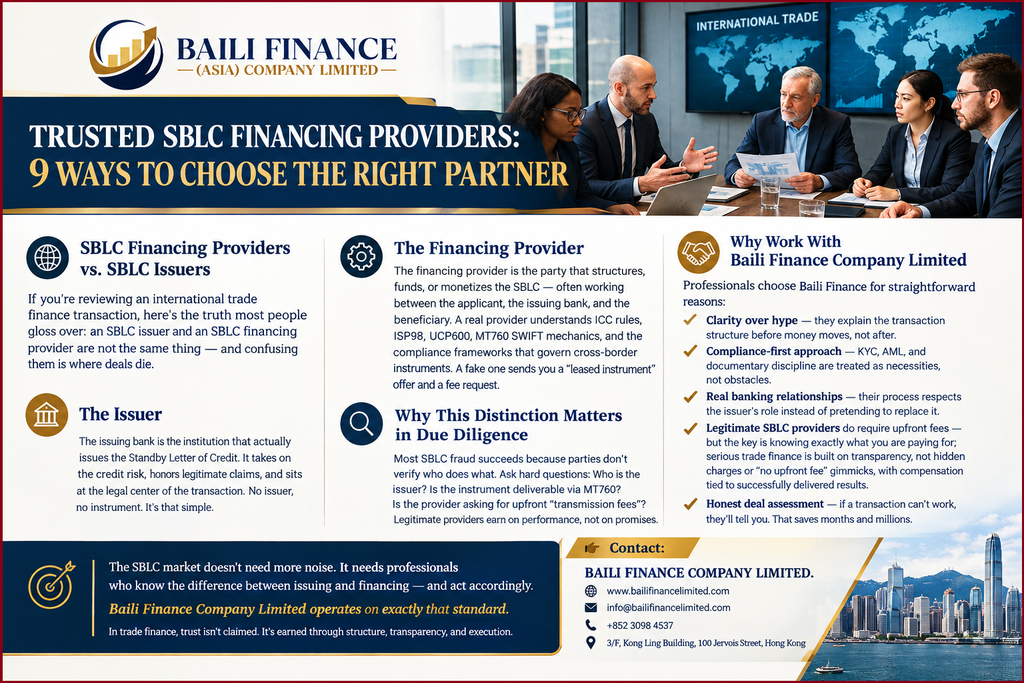
SBLC Financing Providers vs. SBLC Issuers
These terms often appear together, but they can describe different roles.
An issuing bank issues the SBLC.
An SBLC provider or arranger may help a client obtain or structure the instrument.
A financing provider or lender may consider the SBLC as part of a broader financing structure.
A monetization provider may arrange financing against an eligible instrument, subject to its own underwriting and acceptance criteria.
An advising bank may advise the instrument to the beneficiary.
A confirming bank may add its own undertaking where the applicable structure permits it.
These parties shouldn’t automatically be treated as interchangeable.
The ICC’s UCP 600 framework, where expressly incorporated, defines roles such as applicant, issuing bank, and advising bank within documentary-credit transactions.
Consequently, a company searching for SBLC financing providers for business funding should ask:
Who actually issues the SBLC, who provides the financing, and who assumes each contractual obligation?
That single question can clarify much of a proposed transaction.
SBLC Monetization: What Businesses Need to Understand
SBLC monetization generally refers to a financing structure in which an eligible financial instrument supports access to liquidity.
However, monetization isn’t a mechanical process where a company submits an SBLC and automatically receives a predetermined percentage of its face value.
A financing institution may consider:
- Issuing bank
- Instrument authenticity
- Instrument wording
- Beneficiary
- Applicant
- Tenor
- Transaction purpose
- Jurisdiction
- Borrower profile
- Repayment source
- Corporate financial position
- Compliance status
- Security arrangements
- Financing terms
The lender’s assessment remains important.
Therefore, claims such as “100% guaranteed funding,” “instant monetization,” or “automatic cash against any SBLC” should receive careful scrutiny.
A legitimate financing process needs underwriting.
TRUSTED SBLC FINANCING PROVIDERS | 9 WAYS TO CHOOSE
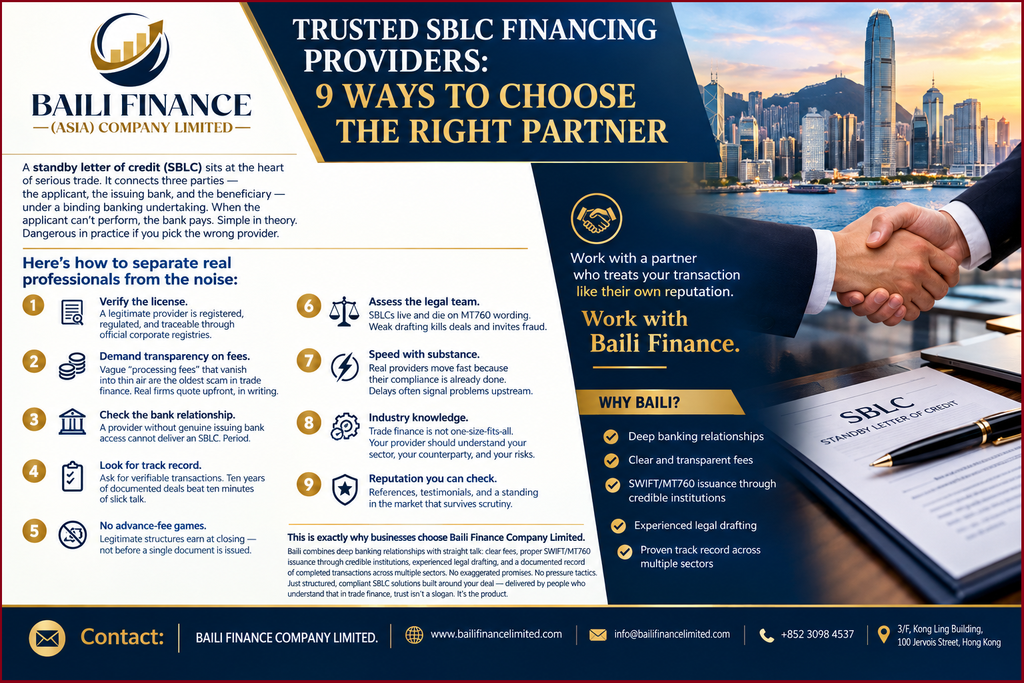
Securing a Standby Letter of Credit (SBLC) is a critical milestone for corporate growth, international trade expansion, and high-value project funding. Because the SBLC market features various institutional lenders, alternative houses, and specialized trade finance advisors, choosing a dependable partner requires rigorous evaluation.
Below are 9 essential ways to evaluate and choose trusted SBLC financing providers to ensure a secure, transparent, and legally sound transaction.
1. Verify Institutional Background and Track Record
A legitimate SBLC provider or issuing institution should have a verifiable corporate history, a transparent organizational structure, and an established track record in global trade finance.
- What to look for: Look for corporate registration details, physical office footprints, and verifiable case studies or project histories. Avoid providers that operate exclusively through anonymous messaging apps, generic web domains, or temporary email addresses.
2. Inspect Banking Network and SWIFT Capabilities
An SBLC is fundamentally a bank-to-bank instrument transmitted securely through established global networks.
- What to look for: Ensure the provider works directly with or through internationally recognized, rated commercial banks. Confirm that they utilize standard SWIFT protocols (such as MT760) for message delivery. Be wary of providers claiming they can issue authentic instruments outside of standard banking channels or via unverified alternative networks.
3. Evaluate Transparency in Fee Structures and Upfront Costs
The trade finance sector unfortunately attracts bad actors who demand heavy upfront fees (“upfront admin charges” or “commitment fees”) with no intention or capacity to deliver the instrument.
- What to look for: Trusted SBLC providers maintain transparent, milestone-based fee structures. While standard banking fees, issuance charges, and legal retainers are normal, they are typically handled through secure escrow arrangements, documentary letters of credit, or paid directly to recognized institutional accounts tied to verifiable issuance milestones.
4. Assess Regulatory Compliance and KYC Standards
Legitimate financial institutions and corporate trade finance advisors strictly adhere to international Anti-Money Laundering (AML) and Know Your Customer (KYC) regulations.
- What to look for: A trusted provider will thoroughly vet your company, requesting corporate documents, proof of funds, project contracts, and a clear rationale for the trade finance instrument. If a provider is willing to issue an SBLC instantly with zero due diligence or background checks, treat it as a major red flag.
5. Review Flexibility in SBLC Monetization and Funding Pathways
Securing an SBLC is often only the first step; many businesses require subsequent monetization (turning the SBLC into cash or credit lines) to fund active operations or trade cycles.
- What to look for: Choose a financing partner that offers integrated guidance or direct pathways for non-recourse funding, recourse loans, or monetization structures aligned with your SBLC. A provider with broad lending relationships can seamlessly connect your instrument to credit lines without breaking compliance.
6. Examine Flexibility in Terms, Text, and Wording
Every international trade contract or project tender has unique requirements regarding the wording of an SBLC (e.g., governing laws, draw conditions, expiry dates, and partial drawing allowances).
- What to look for: Trusted providers and advisory teams work closely with your legal counsel and beneficiary banks to draft custom text that satisfies both parties. Avoid rigid providers who force a one-size-fits-all template that the beneficiary’s bank is guaranteed to reject.
7. Look for Direct Corporate Communication Channels
Clear, unambiguous communication is vital when dealing with high-value financial instruments.
- What to look for: Professional SBLC providers operate through official corporate domains, secure client portals, and designated corporate emails rather than informal chat threads. They provide dedicated account managers who can coordinate directly with corporate officers, CFOs, and legal teams.
8. Analyze Industry Reputation and Client Testimonials
Peer feedback and industry reputation serve as vital barometers of a provider’s reliability.
- What to look for: Seek out client testimonials, references, or independent reviews highlighting successful SBLC issuances and monetization cycles. Trusted providers are usually transparent about past successful engagements within specific sectors like commodities, construction, or manufacturing.
9. Verify Post-Issuance Support and Lifecycle Management
An SBLC is an active contract that requires careful tracking throughout its validity period—ranging from amendments and extensions to final cancellation or drawdowns.
- What to look for: Opt for a provider that offers comprehensive post-issuance support. A reliable partner will assist you through every phase of the instrument’s lifecycle, ensuring clear communication lines remain open between the applicant, issuing bank, and beneficiary until the obligation is fully fulfilled.
Partnering with Baili Finance
If your organization is navigating the complexities of sourcing, structuring, or leveraging Standby Letters of Credit for international trade, Baili Finance (Asia) Company Limited provides structured corporate guidance. We help businesses align their trade finance instruments with legitimate issuance networks and monetization pathways designed to protect corporate liquidity and satisfy global counterparty requirements.
How to Compare Trusted SBLC Financing Providers
Instead of choosing a provider based on marketing language, create a structured comparison.
| Due-Diligence Area | Questions to Ask |
|---|---|
| Corporate identity | Who is the contracting entity? |
| Registration | Where is the company registered? |
| Banking | Which institution issues the SBLC? |
| Instrument | What are the SBLC terms? |
| Rules | Is the instrument subject to ISP98 or UCP 600? |
| Verification | How will the bank authenticate it? |
| Financing | Who provides the actual funding? |
| Fees | What fees apply and when? |
| Compliance | What KYC and AML checks apply? |
| Repayment | What is the repayment source? |
| Security | What collateral or guarantees apply? |
| Legal review | Which jurisdiction governs the agreement? |
| Exit | What happens if financing isn’t approved? |
This process makes provider selection more objective.
It also reduces the likelihood of confusing a financial instrument provider with an actual lender.
ISP98 and UCP 600: Why the Rules Matter
The applicable rules should appear clearly in the instrument where appropriate.
ISP98, or the International Standby Practices, was specifically developed for standby transactions. The ICC states that the rules apply to standby letters of credit when the undertaking expressly incorporates them.
UCP 600, meanwhile, governs documentary credits when the credit expressly subjects itself to those rules. Article 1 also states that UCP 600 applies to standby letters of credit to the extent applicable when expressly incorporated.
This matters because the governing framework affects how the instrument operates.
A professional transaction should therefore identify:
- Applicable rules.
- Governing law.
- Issuing bank.
- Beneficiary.
- Required documents.
- Presentation requirements.
- Expiry provisions.
- Amendment procedures.
- Payment mechanism.
- Relevant dispute provisions.
For complex transactions, independent legal advice can help parties understand these provisions before execution.
Recommended external resource: businesses researching the technical framework should consult the International Chamber of Commerce’s official material on
International Standby Practices (ISP98).
That is a more authoritative reference than relying on generic SBLC marketing content.
Red Flags When Choosing an SBLC Financing Provider
Businesses should stop and investigate when a proposed transaction contains unusual pressure or unsupported claims.
Guaranteed Approval
No legitimate financing assessment should require a business to assume approval before underwriting.
Guaranteed Returns
A financing structure shouldn’t be presented as a risk-free investment simply because an SBLC or bank guarantee forms part of it.
Unclear Source of Funds
Ask where the actual financing comes from.
Is it:
- A bank?
- A private lender?
- An institutional investor?
- A fund?
- A structured-finance company?
- Another financing institution?
The answer should be documented.
Excessive Upfront Payments
Fees should be transparent and contractually defined.
A business should understand exactly what it pays, why it pays it, who receives it, and what happens if the transaction doesn’t proceed.
Pressure to Act Immediately
Complex cross-border finance requires review.
Pressure to sign immediately can interfere with proper legal and financial due diligence.
Unverifiable Bank Claims
Bank names, ratings, SWIFT-related claims, and alleged banking relationships should receive independent verification where relevant.
Unrealistic Funding Percentages
A provider promising an unusually high percentage of an instrument’s face value without examining the transaction should be approached cautiously.
A Professional SBLC Financing Process
A properly structured transaction can follow a sequence similar to this:
Step 1: Define the Funding Requirement
The business should establish the exact amount required and its intended use.
Step 2: Review the Commercial Transaction
The financing provider should understand the underlying business activity.
Step 3: Review the Applicant
Corporate structure, financial position, management, business history, and compliance information may form part of underwriting.
Step 4: Review the SBLC
The proposed instrument should undergo documentary and banking review.
Step 5: Verify the Issuing Institution
The relevant banking relationship should be independently assessed.
Step 6: Conduct KYC and AML Checks
The parties should identify beneficial owners, transaction participants, source of funds, and relevant jurisdictions.
Step 7: Structure the Financing
The lender determines whether and how the SBLC fits into the proposed facility.
Step 8: Execute Legal Documentation
The financing agreement, security documents, instrument documents, and related contracts should be reviewed before execution.
Step 9: Funding
Disbursement follows the conditions established in the final financing agreement.
This sequence can vary significantly depending on the transaction.
Real-World Example: Project Finance Supported by an SBLC
Consider an infrastructure contractor that receives a $20 million equipment and construction contract.
The contractor has the technical capacity and commercial contract but needs additional financial support to satisfy equipment suppliers.
The project requires:
- $5 million for equipment
- $3 million for mobilization
- $4 million for construction costs
- $2 million for logistics
- Remaining funds for working capital and contingency requirements
The contractor approaches an SBLC financing provider.
Rather than treating the $20 million contract as automatic collateral, the provider reviews:
- The underlying contract
- Counterparty
- Payment schedule
- Contractor’s financial statements
- Project economics
- Supplier agreements
- Proposed SBLC
- Issuing bank
- Repayment source
- Compliance documentation
Suppose the proposed SBLC has a $10 million face value.
The provider doesn’t simply release $10 million.
Instead, it determines whether the instrument supports a specific financing structure and whether the underlying project can generate sufficient repayment capacity.
If approved, the resulting facility might combine SBLC support with project receivables, contractual payments, sponsor equity, or other agreed security.
The important lesson is straightforward:
The SBLC supports the financing structure; it doesn’t replace the financing analysis.
Case Study: Structured SBLC Funding for a Growing Contractor
The following case study is illustrative, designed to demonstrate how an SBLC-backed financing transaction can be assessed. It isn’t a representation of a specific client transaction or a guarantee of financing terms.
The Situation
A regional engineering contractor wins a large commercial infrastructure contract.
The contractor needs working capital to purchase equipment and mobilize subcontractors before receiving scheduled project payments.
Traditional lending doesn’t fully meet the timing requirements.
The company therefore explores SBLC-backed business financing.
The Challenge
The contractor needs:
- Immediate working capital
- Supplier confidence
- A documented financing structure
- Cross-border payment support
- Clear repayment arrangements
However, the company doesn’t want to rely on unsupported assumptions about SBLC monetization.
The Review
The financing provider requests:
- Corporate registration
- Ownership information
- Financial statements
- Project contract
- Purchase agreements
- Supplier quotations
- Project budget
- Cash-flow projections
- SBLC details
- Issuing-bank information
- KYC and AML documents
The provider then evaluates whether the proposed SBLC and commercial transaction meet its financing criteria.
The Structure
Assume the company has a qualifying $8 million SBLC.
The lender determines that the SBLC can form part of a $5 million working-capital facility, subject to the final financing agreement, transaction risk, repayment source, and other conditions.
The facility is linked to project cash flows.
The Outcome
The contractor uses the approved facility for equipment procurement and project mobilization.
As project payments arrive, they support repayment according to the financing agreement.
The structure succeeds because the parties address the entire transaction rather than focusing solely on the SBLC’s face value.
This principle also aligns with the broader logic of project finance. The World Bank notes that project financing structures can involve multiple parties, contractual arrangements, revenue sources, debt and equity, and specific risk-allocation mechanisms.
Baili Finance Limited and SBLC Financing
For businesses evaluating providers, Baili Finance (Asia) Company Limited publishes information about SBLC issuance and monetization, bank guarantees, international trade finance, non-recourse funding, and structured financial solutions.
According to its website, Baili Finance is a Hong Kong-registered financial services company and lists Company Registration No. 2315541 and Business Registration No. 65543223.
The company’s published SBLC service information states that it structures SBLC solutions for areas including international trade, project finance, credit enhancement, and liquidity-related transactions.
Its financing-solutions page also describes tailored structures covering working capital, project finance, equipment financing, trade finance, and other commercial financing requirements.
Businesses considering Baili Finance, or any other provider, should still conduct appropriate independent due diligence.
That includes verifying the proposed issuing bank, financing source, contractual terms, applicable regulations, fees, transaction documentation, and the specific obligations of every party.
You can review Baili Finance’s published SBLC provider and monetization services directly through its website.
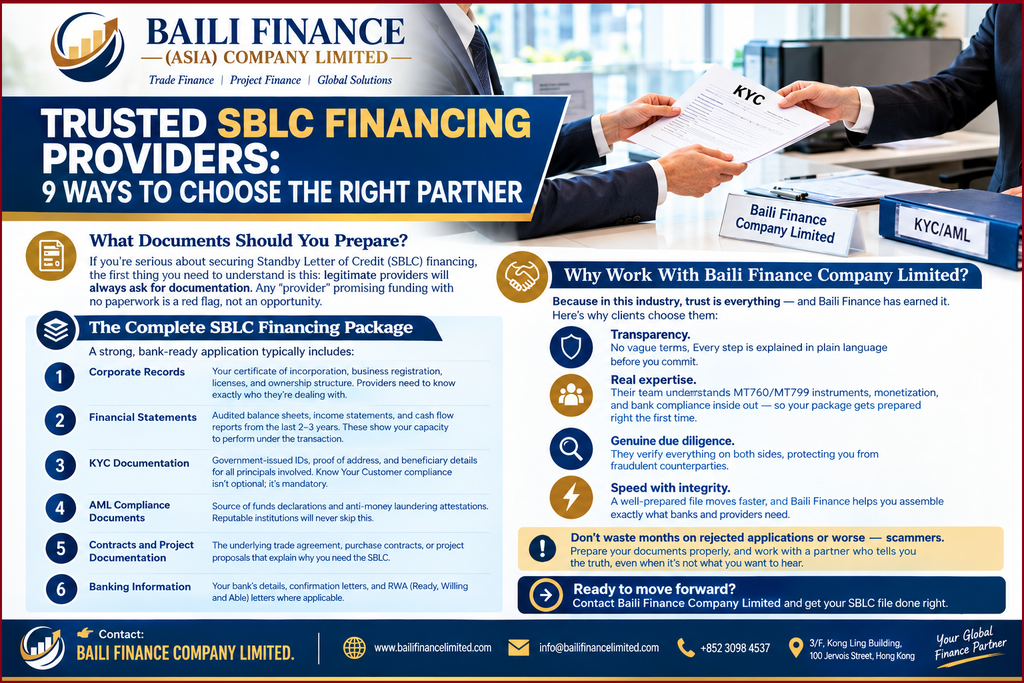
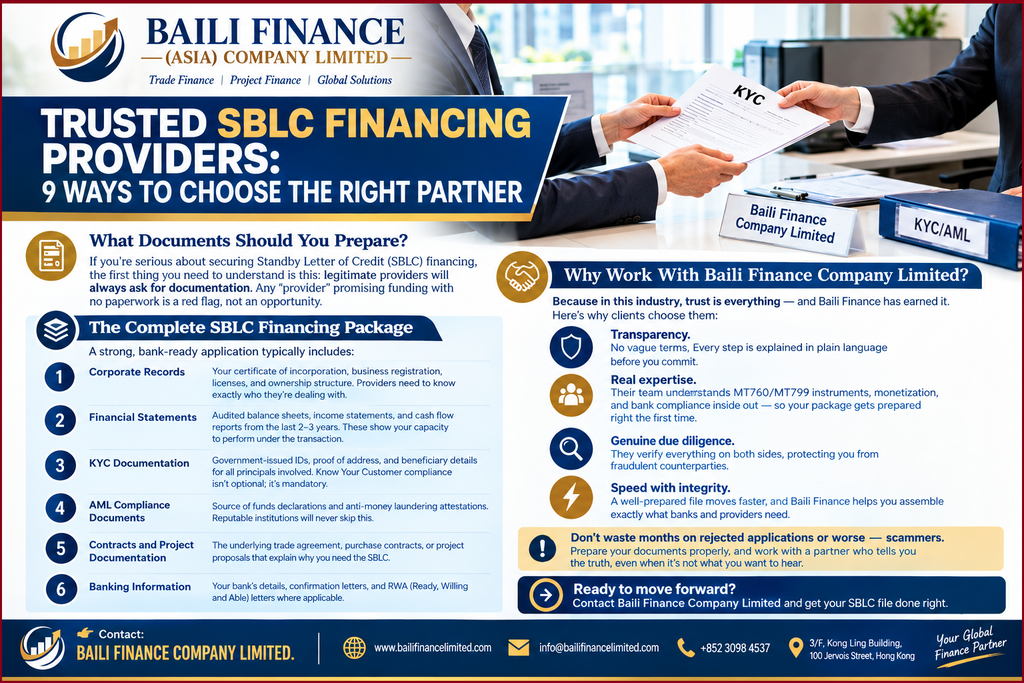
What Documents Should You Prepare?
A business seeking SBLC financing for companies should prepare a professional transaction package.
A typical package may include:
Corporate Documents
- Certificate of incorporation
- Business registration
- Articles or constitutional documents
- Ownership structure
- Directors’ identification
- Beneficial ownership information
Financial Documents
- Recent financial statements
- Bank statements
- Management accounts
- Cash-flow projections
- Existing debt schedule
- Tax documentation where applicable
Commercial Documents
- Purchase contracts
- Sales contracts
- Invoices
- Supply agreements
- Offtake agreements
- Construction contracts
- Project feasibility documents
Financing Documents
- Funding request
- Proposed financing structure
- Repayment plan
- SBLC draft
- Issuing-bank details
- Beneficiary details
- Proposed tenor
- Security information
A complete package allows the provider to assess the transaction more efficiently.
How to Choose an SBLC Financing Provider Without Unnecessary Risk
Before signing an agreement, ask these ten questions:
- What legal entity will sign my agreement?
- Which bank will issue the SBLC?
- How will the SBLC be authenticated?
- Who provides the actual financing?
- What percentage of the SBLC is considered for financing, if applicable?
- What fees apply?
- When do those fees become payable?
- What happens if financing isn’t approved?
- What laws govern the agreement?
- Can my independent lawyer and financial adviser review the transaction?
A provider that gives clear answers helps the client understand the transaction.
A provider that avoids basic questions creates uncertainty.
Why Transparency Matters in Structured Finance
Cross-border finance involves several layers of risk.
There may be differences in:
- Banking regulation
- Contract law
- Currency
- Tax treatment
- KYC requirements
- AML requirements
- Corporate law
- Enforcement procedures
- Banking practices
Accordingly, transparency isn’t simply a communication preference.
It forms part of transaction discipline.
The parties need to understand who does what, which entity assumes each obligation, how funds move, which documents control the transaction, and what happens if a condition isn’t satisfied.
That clarity can reduce avoidable disputes.
Questions to Ask Before SBLC Monetization
Businesses should also determine whether monetization is actually appropriate.
Ask:
Does the business need liquidity or payment security?
Those are different requirements.
Is the SBLC already issued?
If not, the transaction may begin with an issuance process rather than monetization.
Is the issuing bank acceptable to the intended financing institution?
A bank instrument isn’t universally accepted by every lender.
Does the underlying business generate a credible repayment source?
Financing providers still need to understand how the facility will be repaid.
Are the fees and obligations commercially acceptable?
The economics matter as much as the headline funding amount.
Frequently Asked Questions About Trusted SBLC Financing Providers
1. What is a trusted SBLC financing provider?
A trusted SBLC financing provider is a company or financial institution that transparently explains its legal identity, financing role, banking relationships, transaction requirements, fees, documentation, and compliance process.
The term “trusted” shouldn’t be based only on advertising. Businesses should independently verify the provider and the proposed transaction.
2. Can an SBLC guarantee business financing?
No.
An SBLC can support a financing structure when a financing institution accepts it as credit support. However, an SBLC doesn’t automatically guarantee financing.
The lender can still assess the borrower, transaction, issuing bank, repayment source, documentation, and compliance requirements.
3. What is SBLC monetization?
SBLC monetization generally refers to a financing structure where an eligible SBLC supports access to liquidity.
The actual financing terms depend on the instrument, issuing institution, borrower, transaction, lender, jurisdiction, and agreed financing structure.
4. What is the difference between an SBLC provider and an SBLC financing provider?
An SBLC provider may arrange or facilitate issuance of the instrument.
An SBLC financing provider may arrange financing where an SBLC forms part of the security or credit-support package.
Some companies may perform several roles, while others specialize in only one.
5. Is an SBLC the same as cash?
No.
An SBLC is an independent undertaking, not cash in a bank account available for unrestricted withdrawal.
Its value and function depend on its terms, issuing institution, beneficiary, applicable rules, and underlying transaction.
6. What is MT760 in SBLC transactions?
MT760 is commonly associated with the SWIFT messaging environment for guarantees and standby letters of credit.
However, the existence of an MT760 reference doesn’t by itself establish that a transaction is legitimate or that financing will be approved.
The parties should verify the actual banking transaction through appropriate channels.
7. Can an SBLC support project finance?
Yes, an SBLC can form part of a broader project-finance or structured-finance arrangement when the relevant lender accepts it.
However, project finance still involves commercial viability, contracts, revenue sources, risk allocation, debt and equity, and other financing considerations.
8. What documents do SBLC financing providers usually request?
Requirements vary, but businesses can expect requests for corporate documents, ownership information, financial statements, project or trade contracts, bank information, SBLC details, KYC documentation, AML information, and a clear description of the funding requirement.
9. How can I verify an SBLC financing company?
Verify its legal entity, registration, physical address, contractual entity, banking relationships, financing source, transaction history where independently verifiable, applicable licensing, and contractual terms.
For the proposed SBLC, independently verify the issuing institution and instrument through appropriate banking channels.
10. Should I use an independent lawyer?
For significant cross-border transactions, independent legal advice can help identify contractual, regulatory, jurisdictional, fee, liability, and enforcement issues before execution.
Final Summary: Choosing SBLC Financing With Discipline
Finding trusted SBLC financing providers requires more than searching for the company with the strongest marketing message.
Businesses should examine the entire transaction.
That means verifying the provider.
It means identifying the actual issuing bank.
It means reviewing the SBLC wording.
It means understanding whether ISP98 or UCP 600 applies.
It means identifying the actual source of financing.
It means reviewing fees.
It means completing KYC and AML procedures.
It means understanding the repayment structure.
And, importantly, it means recognizing that an SBLC isn’t automatically cash or a guaranteed financing approval.
For companies evaluating SBLC financing, SBLC monetization, trade finance, project finance, working capital, bank guarantees, or structured funding, a transaction-first approach provides a clearer basis for decision-making.
Baili Finance (Asia) Company Limited publishes SBLC issuance and monetization, bank guarantees, international trade finance, non-recourse funding, and structured financing among its services.
If you’re considering a transaction, the next step shouldn’t be to assume that your instrument qualifies.
It should be to have the transaction reviewed.
Ready to Discuss Your SBLC Financing Requirement?
If your company has an SBLC, needs an SBLC, requires trade finance, is evaluating SBLC monetization, or needs structured funding for a commercial project, prepare your transaction documents and request a professional assessment.
Don’t make a financing decision based on an advertisement, an unverified promise, or the face value of an instrument alone.
Discuss your requirements with Baili Finance Limited, explain your funding objective, provide the relevant transaction information, and allow the proposed structure to be assessed against its actual commercial and financial requirements.
Your next financing decision deserves documented analysis. Start the conversation today.
Intermediaries/Consultants/Brokers are welcome to bring their clients 100% protected. Our brokers receive 2% commission for referral. We assist Clients and brokers in their attempt to secure funding by working on their funding requests that may require innovative financing. In complete confidence, we will work together for the benefits of all parties involved.
#SBLC #SBLCFinancing #SBLCProvider #SBLCMonetization #TradeFinance #ProjectFinance #StructuredFinance #BusinessFinancing