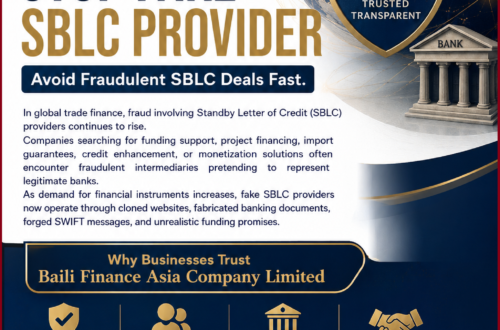
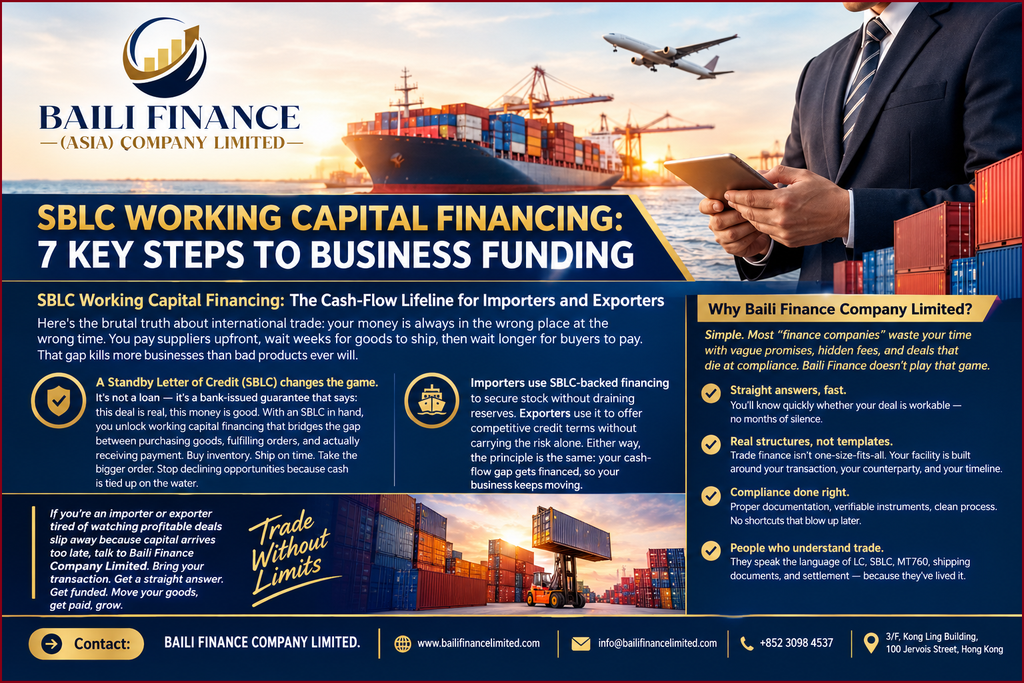
Headline: SBLC WORKING CAPITAL FINANCING: 7 KEY STEPS TO BUSINESS FUNDING
Introduction
SBLC working capital financing gives eligible businesses a way to explore funding arrangements supported by a standby letter of credit (SBLC). For companies managing international trade, large purchase orders, supplier obligations, and delayed customer payments, access to working capital can influence their ability to maintain operations and meet contractual commitments.
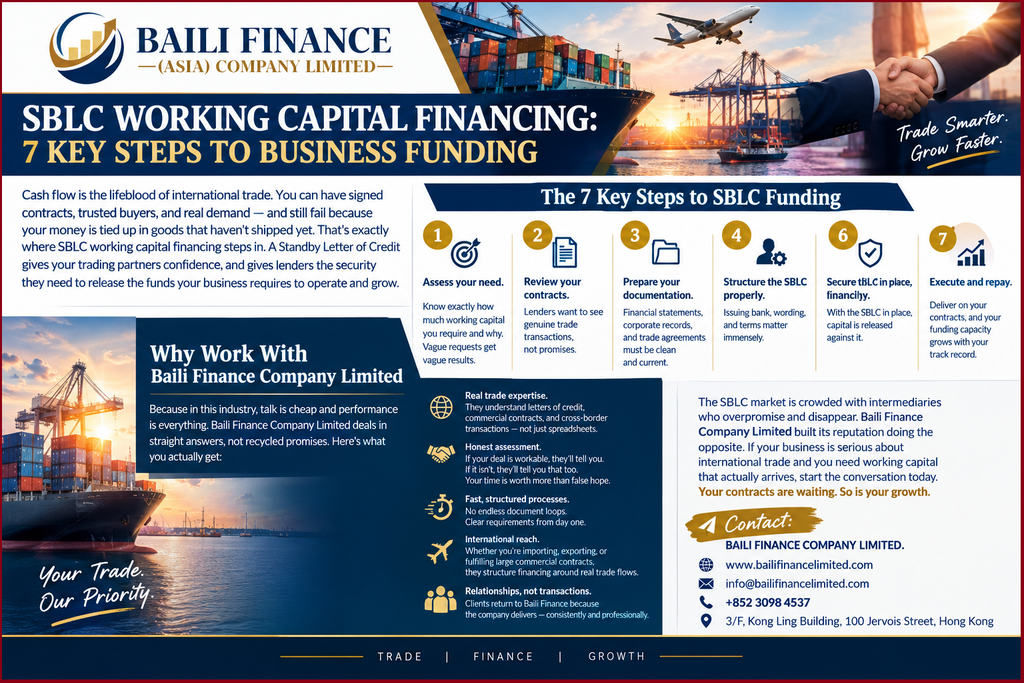
However, obtaining an SBLC and securing a loan against one are two different financial transactions. A standby letter of credit provides a bank’s independent undertaking to pay a beneficiary when the beneficiary makes a complying presentation under the instrument. It doesn’t automatically provide cash to the applicant or guarantee approval for a separate financing facility.
For businesses seeking SBLC-backed working capital, understanding this distinction is essential. The structure, issuing bank, beneficiary, available collateral, financing purpose, and repayment plan all influence whether a lender will consider the proposed transaction.
At Baili Finance Limited, businesses can begin by assessing their financing objectives, the documentation available, and the structure that may suit their commercial requirements. This guide explains how SBLC working capital financing works, its potential applications, the financing process, associated costs, and the practical considerations that businesses should review before proceeding.
Keywords: SBLC working capital financing, SBLC financing for businesses, Working capital financing using an SBLC, SBLC-backed business loans, Standby letter of credit financing requirements, SBLC financing costs, SBLC monetization, Trade finance
What Is SBLC Working Capital Financing?
SBLC working capital financing refers to a financing arrangement in which a standby letter of credit supports a separate credit facility, subject to the lender’s approval and the terms of the transaction.
A standby letter of credit is generally issued by a bank on behalf of an applicant in favour of a beneficiary. The issuing bank undertakes to honour a complying demand under the instrument. The beneficiary may draw on the SBLC if the applicant fails to meet the obligations specified in the instrument and the beneficiary satisfies the documentary requirements.
In a financing transaction, a lender may accept an eligible SBLC as credit support. The lender then assesses the applicant’s financial position, the instrument’s authenticity, the issuer’s credit standing, the transaction’s purpose, and the proposed repayment arrangements.
The International Chamber of Commerce’s guide to standby letters of credit explains how these instruments operate in international trade and how they can support credit arrangements
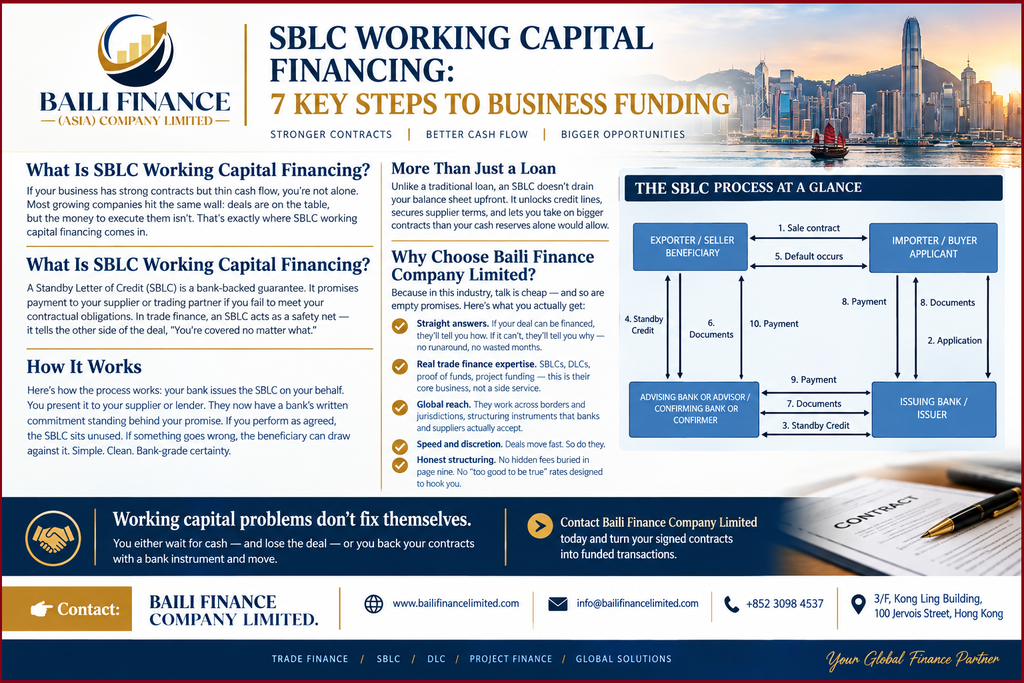
How does the arrangement work?
A typical transaction may involve four principal parties:
- The applicant: The company that requests the SBLC from its bank and accepts the associated reimbursement obligations.
- The issuing bank: The financial institution that issues the standby undertaking.
- The beneficiary: The party entitled to make a demand under the SBLC if the specified conditions occur.
- The financing provider: A lender that independently evaluates whether to extend a loan or credit facility supported by the instrument.
The beneficiary and the financing provider may be the same entity, but they don’t have to be. The transaction documents must clearly identify each party’s role.
Illustrative SBLC financing structure
Applicant business
Requests an SBLC and provides required information
Issuing bank
Issues an authenticated standby undertaking
Financing provider
Verifies the SBLC and assesses the proposed facility
Approved working capital facility
Funds become available under the agreed facility terms
Illustrative structure only. Actual parties, documentation, and disbursement arrangements vary by transaction.
Why Businesses Consider SBLC-Backed Working Capital
Working capital supports a company’s daily financial commitments, including payroll, inventory purchases, freight, supplier payments, and operating expenses. Yet, businesses may experience a mismatch between the date they incur these expenses and the date they receive revenue.
For example, an importer may need to pay a supplier before receiving goods, while an exporter may wait several weeks or months for an overseas buyer to settle an invoice. An approved financing facility can help address this timing gap.
An SBLC may contribute to a financing proposal by providing an additional form of credit support. Whether it improves the terms or availability of funding depends on the lender’s assessment and the quality of the instrument.
Common business applications
- Import and export operations: Supporting financing requests related to inventory, supplier payments, and international trade.
- Contract execution: Helping a business meet the financing requirements associated with a major commercial contract.
- Inventory procurement: Funding eligible purchases when a company needs to replenish stock before collecting customer payments.
- Seasonal working capital: Addressing predictable cash-flow requirements during periods of increased business activity.
- Receivables management: Supporting a wider financing plan where the business has a gap between invoicing and payment collection.
- Supply-chain financing: Forming part of a structured facility designed to support approved transactions across a supply chain.
Not every use qualifies for SBLC-backed financing. A lender may limit the permitted purpose of funds and require supporting contracts, invoices, financial statements, and evidence of the company’s repayment capacity.
Seven Key Steps in the SBLC Working Capital Financing Process
Understanding the process helps businesses prepare their applications, manage expectations, and identify potential issues before incurring transaction costs.
Step 1: Define the financing requirement
Start by calculating the actual working capital requirement. Establish how much funding the business needs, when it needs the funds, and how long it expects to use the facility.
A financing request should connect the amount sought to a documented business purpose. For example, an importer may prepare a purchase schedule, supplier invoices, shipping estimates, and a cash-flow forecast.
A clear funding requirement helps the financing provider determine whether the proposed facility matches the transaction’s commercial needs.
Step 2: Assess the proposed SBLC
Next, establish whether the proposed instrument meets the potential lender’s eligibility criteria. Relevant considerations include:
- The issuing bank and its credit standing.
- The instrument’s face value and currency.
- Its expiry date and any presentation deadline.
- The identity of the beneficiary.
- The governing rules and applicable law.
- The wording of the payment undertaking.
- The required documentary presentation.
- Any transfer, assignment, or other restrictions.
An SBLC’s face value doesn’t establish the amount a lender will advance. The lender may apply a haircut, impose conditions, or decline the instrument altogether.
Step 3: Identify an appropriate financing provider
The business should determine which lenders or financial institutions consider the proposed structure. Different providers have different policies for eligible issuing banks, currencies, countries, collateral, and borrower profiles.
Before sharing sensitive information or paying fees, confirm that the financing provider can explain its underwriting process and the documentary requirements.
The company should also establish whether the facility will take the form of a revolving credit line, a term loan, a transaction-specific loan, or another agreed arrangement.
Step 4: Prepare the application documents
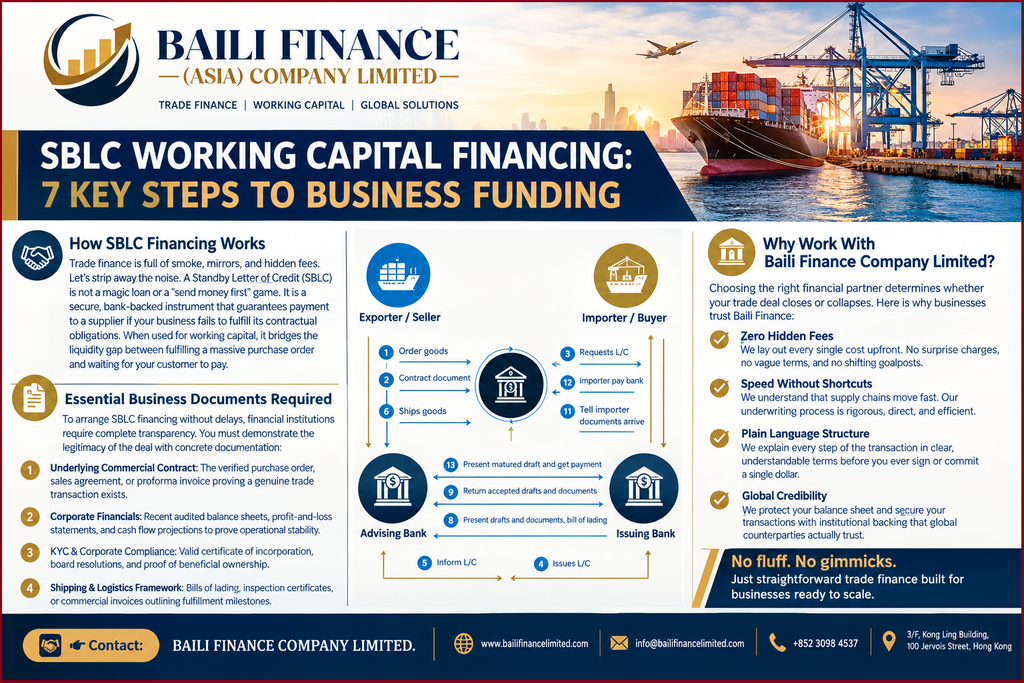
Documentation typically includes corporate registration records, beneficial ownership information, identification documents for relevant parties, financial statements, bank statements, and evidence of the financing purpose.
Where relevant, applicants may also need to provide:
- The proposed SBLC wording or authenticated instrument.
- The issuing bank’s details.
- Underlying commercial contracts.
- Purchase orders and supplier invoices.
- Cash-flow forecasts and repayment projections.
- Existing loan and security information.
- Details of the intended use of proceeds.
The financing provider may request further evidence during due diligence. Providing consistent and verifiable records can help reduce avoidable delays.
Step 5: Complete verification and due diligence
Before making a financing decision, the lender assesses the borrower, the proposed transaction, and the SBLC.
The bank may use established authentication channels to confirm that the instrument came from the stated issuer. It may also review sanctions exposure, anti-money laundering requirements, source of funds, and the legal enforceability of the proposed security arrangements.
Applicants should never rely solely on an emailed PDF or a copy of an SBLC as proof that a bank has issued an enforceable instrument.
Step 6: Agree on the facility terms
If the lender accepts the proposed structure, it can present the financing terms for review.
The agreement should clearly specify the facility amount, currency, interest rate, fees, repayment schedule, security requirements, conditions precedent, and events of default.
The parties should also clarify the relationship between the SBLC and the financing agreement. In particular, they should establish how the lender can make a demand, what documents it must present, and what happens when the instrument approaches expiry.
Legal and banking advisers should review the transaction documents before the company commits to the facility.
Step 7: Complete the closing and manage repayment
Following satisfaction of the lender’s conditions, the parties can complete the agreed closing process. The lender then disburses funds according to the facility agreement.
After disbursement, the business should track the use of proceeds, monitor cash flow, make repayments on schedule, and comply with any reporting obligations.
It should also monitor the SBLC’s expiry date and any renewal or replacement requirements. A financing facility can extend beyond the instrument’s expiry only if the lender accepts the revised credit support or another agreed arrangement.
SBLC Financing Requirements: What Lenders May Review
Lenders don’t assess all SBLC transactions in the same way. However, they commonly consider several core areas.
Borrower creditworthiness: The lender reviews the company’s financial history, existing debt, revenue, profitability, liquidity, and ability to repay.
Instrument quality: The lender examines the issuing bank, authentication status, legal wording, and the enforceability of the SBLC.
Transaction purpose: The lender assesses whether the requested funds support a genuine commercial requirement and comply with its lending policies.
Collateral and recourse: The facility may require additional security, guarantees, or recourse to the applicant. An SBLC doesn’t automatically replace other collateral requirements.
Jurisdiction and compliance: The lender considers the applicable law, country risk, currency exposure, regulatory requirements, and any restrictions affecting the parties.
For businesses operating across borders, the choice of governing law and standby rules matters. The ICC’s International Standby Practices (ISP98) provides a framework for standby undertakings when the parties expressly incorporate it.
Understanding SBLC Financing Costs and Fees
The total cost of SBLC working capital financing depends on the applicant’s profile, the issuing bank, the financing provider, the transaction’s jurisdiction, and the facility’s structure.
Businesses should request a written breakdown of all costs before accepting an offer.
| Cost category | What it may cover |
|---|---|
| SBLC issuance fee | Charges imposed by the issuing bank for issuing the standby |
| Facility arrangement fee | Costs associated with structuring and approving the financing |
| Interest | The cost of borrowing under the facility |
| Commitment fee | A charge that may apply to an approved but undrawn facility |
| Legal and documentation fees | Review, drafting, and execution of transaction documents |
| SWIFT and bank charges | Applicable messaging, authentication, and bank processing costs |
| Amendment or renewal fees | Charges for changes to the SBLC or its validity period |
The company should distinguish between one-time expenses and recurring charges. It should also clarify whether the lender calculates interest on the drawn amount, the entire facility, or another agreed basis.
Importantly, a proposed SBLC financing transaction shouldn’t proceed solely because a provider quotes an attractive advance rate. The borrower must understand the complete financial commitment and the consequences of default.
Real-World Example: Financing an Importer’s Working Capital
Consider a hypothetical Ghanaian company that imports industrial equipment and supplies it to businesses across West Africa. The company has secured a contract to supply equipment worth $1.2 million, but it must pay its overseas supplier before the customer makes the final payment.
The company estimates that it needs $500,000 to cover its supplier payment, shipping, customs-related expenses, and other eligible operating costs. Its existing cash reserves can cover only part of the requirement.
To explore its options, the company considers an SBLC-supported financing arrangement.
Illustrative financial example
Import transaction funding plan
| Commercial contract value | $1,200,000 |
| Estimated working capital requirement | $500,000 |
| Available company funds | $150,000 |
| Potential financing gap | $350,000 |
All amounts are hypothetical. The figures don’t represent an actual Baili Finance Limited client or an approved financing offer.
The company approaches a financing provider and presents its business plan, financial statements, customer contract, supplier invoices, and proposed SBLC documentation. The provider reviews the applicant’s financial position and the instrument’s eligibility.
If the lender approves a $350,000 facility, the company can use the funds for the permitted transaction expenses under the agreement. It then receives payment from its customer, applies the proceeds to the repayment obligation, and retains the remaining amount after covering the relevant costs.
The example demonstrates the potential role of an SBLC in a broader financing structure. It doesn’t mean a lender will automatically provide the requested amount or that the instrument itself generates cash.
Case Study: Managing a Contract-Related Funding Gap
The following is a hypothetical case study created to illustrate the assessment and structuring process. It isn’t a verified historical transaction or a claim about an actual client of Baili Finance Limited.
The business challenge
A regional distribution company receives a substantial order from a corporate customer. The customer agrees to pay after delivery and inspection, but the company’s supplier requires advance payment to release the inventory.
The business has a track record of commercial activity, but its available cash doesn’t cover the complete procurement and delivery cycle. A delayed shipment or missed supplier payment could affect the company’s ability to fulfil the contract.
The proposed financing solution
The company explores an SBLC-backed working capital facility. Its initial task is to establish whether the proposed standby instrument meets the lender’s requirements and whether the company’s cash-flow projections support the repayment schedule.
The financing provider reviews three central elements:
- The applicant’s financial statements and existing borrowing obligations.
- The SBLC’s issuer, wording, validity, authentication, and legal enforceability.
- The underlying purchase order, supplier payment schedule, delivery timetable, and expected customer receipts.
During the review, the company identifies a mismatch between the proposed facility’s repayment date and the customer’s contractual payment date. The company therefore revises its cash-flow forecast and discusses a repayment schedule that better reflects the expected collection cycle.
The outcome to target
Subject to satisfactory due diligence, an acceptable instrument, and formal credit approval, the company may obtain a facility aligned with its documented financing requirement.
The transaction also requires ongoing monitoring. If the customer delays payment, the company needs an agreed contingency plan to manage the resulting cash-flow pressure.
Key lessons
This example highlights several practical considerations:
- A financing request should reflect the company’s actual cash-flow needs.
- The SBLC must meet the lender’s eligibility and authentication standards.
- The borrower must demonstrate an acceptable repayment source.
- Financing terms should account for the commercial transaction’s timing.
- The business should assess risks before paying transaction-related fees.
A well-prepared application can support an informed credit assessment. However, no documentation package can guarantee approval or eliminate the risks associated with a financing transaction.
SBLC Working Capital Financing: Benefits and Risks
An SBLC-backed facility may support a business’s financing objectives, but it also introduces legal, operational, and financial obligations.
Potential benefits
Additional credit support: An eligible standby may provide a lender with additional security for an approved financing arrangement.
Support for commercial transactions: The structure may help eligible businesses address working capital requirements associated with supplier payments and contract execution.
Flexible financing structures: Depending on the provider’s credit policy, a business may explore transaction-specific loans or other facilities that align with its financing requirements.
Potentially improved access to credit: A suitable SBLC may strengthen a financing proposal when the lender accepts the instrument and the borrower meets its other requirements.
Risks and limitations
Issuing bank risk: A lender may reject an instrument if it doesn’t accept the issuing bank or can’t satisfactorily authenticate the SBLC.
Legal and documentary risk: Errors in the wording, governing law, presentation conditions, or beneficiary details may create disputes or affect the instrument’s effectiveness.
Repayment risk: The borrower remains responsible for meeting its financing obligations, even if its customer delays payment or the underlying commercial transaction encounters difficulties.
Cost risk: Issuance, financing, renewal, and legal expenses can reduce the commercial value of the arrangement.
Fraud risk: Fraudsters may advertise unverified SBLCs, guaranteed monetization, or financing that requires substantial upfront payments. Businesses should independently verify counterparties and bank communications.
Before signing any agreement, companies should obtain independent legal and financial advice appropriate to the transaction’s jurisdiction and complexity.
How to Evaluate an SBLC Financing Proposal
When reviewing a financing proposal, a business should look beyond the headline facility amount. The agreement must clearly define the rights and obligations of each party.
Use the following checklist when assessing a proposed arrangement:
Transaction due diligence checklist
Confirm the identity and regulatory status of the financing provider.Verify the SBLC directly through appropriate banking channels.Obtain written eligibility criteria and financing conditions.Review the interest rate, fees, and total borrowing cost.Confirm the repayment source and repayment timetable.Review the applicable law and dispute-resolution provisions.Understand the circumstances under which the lender may draw on the SBLC.Check the instrument’s expiry date and amendment requirements,Obtain independent legal and financial advice before signing.
The checklist can help businesses organise their review, but it isn’t a substitute for a formal credit assessment or professional advice.
How Baili Finance Limited Can Help
Businesses considering SBLC working capital financing need to establish whether their proposed transaction meets the requirements of a suitable financing provider.
Baili Finance Limited can be approached to discuss the company’s financing objectives, the intended use of funds, the proposed instrument, and the documentation available for an initial review. Any specific service, eligibility requirement, financing structure, or available facility should be confirmed directly with the company before a business relies on it.
For an initial discussion, businesses should prepare a brief summary covering:
- The amount and currency of financing requested.
- The intended use of the funds.
- The business’s country of registration and operating locations.
- The proposed issuing bank and SBLC details, if available.
- The expected funding and repayment dates.
- The company’s financial position and relevant commercial contracts.
This information provides a starting point for discussing the transaction’s requirements and identifying what further documentation may be necessary.
Frequently Asked Questions About SBLC Working Capital Financing
1. Can I obtain working capital financing using an SBLC?
Potentially. Some lenders consider eligible standby letters of credit as credit support for a separate loan or working capital facility. Approval depends on the issuing bank, instrument wording, borrower creditworthiness, transaction purpose, and lender’s policies. An SBLC doesn’t itself guarantee a loan.
2. How much financing can I obtain against an SBLC?
There isn’t a universal advance rate. The financing provider determines the amount it may lend after reviewing the SBLC, the issuer’s credit standing, the applicant’s financial position, and the proposed transaction. The instrument’s face value doesn’t automatically determine the approved facility amount.
3. What documents are required for SBLC financing?
Common requirements include corporate registration documents, beneficial ownership records, financial statements, bank statements, the proposed SBLC or authenticated instrument, underlying commercial contracts, and a cash-flow forecast. Additional documentation may apply based on the lender’s requirements and the transaction’s jurisdiction.
4. How long does SBLC working capital financing take?
The timeframe varies with the complexity of the transaction, the issuing bank’s verification process, the completeness of the application, and the lender’s credit approval procedures. Businesses should request a realistic timeline from their proposed financing provider rather than rely on an advertised processing guarantee.
5. Can a newly established business qualify for SBLC financing?
A newly established business may submit a financing proposal, but the lender will assess its eligibility and repayment capacity. A limited operating history may lead to additional documentation or security requirements. The lender may also consider the owners’ financial standing and the strength of the underlying commercial transaction.
6. Is SBLC financing the same as SBLC monetization?
No. SBLC financing generally refers to a lending arrangement in which an eligible standby supports a separate credit facility. SBLC monetization is a term used for transactions intended to convert the instrument’s value into available funds through a separate arrangement. The term doesn’t guarantee that an instrument can be converted into cash, and the proposed structure requires independent verification.
7. Does the applicant need to provide collateral?
It depends on the financing provider and the transaction. A lender may accept an eligible SBLC as credit support, require additional collateral or guarantees, or decline the proposed structure. Businesses should obtain written confirmation of the complete security requirements before proceeding.
8. What happens if the borrower can’t repay the financing?
The lender may exercise its rights under the financing agreement and, where the relevant requirements are met, present a demand under the SBLC. The issuing bank then examines the presentation against the standby’s terms and applicable rules. A demand under an SBLC can create reimbursement obligations for the applicant, subject to the applicable agreements and law.
9. Can an SBLC support international trade financing?
Yes, an eligible SBLC may support certain international trade financing arrangements. The lender will assess the instrument’s acceptability, the parties’ jurisdictions, the underlying trade documents, and the proposed repayment source. The specific transaction structure determines whether the instrument can support the financing.
10. How do I start an SBLC working capital financing application?
Start by defining the funding requirement and preparing the relevant corporate, financial, and transaction documents. Identify the proposed issuing bank and obtain the SBLC’s terms if available. Then approach a financing provider to discuss eligibility, due diligence, costs, and the potential structure before making financial commitments.
Conclusion: Make Your Working Capital Strategy Count
SBLC working capital financing can form part of a business’s broader funding strategy when a lender accepts the instrument and the applicant meets the necessary credit, legal, and compliance requirements.
For companies involved in international trade, inventory procurement, and contract execution, a well-structured financing facility may help address cash-flow gaps and support commercial commitments. However, businesses need to distinguish between an SBLC’s payment undertaking and a lender’s separate decision to provide funding.
Before proceeding, establish the actual financing requirement, verify the issuing bank and instrument, assess the repayment plan, and understand every cost and contractual obligation.
Your next step is to evaluate the transaction before committing to it. Contact Baili Finance Limited to discuss your working capital requirements, the SBLC structure you have in mind, and the documentation needed to begin an initial financing assessment.

Explore Your SBLC Financing Options
Have an SBLC or a business transaction that requires additional working capital? Start a conversation with Baili Finance Limited to discuss your requirements and the potential financing process.
Prepare your proposed funding amount, intended use of funds, and available transaction documents before making an enquiry.
Ready to Secure Working Capital for Your Business?
Take the next step towards meeting your business financing needs with Baili Finance Limited. Whether you’re exploring SBLC working capital financing, managing international trade payments, or seeking funding to fulfil a commercial contract, our team is ready to discuss your requirements. Contact us today to explore potential financing options, understand the application process, and identify the documentation needed to assess your transaction. Don’t let funding uncertainty delay your business plans. Share your financing objectives, proposed SBLC details, and working capital requirements with us to begin the conversation.
Visit www.bailifinancelimited.com today and contact Baili Finance Limited to discuss your financing needs.
Intermediaries/Consultants/Brokers are welcome to bring their clients 100% protected. Our brokers receive 2% commission for referral. We assist Clients and brokers in their attempt to secure funding by working on their funding requests that may require innovative financing. In complete confidence, we will work together for the benefits of all parties involved.
#SBLCFinancing #WorkingCapital #TradeFinance #BusinessFunding #InternationalTrade #StandbyLetterOfCredit #CorporateFinance