
Headline: Agricultural Financing: 7 Funding Options for Farms
Agricultural financing plays a central role in modern farming, food production, and agribusiness development. From purchasing seeds and fertilizers to acquiring machinery, expanding irrigation systems, processing agricultural commodities, and exporting produce, businesses need access to capital at the right time. Without suitable funding, even commercially viable farming operations can struggle to increase production, manage seasonal expenses, or respond to market demand.
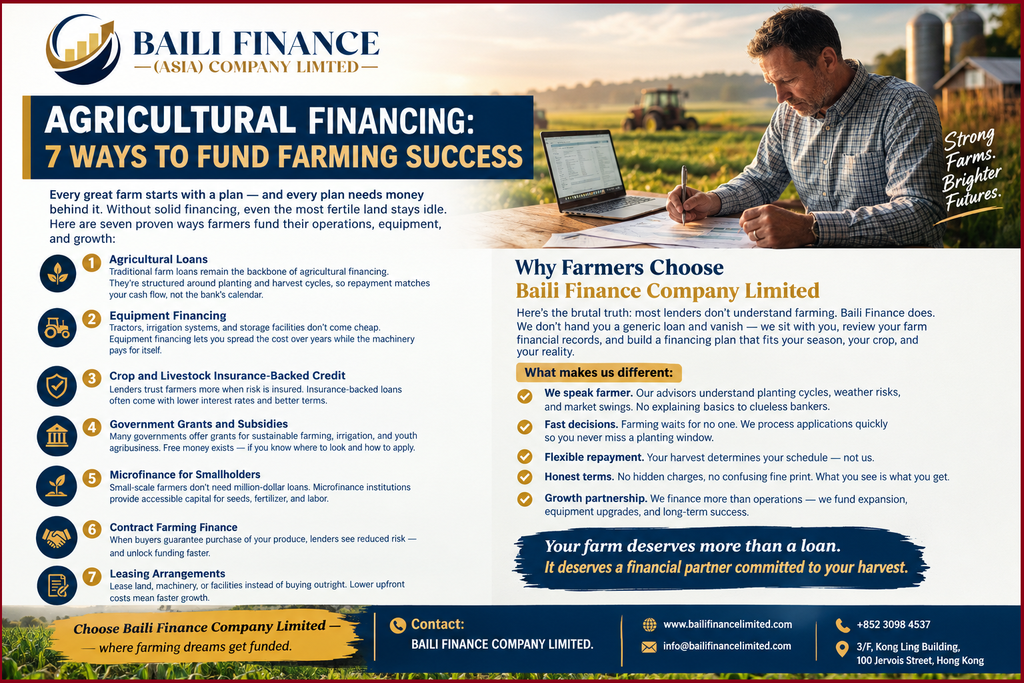
For farmers, agricultural entrepreneurs, agribusiness owners, and agricultural commodity traders, understanding how agricultural financing works can improve financial planning and support sustainable business growth. The right funding structure can help a farming business manage cash flow, invest in productive assets, and meet its financial obligations throughout the agricultural cycle.
However, agricultural finance involves more than obtaining a loan. It requires an understanding of production costs, seasonal revenue, market access, repayment capacity, financial risk, and the funding options available to different agricultural businesses.
For businesses exploring agricultural investment, international trade finance, or structured funding arrangements, Baili Finance Limited provides a starting point for discussing financial requirements and identifying potential funding pathways, subject to the company’s actual services, eligibility requirements, and applicable arrangements.
This guide explains the meaning of agricultural financing, the main types of agricultural funding, the application process, the risks businesses should consider, and the strategies that can help farmers and agribusinesses make informed financial decisions.
Keywords: agricultural financing, agricultural financing options, agricultural financing for farmers, farm loans and agricultural credit, agribusiness financing solutions, agricultural working capital financing, agricultural equipment financing, agricultural trade finance, financing for agricultural exporters, agricultural commodity financing, warehouse receipt financing, seasonal farm financing, financing for smallholder farmers, agricultural investment funding, agricultural supply chain finance, how to qualify for agricultural financing, how to finance an agricultural business, international agricultural trade financing
What Is Agricultural Financing?
Agricultural financing refers to the financial resources that farmers, agricultural cooperatives, agribusiness companies, and agricultural supply-chain participants use to establish, operate, maintain, or expand their businesses.
These resources may come from commercial banks, agricultural development institutions, microfinance providers, specialist lenders, investors, government-supported programmes, buyers, or other legitimate financing partners.
Unlike financing for some conventional businesses, agricultural finance must account for production cycles, weather conditions, biological growth periods, harvest schedules, commodity prices, and the time between investment and revenue generation.
For example, a maize farmer may need money for land preparation, seeds, fertilizer, labour, and irrigation months before harvesting the crop. Revenue may arrive only after harvesting, transportation, and the sale of the produce. A suitable financing arrangement should therefore reflect the timing of these expenses and expected receipts.
Agricultural financing can support several activities, including:
- Crop cultivation and livestock production.
- Farm machinery, equipment, and irrigation systems.
- Fertilizer, seeds, animal feed, and other agricultural inputs.
- Storage facilities, cold-chain systems, and processing equipment.
- Agricultural transportation, distribution, and export operations.
- Working capital for agricultural trading businesses.
- Climate adaptation, water management, and sustainable farming investments.
- Expansion into new agricultural markets and product categories.
The Food and Agriculture Organization of the United Nations (FAO) identifies credit, savings, payments, insurance, and other risk-management products as important components of rural finance. These services can help agricultural households and businesses manage financial needs across the production and marketing cycle.
The central objective is to match a business’s financial needs with a funding structure that supports its operations without creating an unsustainable repayment burden.
Why Is Agricultural Financing Important?
Agriculture contributes to food security, employment, manufacturing, transportation, international trade, and rural economic development. Yet farmers and agribusinesses often face a timing problem: they must spend money before their products generate revenue.
Agricultural financing helps address this gap when the funding terms match the underlying business activity.
1. It Supports Timely Purchase of Agricultural Inputs
Seeds, fertilizer, pesticides, animal feed, fuel, and labour often require payment before production begins. Delays can disrupt planting schedules, reduce production efficiency, or force farmers to purchase inputs at less favourable prices.
Access to appropriate agricultural credit can help businesses secure essential supplies when they need them.
However, borrowing should follow a realistic production budget. Financing inputs that won’t generate sufficient additional revenue can weaken rather than improve profitability.
2. It Improves Agricultural Productivity
Farmers may need capital to purchase tractors, harvesters, irrigation equipment, greenhouse systems, or modern livestock facilities.
These investments can improve output, reduce manual labour requirements, and help manage operating costs. Their commercial value depends on utilization, maintenance expenses, local conditions, and market demand.
For example, a farm considering irrigation equipment should compare the purchase and operating costs against expected yield improvements, water availability, and the value of additional crops.
3. It Helps Businesses Manage Seasonal Cash Flow
Agricultural revenue rarely arrives in equal monthly amounts. Expenses may continue throughout the year, while sales concentrate around harvest periods or specific market windows.
Seasonal agricultural financing can cover operating expenses until the business receives payment for its produce.
A lender evaluating this requirement will generally want to understand when the funds will be used, when sales will occur, and how the borrower will repay the facility.
4. It Enables Storage, Processing, and Market Expansion
Producing a crop is only one stage of the agricultural value chain. Businesses may also need warehouses, processing equipment, refrigerated transport, packaging facilities, or export logistics.
Financing these activities can help agricultural businesses reduce avoidable post-harvest losses, improve product quality, and serve customers who require consistent supply.
Nevertheless, expansion requires evidence of demand. A processing facility may remain underutilized if the business cannot secure enough raw materials or reliable buyers.
5. It Supports Climate Resilience
Agricultural businesses face exposure to drought, flooding, changing rainfall patterns, pests, disease, and other production risks.
Financing may support water-efficient irrigation, improved storage, climate-resilient production methods, renewable-energy systems, and agricultural insurance.
The World Bank discusses ways to mobilize public and private capital for climate-smart agricultural investments while improving access to finance for smallholder farmers and agricultural small and medium-sized enterprises.
For borrowers, the practical priority is to evaluate whether a proposed investment reduces measurable operating risks and whether the business can afford the associated repayments.
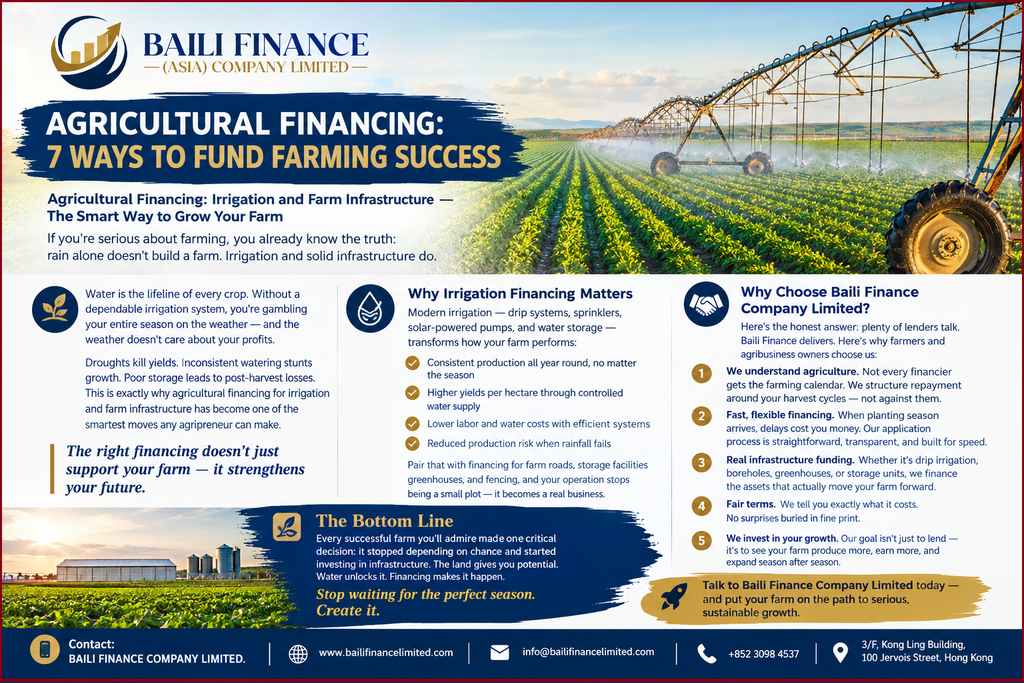
7 Main Types of Agricultural Financing
Choosing the right agricultural financing option depends on the purpose of the funds, the amount required, the business’s financial position, and the expected repayment date. A farmer purchasing fertilizer has different financing needs from an agricultural exporter purchasing inventory or a processor acquiring industrial equipment.
The following options illustrate the principal funding structures that farmers and agribusinesses may consider.
1. Agricultural Loans and Farm Credit
Agricultural loans provide funds for eligible farming activities, equipment purchases, livestock production, land improvements, and other business expenses.
Depending on the lender, the facility may be short-term, medium-term, or long-term. Repayment terms should reflect the investment’s useful life and the business’s ability to generate cash.
Before accepting an agricultural loan, evaluate:
- The interest rate and total borrowing cost.
- Arrangement, administration, and other applicable fees.
- The repayment schedule and any grace period.
- Collateral requirements and personal guarantees.
- Early repayment provisions and default consequences.
- Currency exposure where the loan and business revenue use different currencies.
A loan that appears affordable based on its interest rate alone may become expensive once fees, insurance, security costs, and repayment timing are considered.
2. Seasonal and Working Capital Financing
Seasonal agricultural financing covers costs incurred before a harvest or sales period. Working capital financing also helps agribusinesses pay suppliers, employees, transport providers, and other operating expenses while awaiting customer payments.
Consider an agricultural distributor that must purchase fertilizer several weeks before customers pay for their orders. A suitable working capital facility may bridge that period.
The business should calculate its cash conversion cycle, forecast incoming payments, and assess how a delay in sales would affect repayment.
Best suited to: Farms, agricultural input suppliers, produce aggregators, commodity traders, and businesses with recurring operating expenses.
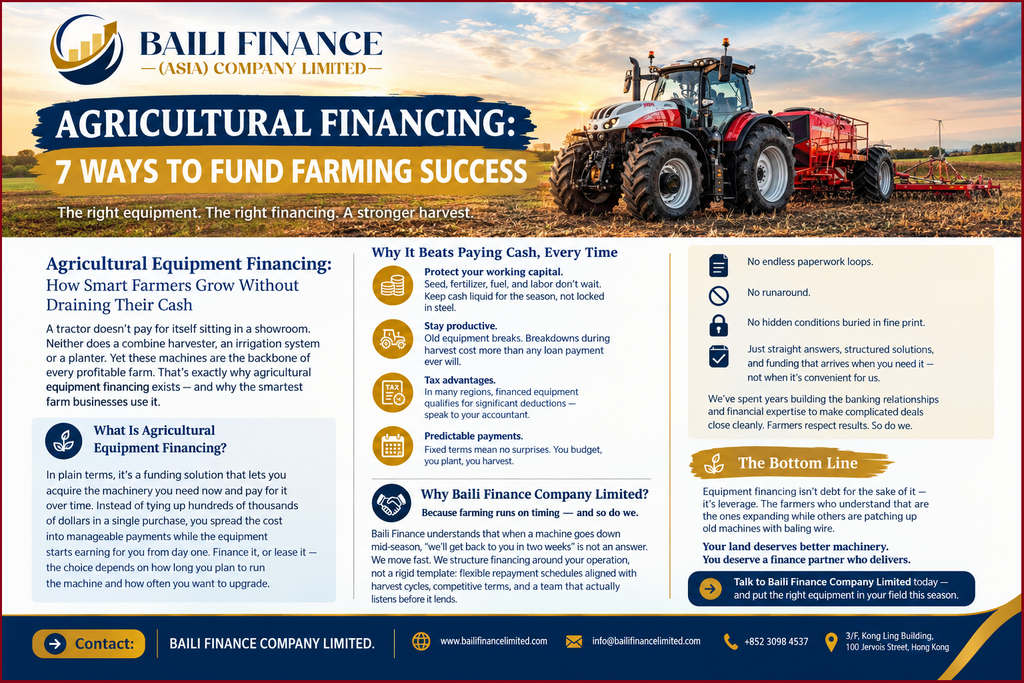
3. Equipment and Agricultural Asset Financing
Equipment financing supports purchases such as tractors, harvesters, irrigation systems, grain dryers, refrigerated vehicles, and processing machinery.
Depending on the agreement, a lender may secure the facility against the financed asset. Some businesses may also consider leasing rather than purchasing equipment outright.
When comparing options, calculate the total cost of ownership. Include maintenance, fuel, insurance, operator training, spare parts, and downtime.
The projected additional income or cost savings should justify the investment. Equipment that remains idle for much of the year can create repayment pressure without generating sufficient revenue.
4. Agricultural Trade Finance
Agricultural trade finance supports transactions involving the purchase, sale, movement, or delivery of agricultural commodities.
It can be relevant to businesses that trade grains, coffee, cocoa, cotton, edible oils, livestock products, or other agricultural goods.
Depending on the transaction, potential structures may include purchase-order finance, receivables finance, inventory finance, letters of credit, and other documentary trade arrangements.
For example, an agricultural exporter may need to purchase a shipment of processed food ingredients before receiving payment from an overseas buyer. A suitable trade finance structure may help address the timing gap, subject to the buyer’s creditworthiness, transaction documentation, and the provider’s terms.
International agricultural transactions require particular attention to contract terms, shipment documents, payment obligations, counterparty risk, and foreign-exchange exposure.
Businesses should also understand that a letter of credit, bank guarantee, standby letter of credit (SBLC), and ordinary loan serve different purposes. None should be assumed to provide unrestricted cash simply because a financial institution issues or discusses the instrument.
5. Value Chain Financing
Agricultural value chain finance connects funding to the relationships among farmers, input suppliers, aggregators, processors, distributors, and buyers.
For example, a processor may work with a lender and an agricultural cooperative to arrange funding for seeds and fertilizer. Farmers produce the crop, deliver it to the processor under agreed terms, and the sales proceeds help settle the financing obligations.
This structure can improve coordination between production and demand. It may also give lenders better visibility into the transaction than an application based solely on a farmer’s assets.
However, it requires credible counterparties, enforceable agreements, reliable delivery arrangements, and a clear allocation of risks.
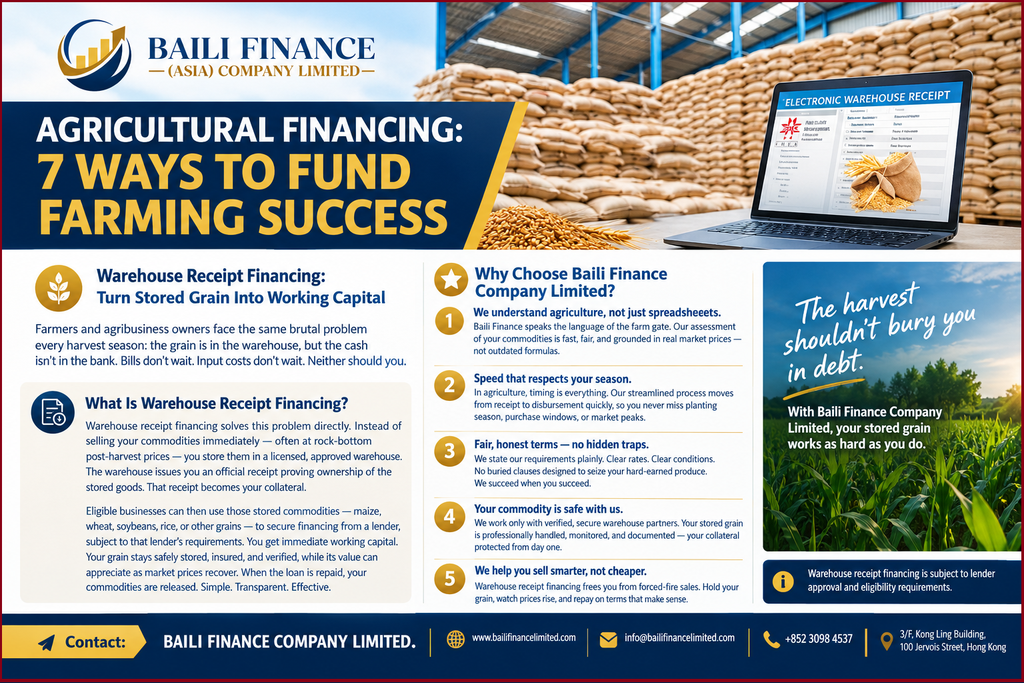
6. Warehouse Receipt and Inventory Financing
Warehouse receipt financing allows eligible borrowers to obtain credit against qualifying commodities held in an approved storage facility.
The warehouse operator documents the stored goods and issues a receipt. Subject to the applicable legal framework, the receipt may support a secured financing arrangement.
This option can help agricultural businesses access working capital without immediately selling all their stored produce.
A documented example comes from the Food and Agriculture Organization of the United Nations and its work on inventory credit in Niger. Under the model introduced in 1999, farmer associations stored part of their harvest and used the stored commodities to support short-term borrowing for agricultural inputs.
The arrangement isn’t risk-free. Commodity prices may fall, storage fees may exceed expected gains, and poor warehouse management can reduce the value of the collateral. Businesses must verify the warehouse, insurance arrangements, quality controls, and enforceability of the security.
7. Grants, Equity Investment, and Blended Finance
Not every agricultural business should finance expansion through debt.
Grants may support eligible research, sustainability, infrastructure, training, or development activities. Equity investors provide capital in exchange for ownership interests, while blended finance combines public or development funding with private capital to support investments that might otherwise struggle to attract commercial financing.
These structures have different implications.
- Grants: Usually have eligibility and reporting conditions and may not be available for ordinary operating expenses.
- Equity: Can reduce immediate repayment pressure but may dilute ownership and involve investor governance rights.
- Blended finance: May help allocate risks between participating parties, but its availability depends on the programme and transaction.
- Commercial debt: Requires repayment under agreed terms, regardless of whether the business achieves its projected returns.
The FAO identifies blended finance, impact investing, financial technology, and other risk-sharing approaches as potential tools for addressing unmet agricultural financing needs.
Businesses should select a funding structure based on the economics of the project rather than the assumption that one financing product suits every agricultural operation.
How to Qualify for Agricultural Financing
Agricultural financing providers generally assess whether the applicant can repay the proposed facility and whether the business presents acceptable financial, operational, and legal risks.
Requirements differ among institutions and jurisdictions. Nevertheless, preparing a coherent application can help a business explain its funding needs and demonstrate its commercial viability.
Step 1: Define the Financing Requirement
Specify the amount required, its intended use, and the period for which the business needs the funds.
Separate capital expenditure from operating expenses. For example, buying a tractor is a capital investment, while purchasing fuel and paying seasonal workers are operating costs.
Avoid requesting an arbitrary amount. The funding request should follow a detailed budget supported by supplier quotations, contracts, and operational forecasts where available.
Step 2: Prepare a Business Plan and Cash Flow Forecast
A financing proposal should explain how the business generates revenue and how the proposed funding will support repayment.
Include:
- The farm or agribusiness model.
- Production capacity and operating history.
- Historical revenue and expenses, where available.
- Expected yields, prices, and sales volumes.
- Confirmed buyer agreements and supplier arrangements.
- Funding requirements and proposed repayment sources.
- Risks and contingency measures.
Use conservative assumptions. Forecasts should account for lower-than-expected yields, price changes, delayed customer payments, and additional operating costs.
Step 3: Organize the Required Documents
Depending on the transaction, a financing provider may request:
- Company registration and ownership documents.
- Identification and authorization documents for relevant parties.
- Financial statements, bank statements, and management accounts.
- Tax records where applicable.
- Land ownership, lease, or other relevant property documentation.
- Supplier quotations, purchase orders, and commercial contracts.
- Evidence of agricultural production, inventory, or equipment ownership.
- Details of existing borrowing and financial obligations.
- Collateral valuations, insurance documents, or guarantees where required.
Submit accurate, consistent information. Discrepancies between a business plan, financial statements, contracts, and bank records can delay due diligence or undermine an application.
Step 4: Demonstrate Repayment Capacity
A financing provider needs a credible explanation of how the borrower will repay the facility.
For a crop-producing business, repayment may depend on harvest proceeds. For a processor, it may depend on recurring customer receipts. For an agricultural exporter, it may depend on settlement under a documented sales contract.
Consider a simplified example.
A farm seeks a $50,000 loan for an agricultural production cycle. It forecasts $90,000 in sales and $55,000 in operating costs before debt service. The resulting $35,000 is the projected cash available before loan repayments, taxes, and any omitted costs.
The farm must then determine whether the actual repayment schedule is manageable under both the expected and downside scenarios. The projected $35,000 isn’t automatically profit or proof that the loan is affordable.
Step 5: Assess the Financing Terms
Compare offers based on their total cost and legal obligations.
Review interest calculations, fees, repayment dates, collateral, guarantees, conditions precedent, default provisions, and any requirements to maintain accounts or insurance.
For international transactions, clarify which currency applies, which jurisdiction governs the agreement, and how the parties will handle exchange-rate changes or payment delays.
Step 6: Complete Due Diligence Before Signing
Verify the identity and authority of the financing provider, the authenticity of the documents, and the precise conditions of the offer.
Do not assume that a preliminary discussion, indicative term sheet, or expression of interest constitutes an approved facility. Likewise, don’t pay an unverified intermediary on the promise of guaranteed financing.
A credible financing process should establish what the provider can offer, what the applicant must supply, which conditions remain outstanding, and what happens if the transaction doesn’t proceed.
Agricultural Financing Challenges and How to Manage Them
Access to agricultural finance remains difficult for many businesses because production risks and financial requirements don’t always align with conventional lending models.
The FAO identifies constraints affecting smallholder families and agricultural enterprises, including limited access to suitable formal financial services.
Understanding these challenges can help applicants develop stronger financing proposals.
Insufficient Collateral
Some farmers lack the property documents or other assets required by traditional lenders.
Potential alternatives may include eligible equipment, inventory-backed financing, buyer-supported arrangements, guarantees, or group-based financing. Availability depends on local law, the lender’s policy, and the quality of the underlying security.
Seasonal and Unpredictable Revenue
Crop failures, livestock disease, weather disruptions, and commodity price fluctuations can affect repayment capacity.
Businesses should use realistic forecasts, maintain appropriate cash reserves where possible, diversify revenue sources when commercially sensible, and investigate relevant insurance products.
High Borrowing Costs
Rural operating expenses, information gaps, and perceived credit risks can make some agricultural facilities expensive.
Borrowers should compare the full financing cost with expected returns and reject structures that require unrealistic production or sales assumptions.
Weak Market Access
Increased production doesn’t guarantee increased profit. A business may struggle if buyers are unavailable, transport costs rise, or market prices fall.
Securing credible buyer relationships, understanding product specifications, and budgeting for storage and logistics can strengthen both commercial performance and a financing application.
Limited Financial Records
Informal operations may struggle to demonstrate income, expenditure, inventory, and repayment history.
Maintaining accurate sales records, purchase receipts, production data, and business bank transactions can improve transparency and support future applications.
Real-World Case Study: Agricultural Financing Through Warehouse Receipts in Ghana
A useful illustration of agricultural financing in practice is Ghana’s warehouse receipt financing system, discussed in a World Bank article on expanding access to this type of lending.
According to the World Bank, a project supported by Switzerland’s State Secretariat for Economic Affairs (SECO) helped 2,113 smallholder farmers and small and medium-sized enterprises receive $584,837 from participating financial institutions, with zero defaults recorded in the reported project results. The initiative also expanded participation among rural financial institutions.
The result demonstrates how inventory-based financing can provide an alternative to lending models that depend primarily on traditional real estate collateral.
How the Model Works
1. Farmers produce and store eligible commodities
Farmers, aggregators, or agricultural businesses deposit qualifying produce with a participating warehouse operator.
2. The stored inventory is documented
The warehouse receipt provides evidence of the stored commodities, subject to the system’s rules and the validity of the receipt.
3. A participating lender assesses the application
The lender evaluates the commodity, documentation, borrower, security arrangements, and applicable credit conditions.
4. Approved financing supports business needs
Where approved, the funds can help eligible borrowers meet working capital or other permitted business expenses.
Key Lessons for Farmers and Agribusinesses
First, collateral doesn’t always have to take the form of land or buildings. Eligible inventory may support a financing structure when the legal framework, storage arrangements, and lender requirements permit it.
Second, proper documentation matters. Commodity quality, quantity, ownership, storage conditions, and the enforceability of the security arrangement all influence the financing decision.
Third, financial access depends on a functioning system. Warehouses, participating lenders, reliable inventory records, commodity markets, and appropriate regulations must work together.
Fourth, reported results require context. The zero defaults recorded in this particular project should not be interpreted as proof that warehouse receipt financing has no credit risk or that future applicants will receive the same outcome.
The wider lesson is that agricultural businesses can improve their financing options by understanding the assets, contracts, and commercial relationships that lenders may recognize.
For further reading, consult the World Bank’s analysis of warehouse receipts and agricultural finance.
Practical Example: How a Farm Can Structure a Financing Request
Consider a hypothetical agricultural business seeking funding to expand its maize production and storage capacity.
The business already operates a farm, has historical sales records, and supplies grain to local commercial buyers. Management wants to purchase improved inputs, lease additional harvesting equipment, and store part of its output for later sale.
Rather than requesting one large loan without explaining its purpose, the business divides the project into specific funding requirements.
| Funding requirement | Illustrative budget |
|---|---|
| Seeds and fertilizer | $12,000 |
| Seasonal labour and field operations | $8,000 |
| Harvesting and transportation | $10,000 |
| Storage and quality control | $8,000 |
| Working capital reserve | $7,000 |
| Total funding requirement | $45,000 |
Illustrative figures only. These aren’t market quotations, an approved financing offer, or a prediction of agricultural returns.
Management then prepares a production budget, obtains supplier quotations, reviews buyer agreements, and forecasts cash receipts under several price and yield scenarios.
It also investigates whether a seasonal credit facility, equipment arrangement, or inventory-backed structure would better match each expenditure.
This approach gives a prospective financier a clearer view of the business’s financial requirements and repayment capacity.
The business should proceed only when the proposed terms remain affordable under reasonable downside assumptions. If the project cannot support the repayment schedule, management should reconsider its scale, timing, funding mix, or operating plan.
How to Reduce Risk When Seeking Agricultural Financing
Securing funding is only one part of financial management. Businesses must also protect their ability to repay.
The following practices can improve financial discipline:
- Match repayment dates to revenue. Avoid schedules that require substantial payments before the relevant crop or inventory generates cash.
- Maintain separate business records. Track farm expenditure, household expenditure, debt obligations, inventory, and customer receipts accurately.
- Diversify where practical. Depending on the business model, different crops, buyers, or revenue streams may reduce concentration risk.
- Use contracts carefully. Confirm delivery obligations, product specifications, pricing mechanisms, payment dates, and remedies for non-performance.
- Assess insurance options. Examine the exclusions, coverage limits, premiums, and claim conditions before relying on an agricultural insurance policy.
- Stress-test financial projections. Estimate how lower yields, higher input prices, delayed payments, or reduced selling prices would affect repayment.
- Verify every financing counterparty. Confirm identities, regulatory status where relevant, legal authority, and contractual obligations before transferring funds or providing sensitive documents.
A financing proposal becomes more credible when it explains not only how the business expects to succeed, but also how management will respond if conditions deteriorate.
The Role of Agricultural Financing in International Business
Agricultural businesses that participate in international supply chains may need more than conventional farm credit.
An exporter, commodity distributor, food processor, or agricultural equipment importer may face payment gaps between purchasing goods and receiving proceeds from customers. These gaps can create working capital requirements even when the underlying transaction appears commercially sound.
Depending on the circumstances, relevant financing discussions may involve trade credit, receivables financing, inventory finance, documentary trade instruments, or other structured arrangements.
Before pursuing any option, businesses should clarify:
- The precise commercial transaction being financed.
- The identities and financial standing of counterparties.
- The source and timing of repayment.
- The documents required to verify the transaction.
- The collateral, guarantees, or other security arrangements.
- The jurisdictions, currencies, and legal rules involved.
- The total cost and the conditions under which funding becomes available.
For example, a commodity trader with a confirmed purchase contract and a creditworthy buyer may be able to present a more clearly defined financing proposal than a business relying on speculative future sales.
Nevertheless, a purchase contract doesn’t guarantee approval, and a financial instrument doesn’t automatically provide cash. The availability and suitability of any structure depend on the relevant institution’s assessment and the terms of the transaction.
Businesses considering international financing can explore their requirements with Baili Finance Limited and establish whether the company can assist with their specific needs. Any discussion should distinguish between preliminary guidance, potential financing arrangements, and facilities that a provider has formally approved and can deliver.
How Baili Finance Limited Can Fit Into Your Financing Journey
Agricultural financing decisions require clarity about the capital needed, the commercial purpose, the repayment source, and the parties responsible for delivering the proposed arrangement.
Baili Finance Limited’s website, www.bailifinancelimited.com, provides the appropriate starting point for enquiries about the company’s services and whether they align with a particular agricultural or trade-related financing requirement.
Before approaching the company, prepare a concise overview of your business and its funding needs.
Include the amount required in USD, the purpose of the financing, the relevant country or countries, the expected funding timeline, the available financial records, and the source of repayment.
If the request relates to an agricultural export or commodity transaction, provide relevant purchase contracts, sales agreements, supplier details, and transaction documents where appropriate and safe to share.
This information can help establish whether the proposed requirement fits the company’s actual capabilities and applicable eligibility criteria. It doesn’t guarantee funding or approval.
A well-defined financing request is a better starting point than a general request for capital. Explain the commercial objective, substantiate the figures, identify the risks, and seek clear written terms before making a commitment.
Frequently Asked Questions About Agricultural Financing
1. What is agricultural financing?
Agricultural financing is the provision of financial resources to farmers and agribusinesses for activities such as crop production, livestock farming, equipment purchases, agricultural processing, storage, distribution, and trade.
Depending on the business and its eligibility, funding may take the form of loans, working capital facilities, asset finance, inventory-backed credit, equity investment, grants, or trade finance.
2. How can farmers obtain agricultural financing?
Farmers can begin by identifying their funding requirements and approaching suitable lenders, agricultural finance institutions, cooperatives, or relevant programmes.
They should prepare a business plan, realistic cash flow forecasts, production records, financial statements where available, supplier quotations, and evidence of potential sales.
The provider will assess the application against its credit criteria, documentation requirements, repayment capacity, and applicable security conditions.
3. Can I obtain agricultural financing without owning land?
Possibly. Some financing arrangements rely on factors other than land ownership, including eligible inventory, equipment, receivables, buyer agreements, guarantees, or other acceptable security.
Warehouse receipt financing is one example. However, lenders apply different eligibility rules, and the absence of land ownership doesn’t mean that financing will automatically be available.
4. What types of agricultural businesses can seek financing?
Potential applicants include crop farmers, livestock producers, agricultural cooperatives, farm input suppliers, produce aggregators, food processors, agricultural equipment businesses, commodity traders, and exporters.
Eligibility depends on the financing provider, the proposed activity, the business’s financial position, the transaction structure, and relevant legal requirements.
5. What documents are needed for an agricultural financing application?
Requirements vary, but applicants may need company registration documents, identification, financial records, bank statements, tax records, production budgets, cash flow forecasts, supplier quotations, commercial contracts, and collateral documentation.
International trade transactions may also require purchase orders, sales contracts, shipping documents, and evidence of the buyer’s payment obligations.
Applicants should obtain the provider’s exact document checklist before submitting sensitive information.
6. What is the difference between agricultural finance and agricultural trade finance?
Agricultural finance is the broader category. It includes funding for production, farm equipment, working capital, storage, processing, and other agricultural activities.
Agricultural trade finance focuses on funding or managing payment risks associated with commercial transactions, such as purchasing, selling, transporting, or exporting agricultural commodities.
A farming business may need agricultural credit for production and trade finance when selling goods to international buyers.
7. Can agricultural financing cover machinery and irrigation equipment?
Yes, some lenders offer agricultural equipment loans, leasing arrangements, or asset financing for eligible machinery and infrastructure.
Applicants should compare the initial payment, interest, fees, maintenance costs, useful life, and expected productivity benefits. The financing structure should match the equipment’s economic life and the business’s repayment capacity.
8. How much agricultural financing can a business receive?
There is no universal amount. A financing provider typically considers the applicant’s financial strength, funding purpose, cash flow, existing liabilities, collateral, transaction size, and applicable lending limits.
A documented project with realistic forecasts and a credible repayment source is generally easier to assess than an unsupported request for a large sum.
9. How can agricultural businesses reduce financing costs?
Businesses can compare the total cost of different offers, improve their financial records, reduce unnecessary borrowing, negotiate appropriate repayment schedules, and investigate eligible guarantees or alternative financing structures.
They should also assess whether the proposed investment generates sufficient cash to cover the financing cost under conservative assumptions.
10. Is agricultural financing available for international commodity trading?
Some financial institutions and specialist providers support eligible agricultural commodity transactions through working capital facilities, receivables financing, inventory finance, or other trade-related arrangements.
Availability depends on the transaction, the counterparties, the relevant countries, documentation, risk assessment, and the provider’s actual services.
Businesses should verify that any proposed financing structure is suitable for their transaction before committing to contractual obligations.
Conclusion: Build a Stronger Agricultural Business With the Right Financing
Agricultural financing can help farmers increase production, purchase equipment, manage seasonal expenses, improve storage, develop processing capacity, and participate in domestic and international markets.
However, successful financing begins with sound business planning. The amount borrowed, the cost of capital, the repayment schedule, and the expected commercial returns must work together. Businesses that understand their cash flow, maintain accurate records, establish credible buyer relationships, and prepare for operational risks can make better-informed funding decisions.
From seasonal farm credit and agricultural equipment finance to inventory-backed lending and international trade finance, the appropriate solution depends on the business’s specific objectives and financial position.
The next step is to turn your funding requirement into a clear, documented proposal. Identify the amount needed, explain how you’ll use it, demonstrate how the business expects to generate revenue, and establish how repayment will occur.
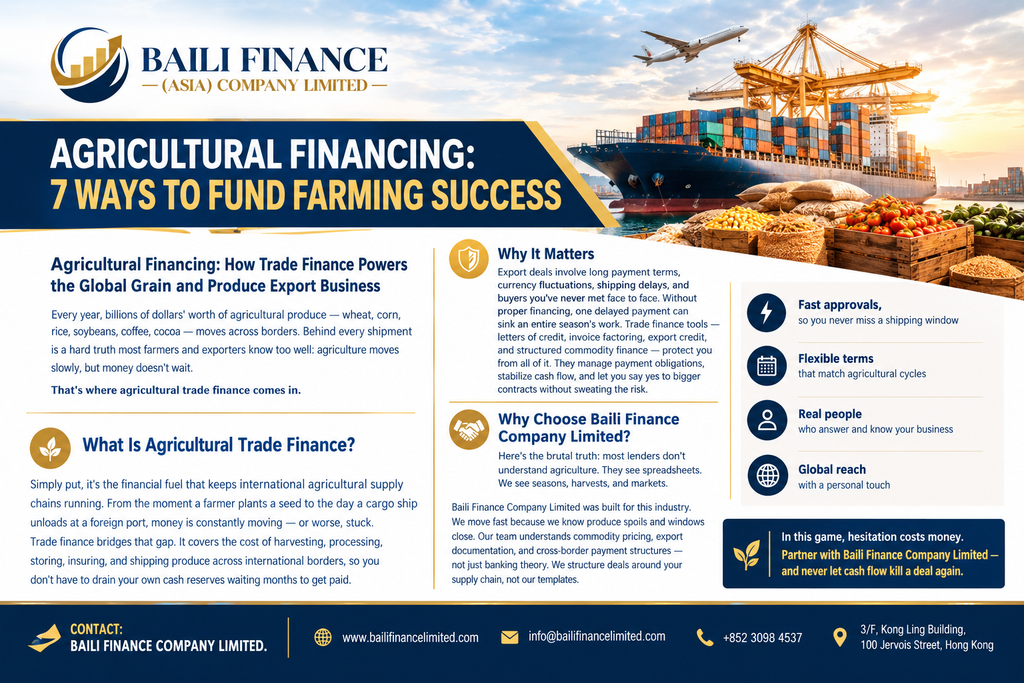
READY TO TAKE YOUR AGRICULTURAL BUSINESS TO THE NEXT LEVEL?
Access to the right financing can help you secure essential supplies, purchase agricultural equipment, manage seasonal cash flow, and expand your operations with greater confidence.
At Baili Finance Limited, we understand that every agricultural business has different funding needs. Whether you are planning to scale production, strengthen your working capital, or explore trade finance solutions for agricultural imports and exports, the right financing strategy starts with understanding your business and its objectives.
Don’t let funding challenges limit your next opportunity. Take the next step toward building a stronger, more sustainable agricultural business.
Contact Baili Finance Limited today to discuss your financing requirements and explore potential solutions tailored to your business needs.
Visit: https://www.bailifinancelimited.com
Agricultural financing is a commercial decision, not a guaranteed outcome. All financing remains subject to the relevant provider’s capabilities, eligibility requirements, due diligence, approval, contractual terms, and applicable laws.
Financing is subject to assessment, eligibility, and applicable terms and conditions.
Intermediaries/Consultants/Brokers are welcome to bring their clients 100% protected. Our brokers receive 2% commission for referral. We assist Clients and brokers in their attempt to secure funding by working on their funding requests that may require innovative financing. In complete confidence, we will work together for the benefits of all parties involved.
#AgriculturalFinancing #AgriculturalFinance #Agribusiness #FarmFinancing #AgriculturalTradeFinance #WorkingCapital #TradeFinance #AgriculturalInvestment