Headline: BG and SBLC Provider | Baili Finance
Businesses involved in international trade, construction, infrastructure development and corporate financing often need more than a strong business plan to secure a contract or obtain funding. They also need credible financial instruments that meet the requirements of banks, suppliers, project owners and institutional counterparties. Choosing the right BG and SBLC provider can therefore play an important role in transaction planning, risk management and access to trade finance.
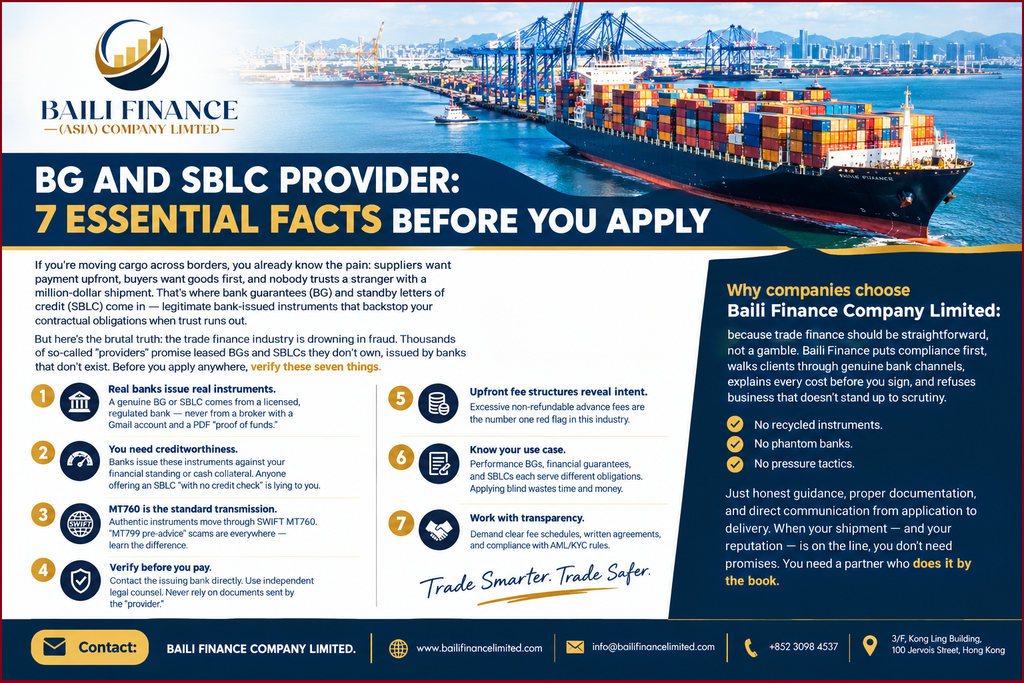
A bank guarantee (BG) and a standby letter of credit (SBLC) help businesses address specific contractual and payment risks. Depending on the transaction, either instrument may support a tender, secure an advance payment, back a financial obligation or provide assurance to a commercial counterparty.
However, selecting a provider requires careful due diligence. Businesses must understand the instrument they need, the identity of the issuing bank, the applicable rules, the issuance process and the conditions governing payment.
At BAILI FINANCE (ASIA) COMPANY LIMITED, we focus on financial instruments, trade finance and structured financing solutions for businesses with international commercial requirements. Our approach begins with understanding the transaction and identifying a structure that aligns with the client’s objectives, documentation and eligibility.
This guide explains how BG and SBLC providers operate, how to evaluate your options, what to expect during the application process and which risks to address before committing funds.
Keywords: BG and SBLC provider, Bank guarantee provider, SBLC provider, standby letter of credit, BG issuance, SBLC issuance, international trade finance, bank guarantee and SBLC, SBLC monetization, BG monetization, performance guarantee, advance payment guarantee, SWIFT MT760, BG and SBLC financing.
What Is a BG and SBLC Provider?
A BG and SBLC provider helps businesses obtain bank guarantees and standby letters of credit for qualifying commercial transactions. Depending on its role, the provider may be a bank that issues the instrument directly or a financial services firm that structures a transaction and arranges issuance through an appropriate banking institution.
Understanding this distinction matters. A financial intermediary does not automatically have the same legal authority, balance sheet or payment obligations as the bank named as the issuer.
What Is a Bank Guarantee (BG)?
A bank guarantee is a written undertaking issued by a bank or other eligible financial institution under which the issuer agrees to make payment when the beneficiary presents a demand that complies with the instrument’s terms.
Businesses commonly use bank guarantees to support contractual obligations and manage counterparty risk.
For example, a construction company bidding for a major infrastructure contract may need a bid bond or tender guarantee. A project owner may request an advance payment guarantee before releasing funds to a contractor. A supplier may require a payment guarantee before extending commercial credit.
Common types of bank guarantees include:
- Bid bonds and tender guarantees: Support a contractor’s obligations during a tender process.
- Performance guarantees: Provide financial protection for specified contractual performance obligations.
- Advance payment guarantees: Protect an advance paid under a contract, subject to the guarantee’s terms.
- Payment guarantees: Support defined payment obligations.
- Financial guarantees: Cover specified financial commitments, such as repayment obligations.
Each instrument serves a particular purpose. Its wording, amount, expiry date, governing law and demand requirements determine how it operates.
What Is a Standby Letter of Credit (SBLC)?
A standby letter of credit is an independent documentary undertaking issued by a bank in favour of a beneficiary. It provides for payment when the beneficiary makes a presentation that complies with the SBLC’s terms.
An SBLC generally serves as a backup payment or performance instrument. The beneficiary expects the applicant to fulfil the underlying obligation, but the SBLC provides a separate source of payment if the applicant fails to meet the relevant obligation and the beneficiary makes a complying demand.
Businesses use SBLCs for purposes such as:
- Securing payment obligations in international trade.
- Supporting project finance arrangements.
- Providing credit support for commercial contracts.
- Securing repayment obligations under eligible financing arrangements.
- Meeting a counterparty’s contractual security requirements.
SBLCs can cover financial or performance obligations. Their effectiveness depends on the actual wording and the rules incorporated into the instrument, not merely on the SBLC label.
The International Chamber of Commerce provides a useful technical introduction in its comprehensive guide to standby letters of credit.
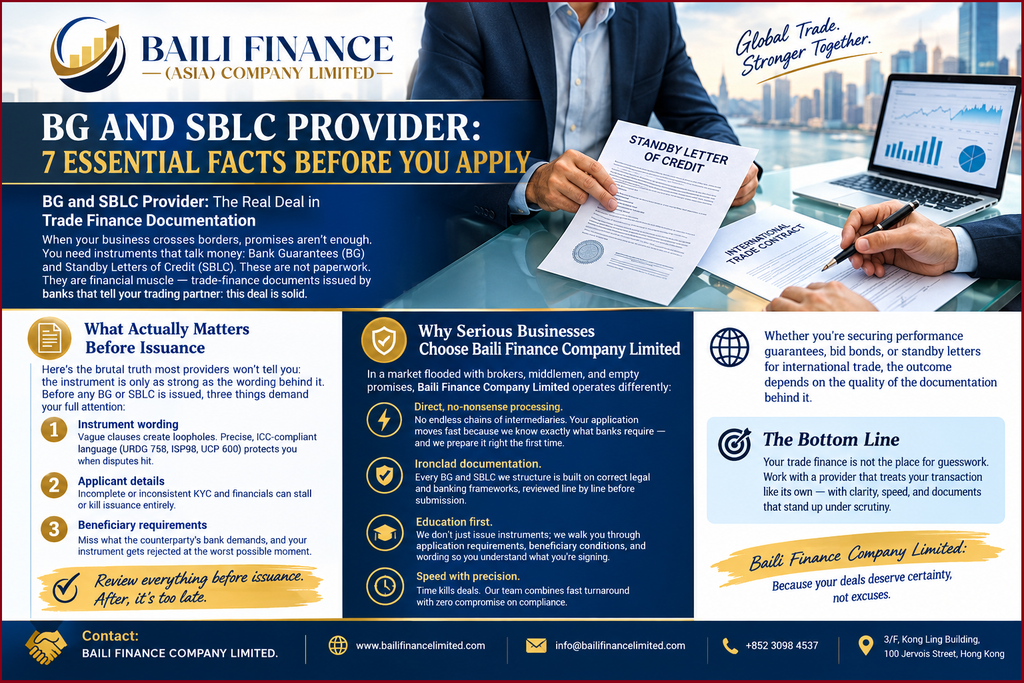
BG vs SBLC: What Is the Difference?
Although bank guarantees and standby letters of credit can provide similar commercial protection, they aren’t interchangeable in every transaction.
The correct choice depends on what the beneficiary requires, how the instrument must be presented, which legal framework applies and whether the issuing bank meets the counterparty’s acceptance criteria.
| Comparison | Bank Guarantee (BG) | Standby Letter of Credit (SBLC) |
|---|---|---|
| Primary purpose | Supports payment or contractual performance obligations | Supports payment or performance obligations |
| Common applications | Construction, tenders, procurement and project contracts | International trade, credit support and project finance |
| Issuer’s obligation | Determined by the guarantee’s wording and applicable law | Determined by the SBLC’s wording and applicable law |
| Common international rules | ICC URDG 758, where expressly incorporated | ICC ISP98 or UCP 600, where expressly incorporated |
| Payment conditions | Depends on the demand and documentary requirements | Depends on the presentation and documentary requirements |
| Beneficiary | A party named in the guarantee | A party named in the SBLC |
| Expiry | Specified in the instrument | Specified in the instrument |
The table provides a general comparison, not a universal legal distinction. In practice, both instruments can function as independent undertakings. Their legal effect depends on their wording, governing law and incorporated rules.
Which Instrument Should Your Business Choose?
Choose the instrument that matches the actual contract rather than selecting one based solely on its name or perceived market value.
A contractor participating in an international tender may need a bank guarantee that meets the project owner’s tender requirements. An importer negotiating payment security with a foreign supplier may find that the supplier accepts an SBLC issued by a bank with an appropriate credit standing.
In either situation, obtain the beneficiary’s written requirements before applying.
Confirm the following:
- The instrument type and purpose.
- The required face value and currency.
- The acceptable issuing bank or bank rating, if specified.
- The required wording and governing rules.
- The expiry date and any extension provisions.
- The presentation location, method and documents required for a demand.
- Whether an advising or confirming bank is necessary.
Resolving these points early reduces the risk of paying for an instrument that the intended beneficiary won’t accept.
How a Professional BG and SBLC Provider Works
A professional provider should establish the transaction’s requirements before proposing a financial structure. This involves reviewing the commercial objective, applicant’s financial position, beneficiary’s conditions and the banking arrangements available for the proposed transaction.
At Baili Finance, businesses can begin by discussing their requirements for SBLC issuance and related services or bank guarantee solutions.
The appropriate process depends on the instrument, transaction size, applicant’s circumstances and issuing bank’s policies.
Step 1: Initial Consultation and Requirements Assessment
The process begins with a clear explanation of the business objective.
Are you securing an advance payment? Meeting a tender requirement? Supporting an import contract? Seeking credit enhancement for a financing arrangement?
The answer determines which instrument may be appropriate and which documents the provider will need.
At this stage, establish whether the beneficiary requires a specific issuing bank, a particular jurisdiction or prescribed instrument wording. These requirements can materially affect feasibility.
Step 2: Document Submission and Due Diligence
Banks and financial institutions generally assess applicants before undertaking significant contingent obligations.
Depending on the transaction, documentation may include:
- Certificate of incorporation and company registration details.
- Identification and ownership information for relevant individuals.
- Financial statements and management accounts.
- Bank reference letters or evidence of existing banking relationships.
- The underlying commercial contract, tender or purchase agreement.
- The proposed beneficiary’s details.
- Requested instrument amount, currency and validity period.
- Information about the source of funds and transaction purpose.
Additional documents may be necessary for cross-border transactions or enhanced compliance checks.
Submitting complete, consistent information helps the reviewing institution assess the application. It does not guarantee approval.
Step 3: Structure and Commercial Terms
After reviewing the requirements, the provider should explain the proposed structure and its conditions.
This includes the intended issuing bank, the instrument’s purpose, fees, collateral or credit support requirements, expected processing stages and any conditions that must be satisfied before issuance.
For an SBLC or bank guarantee, businesses should also review the draft wording with the beneficiary and appropriate legal advisers.
Never assume that an instrument is acceptable simply because a provider describes it as internationally recognised or SWIFT-enabled.
Step 4: Issuance by the Appropriate Bank
Where the transaction proceeds, the issuing bank prepares and issues the instrument under its applicable procedures.
International instruments may be transmitted through SWIFT, the secure financial messaging network used by financial institutions. For example, SWIFT message type MT760 is associated with the issuance of a guarantee or standby letter of credit.
However, a reference to MT760 does not, by itself, prove that an instrument is genuine, that a particular bank has approved it or that the beneficiary will accept it.
The beneficiary or its bank should authenticate the instrument through appropriate banking channels and verify that its terms meet the contractual requirements.
Step 5: Delivery, Verification and Ongoing Management
After issuance, the parties should confirm receipt, authenticity, wording and validity.
They should also monitor the expiry date and any amendment or extension requirements. If the underlying contract changes, the parties must determine whether the instrument requires an amendment.
A well-managed process considers the entire instrument lifecycle, not just the date of issuance.
Seven Factors to Evaluate Before Selecting a BG and SBLC Provider
Choosing a provider based on an advertised price or promised delivery time alone exposes a business to avoidable risk. The following factors provide a more disciplined basis for evaluation.
1. Verify the Legal Identity of the Provider
Confirm the provider’s registered legal name, incorporation jurisdiction, business address and registration details.
Where applicable, distinguish a company’s registration from a banking licence, financial services authorisation or authority to issue a particular instrument.
These are different matters. Company registration alone does not establish that a business is a licensed bank or that a bank will honour an instrument arranged by that business.
For Baili Finance, prospective clients can review the company information published on its official website. They should independently verify relevant details and clarify the firm’s precise role in any proposed transaction.
2. Identify and Verify the Issuing Bank
The issuing bank’s identity and credit standing are central to the value of a bank-issued undertaking.
Ask which institution will issue the instrument, whether the proposed beneficiary accepts it and how the beneficiary can authenticate it.
Where relevant, review the bank’s financial strength using credible independent information, including published ratings from established credit-rating agencies. A rating is an assessment, not a guarantee against loss.
If an intermediary cannot clearly identify the issuing arrangement or explain the verification process, pause before committing funds.
3. Review the Instrument’s Wording
A bank’s name alone doesn’t determine whether an instrument meets your requirements.
The wording should specify the beneficiary, amount, currency, expiry, governing rules, demand requirements and any other conditions relevant to payment.
Where a guarantee is subject to the ICC’s Uniform Rules for Demand Guarantees, URDG 758, the instrument should expressly incorporate those rules. The same principle applies to an SBLC incorporating ISP98 or UCP 600.
The ICC’s official URDG 758 rules explain the framework for demand guarantees, including the concept of a complying demand.
4. Understand All Fees and Collateral Requirements
BG and SBLC transactions can involve several separate costs.
Depending on the structure, these may include:
- Arrangement or advisory fees.
- Bank issuance commissions.
- Collateral or cash-margin requirements.
- Advising, confirmation or amendment fees.
- Legal, compliance and due diligence expenses.
- Extension, renewal or cancellation charges.
Ask for a written breakdown that identifies each fee, who receives it, when it becomes payable and whether it is refundable under specified circumstances.
Avoid relying on a generic market percentage as a binding quote. Pricing depends on the issuing bank, amount, tenor, applicant’s creditworthiness, collateral, jurisdiction and transaction structure.
5. Assess Processing Timelines Realistically
A provider may help coordinate the process, but the issuing bank controls its own approval procedures.
Processing can depend on document completeness, compliance screening, credit approval, collateral arrangements and beneficiary negotiations.
Ask for an estimated timeline with clearly defined milestones. Treat any promised issuance date as conditional until the responsible institution confirms the requirements and approvals.
6. Evaluate Compliance and Transparency
International finance involves financial crime controls, sanctions screening, customer identification and other legal requirements.
A responsible provider should explain its documentation requirements and avoid requests that conflict with applicable law or sound banking practice.
Be cautious if a representative promises guaranteed approval without reviewing the applicant’s circumstances, discourages independent bank verification or pressures you to pay immediately.
A credible commercial process should permit appropriate due diligence by the applicant and its professional advisers.
7. Assess the Provider’s Ability to Meet Your Specific Objective
A provider may have experience arranging instruments for one type of transaction but not another.
A tender guarantee, a financial SBLC and an instrument intended to support a project financing arrangement can involve different requirements.
Ask the provider to explain how its proposed structure addresses the actual beneficiary’s requirements. Request clear documentation of responsibilities, fees and conditions rather than relying solely on marketing claims.
The central question is not simply whether a provider can arrange a BG or SBLC. It is whether the proposed instrument is suitable, authentic, acceptable to the beneficiary and commercially appropriate for your transaction.
How Much Does a Bank Guarantee or SBLC Cost?
There is no universal fee for obtaining a bank guarantee or standby letter of credit. The total cost depends on the instrument’s face value, validity period, applicant’s credit profile, collateral, issuing institution and transaction-specific risks.
For example, a bank may price a fully cash-collateralised instrument differently from one supported by a corporate credit facility. A transaction involving several banks or additional confirmation may also incur costs beyond the initial issuance fee.
An Illustrative Cost Example
Consider a company that needs a USD 5 million SBLC with a validity period of 12 months.
For budgeting purposes only, suppose the proposed annual issuance fee is 2% of the face value. This is a hypothetical assumption, not a market quote or an offer from Baili Finance.
| Cost item | Illustrative amount |
|---|---|
| SBLC face value | USD 5,000,000 |
| Assumed annual fee rate | 2% |
| Illustrative annual fee | USD 100,000 |
| Other banking and transaction expenses | Additional, if applicable |
The calculation is straightforward:
USD 5,000,000 × 2% = USD 100,000.
However, the applicant should not assume that the instrument will cost 2%, that collateral won’t be required or that the fee includes all transaction expenses. Actual terms must come from the relevant provider and issuing bank.
Before accepting an offer, request a written term sheet covering the total cost, payment schedule, collateral arrangements, refund conditions and any additional charges.
Can You Monetize a BG or SBLC to Obtain Funding?
BG or SBLC monetization refers to financing arrangements in which a financial instrument may support a lending or liquidity transaction.
In an eligible structure, a lender may assess a bank guarantee or standby letter of credit as part of its credit decision. The lender may then offer financing against the instrument, subject to its own risk assessment, legal requirements and contractual terms.
However, monetization is not automatic. A bank-issued instrument does not necessarily have a readily available cash value independent of its terms and the lender’s willingness to accept it.
Businesses considering this route should distinguish between three separate activities:
- Issuance: A bank issues the BG or SBLC to the designated beneficiary.
- Acceptance: A proposed lender or financing counterparty reviews the instrument and decides whether to accept it as credit support.
- Funding: The lender completes its underwriting and documentation requirements before disbursing funds under an agreed facility.
These stages may involve different institutions and separate approval decisions.
What Lenders May Consider
A lender assessing a proposed BG or SBLC-backed facility may review:
- The issuing bank’s identity, credit standing and jurisdiction.
- The instrument’s authenticity and enforceability.
- Whether the lender can obtain acceptable rights over the instrument.
- The wording, expiry date and demand provisions.
- The applicant’s business model and repayment capacity.
- The source of funds and transaction purpose.
- The proposed financing amount and tenor.
- Applicable legal, regulatory and compliance requirements.
A lender may reject an instrument even when another institution considers it acceptable.
Is Non-Recourse Funding Available?
Some financing arrangements are structured as non-recourse facilities. In general, a genuinely non-recourse arrangement limits the lender’s recovery rights to specified assets or sources, subject to the contract and applicable law.
The label alone does not establish that a borrower has no personal or corporate liability. The financing documents may contain representations, warranties, fraud exceptions, indemnities or other provisions that affect the parties’ rights.
Before entering a BG or SBLC monetization transaction, obtain independent legal advice on the actual recourse provisions, repayment obligations, fees and default consequences.
Businesses can review Baili Finance’s published information on non-recourse loan solutions and request transaction-specific details. Availability, pricing and approval depend on the proposed structure and applicable requirements.
Real-World Example: Using a Bank Guarantee in International Construction
Consider an international construction project in which a contractor has won a contract to develop a logistics facility for a private project owner.
The contract requires the contractor to provide a performance guarantee equal to 10% of the contract value before work begins.
The project has a contract value of USD 20 million. The required guarantee is therefore USD 2 million.
The contractor needs a bank guarantee that meets the project’s conditions, identifies the correct beneficiary and remains valid for the period stipulated in the contract.
How the Transaction Could Work
First, the project owner defines the requirement. The contract identifies the required guarantee amount, beneficiary, expiry provisions and acceptable issuing bank.
Second, the contractor approaches its financial institution or an appropriate provider. The contractor submits the contract, corporate documents, financial information and any other required evidence.
Third, the proposed structure undergoes review. The bank evaluates the applicant, the transaction and any required collateral or credit support. The parties review the guarantee wording to ensure that it meets the contract’s requirements.
Fourth, the bank issues the guarantee if it approves the application. The beneficiary or its bank authenticates the instrument and checks its terms.
Finally, the project proceeds under the agreed contract. If the contractor fulfils its obligations, the guarantee may expire or be released according to its terms. If the beneficiary makes a complying demand within the applicable period, the issuing bank handles that demand under the guarantee’s conditions and governing rules.
Why the Guarantee Matters
The project owner obtains specified financial protection if the contractor fails to meet covered obligations. The contractor, meanwhile, can satisfy a contractual security requirement without necessarily depositing the entire guarantee amount as cash with the project owner.
However, the bank may require collateral or a credit facility from the contractor. A guarantee also creates potential liability for the applicant if the bank pays a complying demand and seeks reimbursement under its arrangements with the applicant.
This example reflects a common commercial use of bank guarantees. It is illustrative and does not describe a verified Baili Finance client transaction.
Case Study: An Importer Evaluates an SBLC for Supplier Credit
The following case study is hypothetical. It illustrates how a business might evaluate an SBLC-based financing requirement without suggesting that a particular client received funding or that a specific outcome occurred.
The Business Challenge
An industrial equipment importer agrees to purchase USD 3 million of machinery from an overseas supplier.
The supplier is willing to reserve production capacity but wants additional payment security before offering the importer 90-day payment terms.
The importer expects to generate revenue from the equipment after installation. Paying the entire purchase price upfront, however, would place pressure on its working capital.
The importer therefore investigates whether an SBLC can satisfy the supplier’s payment-security requirement.
The Proposed Solution
The importer first obtains the supplier’s written SBLC requirements. These specify the acceptable issuing bank, amount, expiry date, applicable rules and documents required for a demand.
It then approaches its bank and a financial services provider to explore a suitable structure.
During the assessment, the parties examine the import contract, the importer’s financial statements, the issuing bank’s requirements and the supplier’s acceptance criteria.
The importer also asks whether its bank can issue the instrument directly or whether another arrangement is necessary.
Before proceeding, the importer confirms the following:
- The supplier will accept the proposed instrument and issuing bank.
- The bank has assessed the applicant and explained any collateral requirements.
- The SBLC’s wording corresponds with the underlying contract.
- The issuance fee and other expenses fit the importer’s budget.
- The importer understands its reimbursement obligations if the bank pays a complying demand.
- The expected commercial benefits justify the cost of the instrument.
Possible Outcomes and Lessons
If the bank approves the application and issues an acceptable SBLC, the supplier may agree to the proposed payment terms. This could allow the importer to preserve working capital during the agreed credit period.
Nevertheless, the SBLC does not itself guarantee that the supplier will extend credit, that the equipment will generate sufficient revenue or that a lender will provide additional financing.
The supplier retains its own commercial discretion, while the issuing bank applies its underwriting and documentation requirements.
If the bank declines the application or the supplier rejects the proposed wording, the importer must consider alternatives. These might include a documentary letter of credit, another form of payment security, a different credit arrangement or renegotiated payment terms.
The central lesson is that an SBLC should solve a defined commercial problem. Its value depends on acceptance, enforceability, cost and its fit with the underlying transaction.
Why Consider Baili Finance for BG and SBLC Solutions?
Selecting a financial services provider requires more than comparing promotional claims. Businesses need a clear understanding of the provider’s role, proposed banking arrangements, transaction requirements and fees.
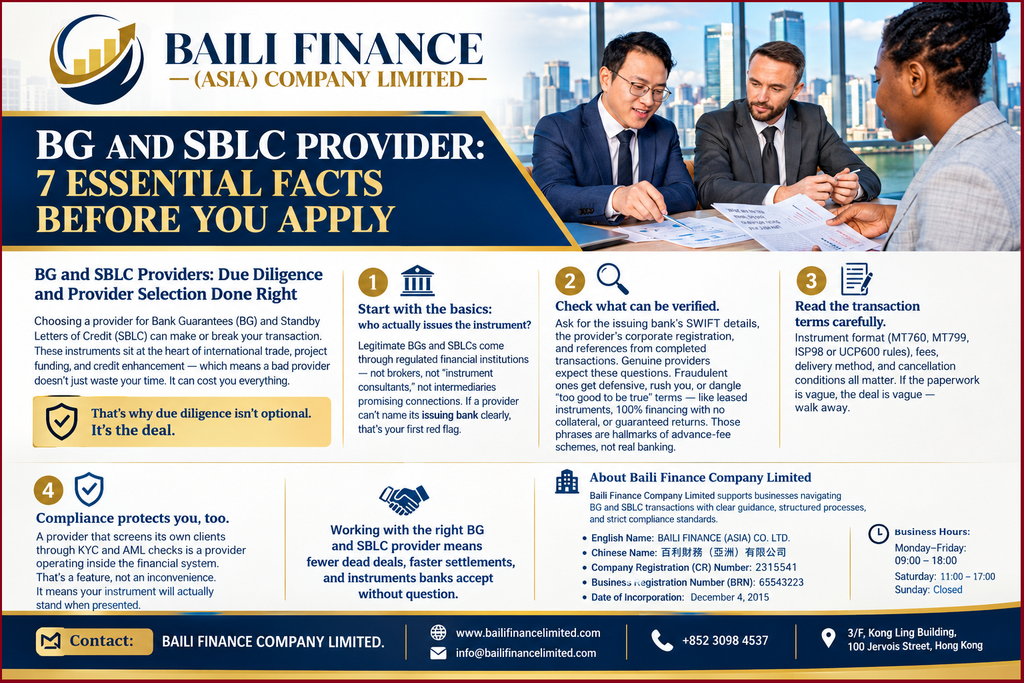
BAILI FINANCE (ASIA) COMPANY LIMITED is a Hong Kong-registered financial services firm that publishes information about its bank guarantee, SBLC, trade finance and structured financing services.
Businesses considering the company can begin with its published BG and SBLC service information and request clarification about the arrangement relevant to their requirements.
Transaction-Focused Assessment
A transaction-focused assessment begins with the beneficiary’s requirements and the applicant’s commercial objective.
Rather than assuming that every business needs the same instrument, the parties should determine whether a BG, SBLC or another trade finance solution fits the transaction.
International Commercial Requirements
Cross-border transactions can involve different legal systems, bank acceptance criteria and documentary standards.
Businesses should identify these requirements before committing to a structure. Where necessary, independent banking and legal professionals should review the proposed terms.
Clarity on Costs and Conditions
Applicants should receive a clear explanation of fees, documentation, approval stages, collateral requirements and the responsibilities of each party.
These details should be documented before the applicant makes a financial commitment.
A Broader View of Financing
Some businesses need a guarantee solely to meet a contractual requirement. Others are evaluating trade finance or potential financing arrangements supported by an instrument.
The distinction matters because issuance and financing are separate decisions. Any proposed funding solution must satisfy the relevant lender’s approval criteria.
The appropriate next step is to discuss the transaction’s purpose, amount, beneficiary requirements and timetable with the provider before deciding how to proceed.
How to Avoid BG and SBLC Scams
The market for bank guarantees and standby letters of credit requires careful verification. Transactions can involve substantial fees, multiple intermediaries and cross-border payments, creating opportunities for misrepresentation.
Before proceeding, apply these safeguards.
- Verify the issuing bank independently. Use contact details obtained from the bank’s official website or established banking channels rather than relying solely on contact information supplied by an intermediary.
- Confirm the instrument’s authenticity. Ask the beneficiary or its bank to authenticate the instrument through appropriate channels.
- Request a written agreement. The agreement should explain the parties’ responsibilities, fees, payment milestones, conditions and remedies if the transaction doesn’t proceed.
- Investigate claims of guaranteed returns. An SBLC or BG does not automatically produce investment profits or guarantee access to financing.
- Avoid unsupported claims of guaranteed issuance. Banks apply their own credit, compliance and operational requirements.
- Review MT760 documentation carefully. A message reference, draft instrument or screenshot is not sufficient proof of an authentic, operative bank undertaking.
- Seek independent professional advice. Legal counsel and banking professionals can help assess the instrument’s wording, enforceability and commercial suitability.
What Should You Check Before Paying a Provider?
Before transferring arrangement fees or other funds, establish precisely what you’re purchasing.
Is the payment for advisory services, bank issuance, collateral, an application or another contractual obligation? Who receives the funds? What happens if the bank declines the application? Does the agreement specify whether any portion is refundable?
The answers should appear in the transaction documentation.
A provider’s marketing material is not a substitute for independent verification. Equally, the existence of a company registration does not prove that a proposed bank instrument is authentic or that a funding transaction will succeed.
BG and SBLC Market Trends in 2026: What Businesses Should Expect
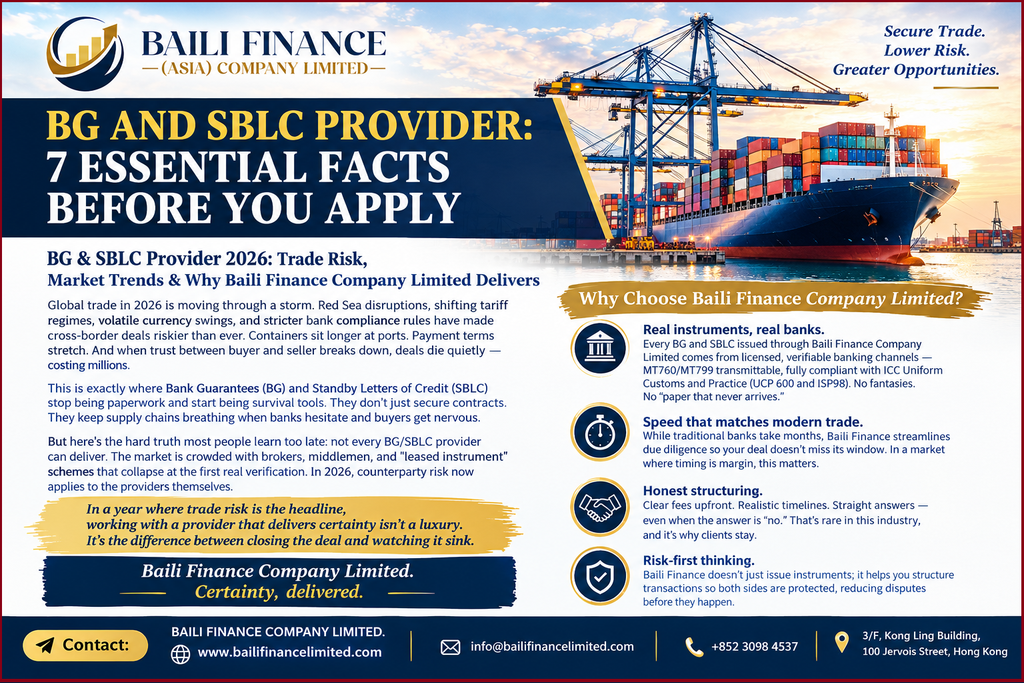
The BG and SBLC market in 2026 is being shaped by changing trade conditions, stronger compliance controls, digital documentation and growing attention to transaction risk. Businesses involved in international trade, procurement, construction and cross-border commercial agreements continue to use bank guarantees and standby letters of credit to address specific contractual and payment risks.
One of the most significant developments is the growing importance of counterparty verification. Financial institutions are strengthening their approach to customer due diligence, sanctions screening, document review and fraud prevention. Consequently, businesses seeking a BG or SBLC should prepare accurate corporate records and transaction documents before approaching a prospective provider.
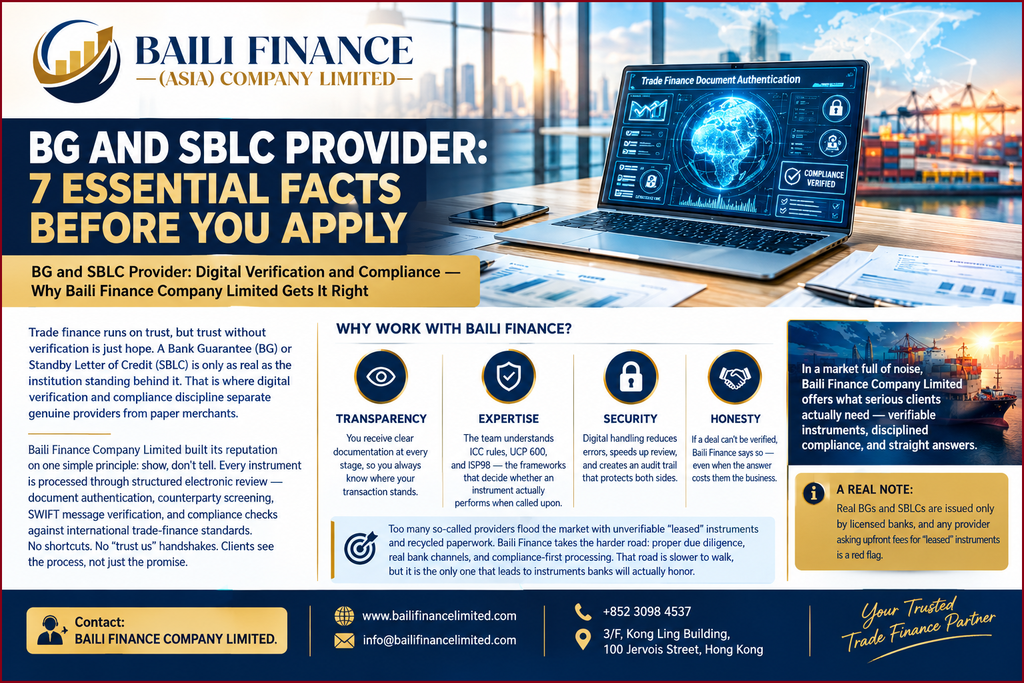
Digitalisation is also changing trade-finance operations. Electronic documentation, automated document review and improved information exchange can support more efficient processing. However, digital systems do not eliminate the need to verify the issuing institution, confirm the instrument’s terms and establish whether the beneficiary will accept it.
Another important trend is increased scrutiny of SBLC monetization and collateral-based funding proposals. An SBLC does not guarantee access to cash or financing. Any lending decision depends on the proposed lender’s requirements, the instrument’s characteristics, the applicant’s financial position and the terms of the transaction.
At the same time, geopolitical uncertainty and volatile financial conditions continue to influence trade-finance availability. Businesses should therefore compare providers carefully, understand the proposed issuance arrangements and review all fees and conditions before making financial commitments.
For companies seeking a BG and SBLC provider in 2026, the priority should be a transparent, properly documented process that reflects the requirements of the underlying transaction. Careful due diligence, realistic expectations and clear contractual terms remain essential to making informed decisions.
Frequently Asked Questions About BG and SBLC Providers
1. What is a BG and SBLC provider?
A BG and SBLC provider helps businesses obtain bank guarantees and standby letters of credit for commercial transactions. Depending on its role, the provider may issue the instrument as an authorised financial institution or arrange issuance through an appropriate bank. Applicants should verify the provider’s legal identity, the issuing bank and the proposed instrument’s terms before proceeding.
2. What is the difference between a bank guarantee and an SBLC?
A bank guarantee and an SBLC can both provide financial protection when an applicant fails to meet specified obligations. Their legal form, governing rules, market conventions and documentary requirements may differ. A BG is frequently used for tender, performance and advance payment obligations, while an SBLC is common in international trade and credit support. The contract and instrument wording determine the appropriate choice.
3. How can I obtain a bank guarantee or SBLC?
Start by identifying the beneficiary’s requirements, the instrument amount, currency and validity period. Prepare your corporate documents, financial information and underlying contract. A provider or bank can then assess the proposed transaction, explain the available structure and identify any additional requirements. Issuance remains subject to the relevant institution’s approval and compliance procedures.
4. How much does an SBLC cost?
The cost depends on the face value, validity period, issuing bank, applicant’s credit profile, collateral and transaction structure. Additional expenses may include arrangement, advising, confirmation and amendment fees. Request a written quotation that separates the bank’s charges from other service fees. Don’t assume that a published percentage applies to your transaction.
5. Can an SBLC be used to obtain a business loan?
An SBLC may support a financing arrangement if a lender accepts the instrument and approves the proposed facility. The lender will assess the issuing bank, instrument wording, enforceability, borrower and transaction. An SBLC doesn’t automatically entitle its holder to a loan, and any funding remains subject to the lender’s terms and approval.
6. What is SBLC monetization?
SBLC monetization describes a financing arrangement in which an eligible standby letter of credit supports a funding transaction. A lender or financing counterparty assesses the instrument and may offer financing under agreed conditions. Monetization isn’t automatic, and advertised advance rates or funding amounts shouldn’t be treated as guaranteed outcomes.
7. What is SWIFT MT760 in BG and SBLC transactions?
SWIFT MT760 is a financial messaging format associated with issuing a guarantee or standby letter of credit. Its use can facilitate communication between financial institutions, but the message reference alone doesn’t establish authenticity, acceptance or payment. The beneficiary or its bank should verify the instrument through appropriate banking channels.
8. What documents are required to apply for a BG or SBLC?
Requirements vary by bank and transaction. Common documents include company registration records, ownership information, financial statements, identification documents, the underlying contract and details of the proposed beneficiary. Banks may also request evidence of the source of funds, collateral or existing banking facilities. A complete document checklist should be obtained before submission.
9. How long does it take to issue a BG or SBLC?
There is no universal processing time. The timeline depends on the completeness of the application, credit assessment, compliance checks, collateral arrangements, instrument wording and bank approval. An intermediary may coordinate the process, but it cannot independently guarantee that a bank will approve or issue the instrument by a specific date.
10. How do I verify whether a BG or SBLC is genuine?
Confirm the identity of the purported issuing bank using independently obtained contact details. Request authentication through the beneficiary’s bank or other appropriate banking channels. Review the instrument’s reference, beneficiary, amount, validity, terms and applicable rules. Never rely solely on screenshots, email attachments, intermediary assurances or claims that a document has been transmitted through SWIFT.
11. Can a BG or SBLC be issued without cash collateral?
Possibly, depending on the issuing institution’s policies, the applicant’s creditworthiness and the structure of the transaction. A bank may accept other collateral, an existing credit facility or another form of credit support. However, an unsecured issuance isn’t guaranteed, and applicants should confirm the actual requirements with the responsible institution.
12. How do I choose the best BG and SBLC provider?
Compare the provider’s legal identity, precise role, proposed issuing bank, documentation standards, fees, contractual protections and verification procedures. Confirm that the beneficiary will accept the proposed instrument before committing funds. The most suitable provider is one whose proposed structure meets your commercial requirements and whose claims and arrangements withstand independent due diligence.
Conclusion: Choose the Right BG and SBLC Provider for Your Business
Bank guarantees and standby letters of credit help businesses manage defined commercial risks, support contractual commitments and negotiate international transactions. When structured appropriately, these instruments can provide financial assurance to suppliers, project owners, lenders and other counterparties.
However, successful implementation requires more than obtaining a document. Businesses must select the appropriate instrument, establish acceptable banking arrangements, understand the fees, verify authenticity and review the conditions governing payment.
For companies considering BG and SBLC issuance, trade finance or instrument-backed financing, the most effective starting point is a clearly defined commercial objective and a thorough assessment of the available options.
BAILI FINANCE (ASIA) COMPANY LIMITED provides information on bank guarantees, standby letters of credit and related financial services for businesses with international requirements. Prospective clients should discuss their specific needs and verify the proposed terms before making a commitment.
READY TO SECURE YOUR NEXT BUSINESS TRANSACTION?
Your next contract, international trade deal or financing opportunity deserves the right financial structure.
Whether you need a Bank Guarantee (BG), Standby Letter of Credit (SBLC), or an instrument to support an eligible financing arrangement, BAILI FINANCE (ASIA) COMPANY LIMITED invites you to discuss your requirements with our team.
Don’t commit to a financial instrument before understanding its costs, documentation requirements, issuing arrangements and acceptance conditions. Start with a clear assessment of your transaction and the options available to your business.
Let’s discuss your requirements.
Contact Baili Finance today and provide the key details of your transaction:
- Instrument required: BG, SBLC or related trade finance solution
- Amount and currency: Your intended instrument value
- Purpose: Contract security, international trade, project requirements or potential financing
- Timeline: Your expected issuance or transaction date
Our team can review your enquiry and discuss the relevant requirements, subject to transaction assessment and applicable approvals.
TAKE THE NEXT STEP TODAY.
Visit Biali Finance Limited or contact us directly:
🌐 www.bailifinancelimited.com
✉️info@bailifinancelimited.com
📞+852 3098 4537
📍 3/F, Kong Ling Building, 100 Jervois Street, Hong Kong
BAILI FINANCE (ASIA) COMPANY LIMITED — Discuss your BG and SBLC requirements with a clear understanding of the process, the costs and the next steps.
Intermediaries/Consultants/Brokers are welcome to bring their clients 100% protected. Our brokers receive 2% commission for referral. We assist Clients and brokers in their attempt to secure funding by working on their funding requests that may require innovative financing. In complete confidence, we will work together for the benefits of all parties involved.
#BankGuarantee #SBLCProvider #BGProvider #StandbyLetterOfCredit #TradeFinance #SBLCMonetization #InternationalTrade #ProjectFinance