Headline: SBLC Credit Facility: 7 Steps to Business Funding
Introduction: Understanding the SBLC Credit Facility
An SBLC credit facility can support business financing, international trade, working capital requirements, and project development when a lender accepts a Standby Letter of Credit (SBLC) as credit support. For companies seeking access to international finance, an SBLC may strengthen a financing proposal, support contractual obligations, or help meet a lender’s security requirements.
However, businesses must understand one important distinction: an SBLC isn’t cash, a conventional business loan, or an automatic guarantee of financing approval. Its practical value depends on the issuing bank, the instrument’s wording, the transaction’s commercial purpose, and the financing provider’s independent assessment.
For importers, exporters, corporate borrowers, contractors, commodity traders, and project developers, understanding how an SBLC credit facility works can help them evaluate financing opportunities and avoid unsuitable arrangements.
At BAILI FINANCE (ASIA) COMPANY LIMITED, we support clients seeking structured financial solutions, including SBLC-related services, trade finance, and business financing arrangements. Each transaction requires an assessment of the client’s requirements, supporting documentation, eligibility, and proposed structure.
This guide explains how SBLC credit facilities work, their potential applications, the application process, associated costs, and the principal risks businesses should consider before proceeding.
Keywords: SBLC credit facility, SBLC financing, standby letter of credit financing, SBLC-backed loan, SBLC working capital financing, SBLC monetization, standby letter of credit facility, trade finance solutions, corporate credit facility, bank-issued financial instruments, project finance with SBLC, SBLC financing provider, SBLC funding solutions.
What Is an SBLC Credit Facility?
An SBLC credit facility is a financing arrangement in which a Standby Letter of Credit supports a lender’s credit exposure or a specific financial obligation, subject to the lender’s approval and the agreed contractual terms.
A Standby Letter of Credit is an independent undertaking issued by a bank in favour of a beneficiary. The issuing bank agrees to honour a complying demand under the instrument according to its terms. Depending on the structure, the beneficiary may present a demand when the applicant fails to meet the specified financial or contractual obligations.
The International Chamber of Commerce (ICC) explains the principles governing standby letters of credit in its International Standby Practices (ISP98). These rules address matters such as documentary presentation, examination, payment obligations, and the duration of a standby.
In an SBLC-backed financing transaction, a lender may consider the instrument as part of its security package. If the lender approves the arrangement, it may extend a credit facility under separate financing documentation.
The facility could support business expansion, procurement, project expenditure, or working capital, depending on the approved purpose and structure.
How Does an SBLC Credit Facility Work?
A typical transaction may involve four principal parties:
- Applicant: The business or entity requesting the SBLC.
- Issuing bank: The bank that issues the standby undertaking.
- Beneficiary: The party entitled to make a complying demand under the SBLC.
- Financing provider: The lender evaluating whether to extend credit supported by the instrument.
The beneficiary and the financing provider may be the same entity, but they don’t have to be. The contractual arrangements must identify each party’s role and establish the rights attached to the instrument.
The process generally follows these stages:
- The applicant identifies a legitimate commercial or financing requirement.
- The parties determine whether an SBLC suits the transaction.
- The issuing bank evaluates the applicant and its proposed undertaking.
- The instrument is issued under agreed terms.
- The financing provider verifies the instrument and assesses the overall transaction.
- The lender determines whether to approve a credit facility.
- The parties execute the necessary agreements and satisfy the conditions for funding.
The key principle is that the SBLC supports the transaction; it doesn’t independently create a right to borrow money from every lender.

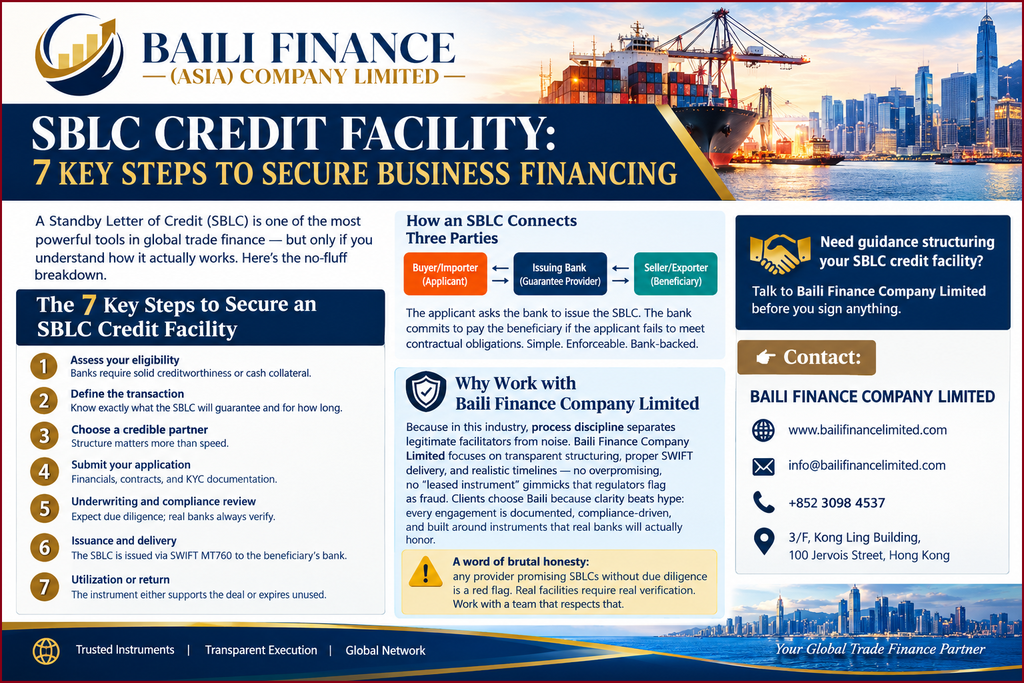
7 Key Steps to Secure an SBLC Credit Facility
Step 1: Define Your Business Financing Requirements
Before approaching an SBLC provider or lender, establish exactly what your business needs to finance.
A company importing machinery may require short-term trade finance. A construction contractor may need a financial instrument to satisfy a project owner’s contractual requirements. Meanwhile, a project developer may seek a credit facility to support approved expenditure.
These requirements aren’t interchangeable. Each requires a financing structure suited to the underlying commercial transaction.
Prepare a clear funding proposal that identifies:
- The required financing amount in USD.
- The intended use of funds.
- The expected funding period.
- The proposed repayment source.
- The transaction’s counterparties.
- The available collateral or credit support.
- The anticipated commercial return or operational benefit.
A defined financing requirement helps the lender evaluate whether an SBLC-backed structure is appropriate.
Step 2: Assess the SBLC Requirements
Not every standby letter of credit qualifies for every financing programme.
Lenders typically examine the issuing bank’s credit standing, the instrument’s authenticity, its expiry date, the governing rules, the beneficiary designation, and the conditions for making a demand.
They may also review whether the instrument permits the proposed security arrangement, assignment, transfer, or other transaction-specific requirements.
For example, an SBLC issued by a bank that the lender doesn’t accept may fail to meet its eligibility criteria, even when the instrument appears professionally prepared.
Similarly, an instrument that expires before the proposed facility matures may provide inadequate protection.
Before committing to fees or contractual obligations, obtain the proposed instrument terms and ask the prospective lender to confirm its acceptance criteria in writing.
Step 3: Prepare Your Financial and Compliance Documents
Financial institutions conduct due diligence before issuing instruments or approving financing. The scope depends on the jurisdiction, the parties, the transaction size, and applicable compliance requirements.
Commonly requested documents include:
- Certificate of incorporation and company registration records.
- Identification and verification documents for directors and beneficial owners.
- Recent audited financial statements or management accounts.
- Bank statements and evidence of available funds, where relevant.
- Business plans, cash-flow forecasts, and repayment projections.
- Underlying contracts, purchase orders, or project agreements.
- Details of the proposed issuing bank and instrument.
- Information concerning the source of funds and the transaction’s commercial purpose.
Additional documentation may be necessary for cross-border transactions, regulated industries, or complex ownership structures.
Prepare accurate, consistent information. Discrepancies between corporate records, financial statements, and transaction documents can delay the assessment or result in rejection.
Step 4: Identify a Suitable Issuing Bank and Financing Provider
The issuing bank and the financing provider perform different functions.
The issuing bank assumes the obligations specified in the SBLC. The financing provider decides whether to extend credit and on what terms.
A business should therefore assess both parties independently.
When evaluating a potential financing arrangement, establish:
- Whether the issuing bank is appropriately licensed and identifiable.
- Whether the financing provider has authority to enter the proposed transaction.
- Whether the lender accepts the specific issuing bank and instrument.
- Whether the financing terms are documented clearly.
- Whether the parties can verify the instrument through appropriate banking channels.
- Whether the proposed arrangement complies with applicable laws and banking requirements.
A message transmitted through SWIFT, including an MT760 message used for certain guarantees and standby letters of credit, isn’t by itself proof that a lender will approve a separate credit facility.
Verification, legal review, and financing approval remain essential.
Step 5: Agree on the Financing Structure
Once the parties establish preliminary eligibility, they can assess the appropriate financing structure.
Depending on the transaction, an SBLC may support a revolving credit facility, a term loan, a working capital arrangement, a project-related facility, or another agreed financing structure.
The lender determines the structure it is willing to offer.
The parties should document the following terms before proceeding:
- Approved facility amount and currency.
- Interest rate or financing charge.
- Arrangement, issuance, advisory, and other applicable fees.
- Facility maturity and repayment schedule.
- Required collateral and security arrangements.
- Conditions precedent to disbursement.
- Events of default and enforcement rights.
- SBLC expiry, renewal, and replacement requirements.
- Governing law and dispute-resolution provisions.
Pay particular attention to the difference between the SBLC’s face value and the amount a lender may be willing to finance.
A USD 10 million SBLC doesn’t automatically provide USD 10 million in cash. A lender may decline the instrument, require additional security, or offer a facility substantially below its face value.
Step 6: Complete Verification, Legal Review, and Approval
Before funding, the relevant parties must complete their due diligence and satisfy the agreed conditions.
The lender may authenticate the SBLC through the issuing bank, review the instrument’s terms, assess the applicant’s creditworthiness, and evaluate the transaction’s repayment capacity.
Legal advisers may also need to assess enforceability, the governing rules, the rights of the beneficiary, and the implications of the proposed security arrangement.
Where applicable, the parties should establish whether the instrument is subject to ISP98 or the Uniform Customs and Practice for Documentary Credits (UCP 600). The applicable rules depend on the instrument’s wording and incorporation of those rules.
Neither rule set replaces the need to review the instrument itself or consider mandatory local law.
Only after the relevant approvals and conditions have been satisfied should the parties proceed in accordance with their executed agreements.
Step 7: Receive Funding and Manage the Facility
Following approval, the financing provider disburses funds according to the agreed documentation.
The borrower should maintain proper financial records, monitor cash flow, meet repayment obligations, and comply with reporting requirements.
If the SBLC supports a time-limited facility, the borrower must also monitor its expiry and any renewal obligations. Waiting until shortly before expiry can create unnecessary refinancing and compliance risks.
Businesses should maintain a clear record of:
- Amounts drawn and outstanding.
- Repayment dates and interest obligations.
- Instrument expiry and amendment dates.
- Financial reporting deadlines.
- Covenants and other contractual conditions.
- Communications with the issuing bank and lender.
Effective facility management helps businesses avoid preventable defaults and maintain a clear understanding of their financial commitments.
Common Uses of an SBLC Credit Facility
SBLC-backed financing may suit different commercial requirements when the lender approves the structure and the underlying transaction supports repayment.
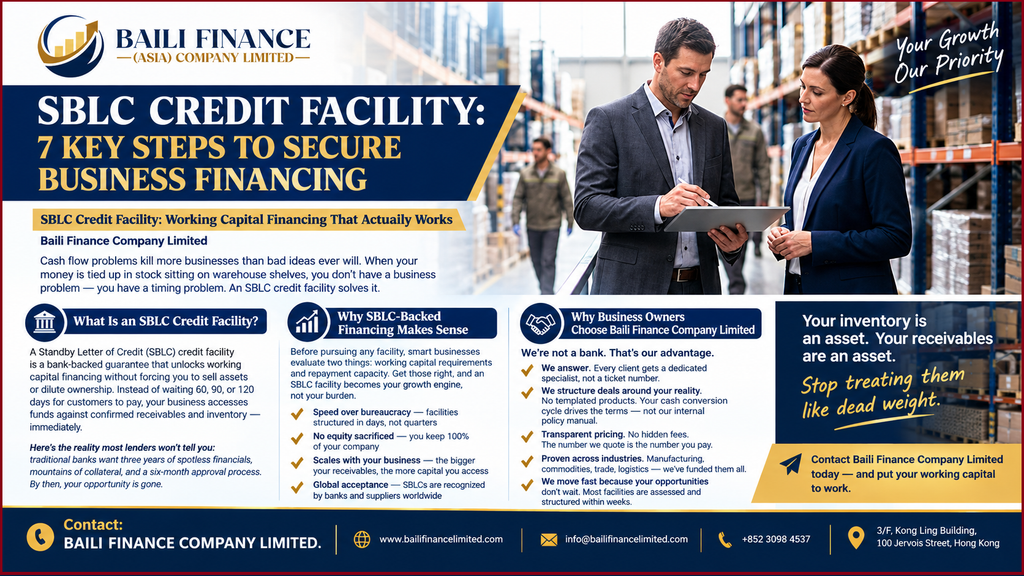
1. Working Capital Financing
Businesses often need working capital to cover payroll, inventory purchases, supplier payments, freight, and operating expenses.
An eligible SBLC may support a working capital facility when a lender accepts the instrument as part of its credit assessment.
However, the business must still demonstrate a credible repayment source and meet the lender’s underwriting requirements.
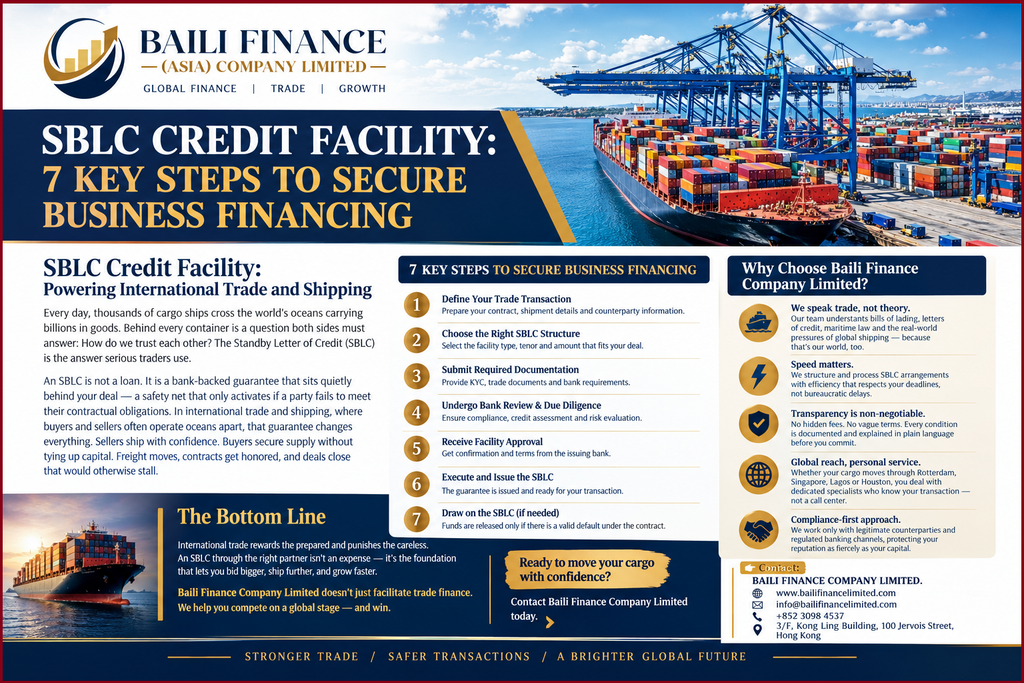
2. International Trade Finance
Cross-border transactions expose businesses to payment, counterparty, documentation, and jurisdictional risks.
An SBLC can provide contractual payment assurance where the applicant fails to meet specified obligations. In suitable arrangements, an acceptable instrument may also support a separate financing facility connected with the transaction.
The structure must distinguish the standby undertaking from a commercial documentary letter of credit, which serves a different primary function.
3. Project Finance
Infrastructure, construction, energy, manufacturing, and other capital-intensive projects may require substantial financing.
An SBLC can support a project’s contractual or financial obligations. A lender may also consider an eligible standby as part of the project’s credit support.
Nevertheless, the instrument doesn’t replace a viable project model, credible sponsors, suitable contracts, or a sustainable repayment plan.
4. Corporate Expansion
A business expanding into a new market may need funding for equipment, facilities, procurement, or additional inventory.
Where the lender accepts the instrument, an SBLC-backed credit facility may form part of the company’s wider financing strategy.
The business should assess the cost of the facility against its projected operating cash flow and expected commercial benefit.
5. Contractual and Supplier Obligations
Some suppliers, project owners, and counterparties require financial assurance before they agree to contractual terms.
An SBLC may satisfy a qualifying contractual requirement, subject to the wording and acceptance criteria.
However, satisfying a contract’s security requirement doesn’t automatically create a separate loan or working capital facility.
SBLC Credit Facility vs. Traditional Business Loan
Understanding the distinction helps borrowers select a suitable financing option.
| Feature | SBLC-backed credit facility | Traditional business loan |
|---|---|---|
| Primary structure | Credit supported by an accepted SBLC | Credit assessed under the lender’s lending criteria |
| Financial instrument | Requires an eligible standby where specified | May rely on cash flow, assets, guarantees, or other security |
| Approval | Depends on instrument eligibility and credit assessment | Depends on underwriting and agreed conditions |
| Funding amount | Determined by the lender’s approved structure | Determined by the lender’s approved facility |
| Repayment | Governed by the financing agreement | Governed by the loan agreement |
| Main consideration | Instrument quality, enforceability, and transaction suitability | Creditworthiness, repayment capacity, and security |
Neither structure is universally preferable. The appropriate option depends on the business’s financial position, available security, funding objectives, and the lender’s requirements.
What Is SBLC Monetization?
SBLC monetization generally refers to a financing arrangement in which an eligible standby letter of credit supports access to liquidity through an agreed lending or structured finance transaction.
The exact arrangement varies by provider and contract.
In a conventional secured financing structure, a lender evaluates the SBLC and may extend credit if the instrument satisfies its eligibility criteria. The borrower then receives funds under a separate financing agreement and assumes the obligations set out in that agreement.
Monetization isn’t automatic. A standby letter of credit cannot simply be converted into cash on demand without an appropriate transaction and a willing financing counterparty.
Businesses should confirm the following before proceeding:
- The issuing bank and instrument can be authenticated.
- The proposed lender has reviewed the instrument’s terms.
- The funding amount and financing ratio are documented.
- All charges and payment obligations are disclosed.
- The repayment terms and enforcement rights are clear.
- The transaction’s legal and regulatory requirements have been assessed.
Avoid proposals that promise guaranteed funding, unusually high returns, or immediate monetization without meaningful verification.
Real-World Example: SBLC Financing for an Equipment Importer
Consider an illustrative transaction involving a manufacturing company that imports industrial equipment from an overseas supplier.
The supplier agrees to deliver equipment valued at USD 4 million but requires additional financial assurance before confirming the order.
The buyer wants to preserve its working capital while demonstrating its ability to meet the contractual payment obligations.
The buyer’s bank reviews the request and, subject to its credit assessment and applicable conditions, issues an SBLC in favour of the supplier.
The standby sets out the maximum amount available, the expiry date, the conditions for making a demand, and the documentary requirements.
Separately, the buyer approaches a financing provider to discuss whether an SBLC-backed facility could support its procurement requirements.
The financing provider reviews the instrument, the purchase contract, the buyer’s financial position, and the proposed repayment source. It then determines whether it can approve a separate facility and establishes the applicable terms.
If approved, the financing arrangement may help the buyer manage procurement costs while preserving cash for other operational needs.
The supplier benefits from the contractual payment assurance, while the buyer gains a potential financing option subject to the agreed structure.
Important: This is an illustrative scenario, not a verified transaction involving Baili Finance Limited or a claim that any particular lender would approve the facility. Actual outcomes depend on the parties, documentation, banking arrangements, and credit decisions.
Case Study: Evaluating an SBLC-Backed Working Capital Proposal
The following case study is hypothetical and demonstrates how a business might evaluate an SBLC credit facility. It doesn’t describe a verified client transaction.
The business challenge
A regional distribution company secures a supply contract that requires an initial inventory purchase of USD 2 million.
The company has sufficient projected sales to support the order but wants to retain part of its available cash for logistics, payroll, and other operating costs.
Management considers using an SBLC to support a working capital facility.
The proposed solution
The company develops a financing proposal containing its supply contract, financial statements, projected sales, cash-flow forecast, and proposed repayment schedule.
Its advisers assess whether an SBLC-backed arrangement is commercially appropriate.
The proposed issuing bank, instrument terms, financing provider, and transaction structure are then subject to due diligence and independent review.
The financing provider evaluates the instrument and the company’s ability to repay the proposed facility. It also considers the risks associated with inventory turnover, customer payment delays, and changes in demand.
The financial assessment
Assume the lender considers a hypothetical facility of USD 1.2 million against the company’s USD 2 million inventory requirement.
The proposed facility would cover 60% of the initial inventory expenditure, leaving the company responsible for arranging the remaining USD 800,000.
This calculation describes the proposed funding requirement only. It isn’t a standard SBLC financing ratio or a prediction of what a lender would approve.
Management must then assess the financing cost, expected sales receipts, repayment dates, and contingency arrangements.
The outcome assessment
Before proceeding, the company should establish whether the projected cash flow can support repayment under less favourable trading conditions.
If the financing cost exceeds the commercial benefit, the company may need to reduce the facility, negotiate supplier credit, or consider alternative funding.
If the lender approves the structure and the transaction satisfies all conditions, the facility may help the company meet its inventory requirements while retaining a portion of its working capital.
Key lessons
This example highlights three principles:
- A credible repayment plan matters. An SBLC doesn’t eliminate the borrower’s repayment obligations.
- The financing amount requires independent approval. The instrument’s face value doesn’t determine the amount of credit available.
- Commercial viability remains essential. The company must be able to repay the facility from a credible source of cash flow.
Costs and Risks of an SBLC Credit Facility
Before signing an agreement, businesses should understand the financial and legal commitments involved.
Issuance and arrangement fees
The issuing bank may charge fees for issuing and maintaining the SBLC. Other parties may charge arrangement, advisory, legal, verification, or financing fees, depending on the transaction.
Request a complete fee schedule and establish when each payment becomes due.
Interest and financing charges
A credit facility may carry interest, commitment fees, facility charges, or other costs.
Compare the total cost with the expected commercial benefit. Don’t assess a financing proposal solely by its headline interest rate.
Expiry and renewal risk
An SBLC normally contains an expiry date or a termination mechanism under the applicable rules and its terms.
If the facility continues beyond the instrument’s effective period, the borrower may need to arrange a renewal, replacement security, or repayment.
Issuer and counterparty risk
The financing provider may reject an instrument because of the issuing bank’s credit standing, authentication concerns, jurisdictional limitations, or unacceptable wording.
Businesses should verify counterparties independently and avoid relying exclusively on promotional materials or intermediaries.
Legal and documentary risk
A standby operates according to its wording, incorporated rules, and applicable law.
Errors in the beneficiary’s name, expiry date, presentation requirements, or demand wording can create disputes or affect the ability to obtain payment.
Independent legal review can help identify these issues before issuance.
Fraud and misleading financing claims
Be cautious when a provider guarantees approval before completing due diligence, demands unexplained advance payments, or promises funding regardless of the issuing bank.
Verify bank details independently, use documented payment arrangements, and obtain professional advice before committing funds.
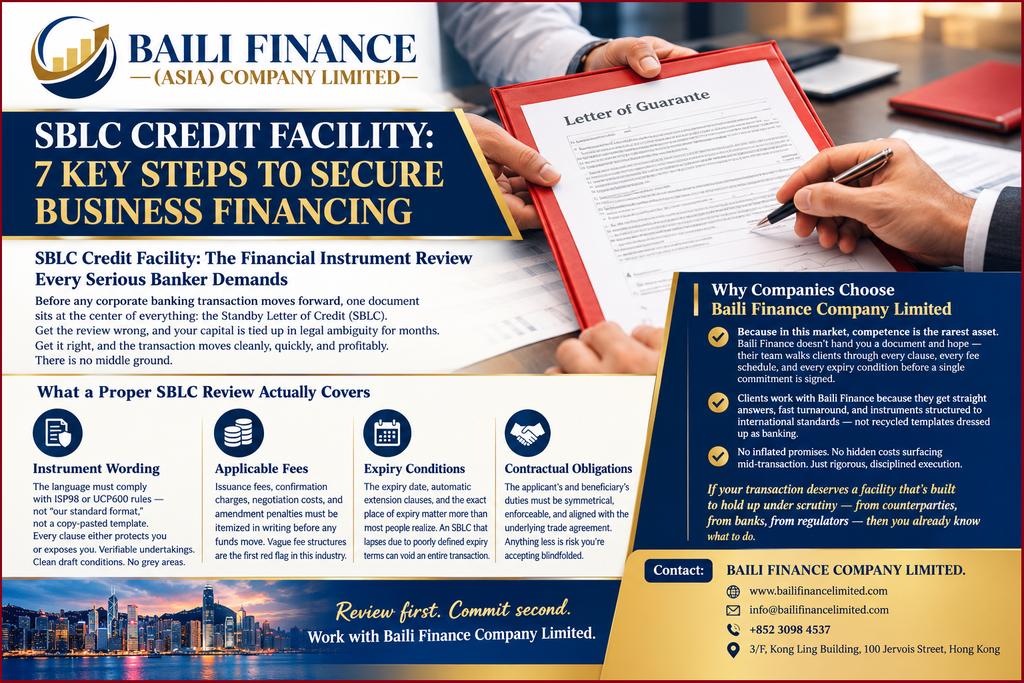
How to Choose an SBLC Financing Partner
Choosing the right counterparty requires more than comparing quoted fees.
A suitable partner should explain the proposed structure, the parties’ responsibilities, the applicable conditions, and the steps required before funding.
Use this checklist when evaluating an SBLC financing proposal:
- Confirm the company’s legal identity and registration details.
- Verify the issuing bank independently.
- Obtain written confirmation of the lender’s eligibility requirements.
- Review the complete financing agreement before paying fees.
- Request a transparent breakdown of costs.
- Understand repayment obligations and enforcement rights.
- Seek independent legal and financial advice where appropriate.
- Avoid guarantees of returns or financing approval that lack contractual and evidential support.
Businesses can also consult the International Chamber of Commerce’s guidance on ISP98 to understand the rules that may govern standby letters of credit.
SBLC Credit Facility Services at Baili Finance Limited
BAILI FINANCE (ASIA) COMPANY LIMITED, based in Hong Kong, supports clients exploring financial instruments, structured finance, trade finance, and financing-related solutions.
For businesses considering an SBLC credit facility, the first step is to define the transaction and establish whether the proposed structure fits the commercial requirement.
Our team can discuss your financing objectives, the proposed instrument, available documentation, and the requirements that may apply to your transaction.
Depending on the circumstances, the assessment may involve:
- Reviewing the intended use of funds.
- Identifying the type of financial instrument required.
- Assessing the proposed transaction structure.
- Reviewing relevant corporate and compliance documentation.
- Discussing the proposed financing requirements and applicable conditions.
Any proposed arrangement remains subject to eligibility, due diligence, counterparty acceptance, contractual terms, and applicable law. An enquiry doesn’t constitute an offer of credit or guarantee that funding will be approved.
To learn more, visit Baili Finance Limited’s financial instruments page or contact the team directly through the company’s official website.
Frequently Asked Questions About SBLC Credit Facilities
1. What is an SBLC credit facility?
An SBLC credit facility is a financing arrangement in which an eligible Standby Letter of Credit supports a lender’s credit exposure or a specified financial obligation. The lender independently assesses the instrument, the borrower, and the proposed transaction before deciding whether to provide funding.
2. Can I obtain a loan using an SBLC?
Potentially, yes. A lender may accept an eligible SBLC as security or credit support for a separate loan or credit facility. Approval depends on the issuing bank, the instrument’s terms, the borrower’s financial position, the financing structure, and the lender’s underwriting requirements.
An SBLC doesn’t automatically entitle its holder to receive a loan.
3. How much financing can I obtain against an SBLC?
There is no universal financing ratio. The amount depends on the instrument’s face value, the issuing bank’s credit standing, the lender’s eligibility criteria, the transaction’s risks, and any additional security requirements.
A lender may approve less than the SBLC’s face value or decline the transaction altogether.
4. What documents are required for SBLC financing?
Typical requirements include company registration documents, identification records, financial statements, bank statements, business plans, underlying contracts, and details of the proposed SBLC.
The lender or issuing bank may request additional information depending on the transaction, applicable regulations, and its internal policies.
5. How long does it take to arrange an SBLC credit facility?
There is no standard completion period for every transaction. Timing depends on document preparation, compliance checks, bank approval, instrument verification, legal review, and the financing provider’s procedures.
Businesses should obtain a transaction-specific timeline rather than relying on an unconditional promise of rapid funding.
6. What is the difference between an SBLC and an SBLC-backed loan?
An SBLC is a bank undertaking to honour a complying demand under specified terms. An SBLC-backed loan is a separate financing agreement under which a lender extends credit, potentially relying on the SBLC as security or credit support.
The SBLC itself doesn’t create the loan or determine the lender’s approval decision.
7. What is SBLC monetization?
SBLC monetization generally describes a transaction in which an eligible standby letter of credit supports access to liquidity through a financing arrangement.
The structure may involve a lender accepting the SBLC as security or credit support. The transaction requires verification, appropriate agreements, and approval by the financing counterparty.
8. Is an SBLC credit facility risk-free?
No. Potential risks include instrument rejection, counterparty failure, financing costs, legal disputes, expiry issues, and repayment difficulties.
Businesses should assess these risks, verify the parties, review the contracts, and obtain independent professional advice before committing to a transaction.
9. Can an SBLC support international trade and project finance?
Yes, where the instrument and transaction are suitable. An SBLC can provide payment or performance assurance and may support a separate financing arrangement accepted by a lender.
The underlying project or trade transaction must still satisfy the relevant commercial, legal, compliance, and credit requirements.
10. How can I discuss an SBLC credit facility with Baili Finance Limited?
Visit www.bailifinancelimited.com or contact BAILI FINANCE (ASIA) COMPANY LIMITED at info@bailifinancelimited.com or +852 3098 4537.
Provide a brief explanation of your business, required financing amount, intended use of funds, and available documentation. The team can then discuss the nature of your enquiry and the applicable assessment requirements.
Conclusion: Make an Informed Decision About SBLC Financing
An SBLC credit facility can form part of a business’s financing strategy when the instrument, issuing bank, lender, and underlying transaction meet the relevant requirements.
For businesses engaged in international trade, procurement, project development, and corporate expansion, the arrangement may provide an additional way to address contractual security requirements or support access to financing.
However, successful financing depends on more than the existence of a standby letter of credit. Companies must establish a credible repayment plan, prepare accurate documentation, verify their counterparties, understand the instrument’s terms, and assess the total cost of borrowing.
The most effective approach begins with a clearly defined commercial objective and a realistic assessment of the available financing options.
BAILI FINANCE (ASIA) COMPANY LIMITED invites businesses seeking SBLC-related financial solutions to discuss their requirements with our team. Whether you’re exploring working capital, trade finance, project-related funding, or a structured financing arrangement, a clear understanding of your transaction is the first step towards identifying an appropriate solution.
Discuss Your SBLC Credit Facility Requirements Today
Are you planning an international transaction, expanding your operations, or evaluating an SBLC-backed financing proposal?
Don’t commit to a financial structure until you’ve assessed its suitability, costs, documentation requirements, and repayment obligations.
Contact Baili Finance Limited to discuss your business objectives and explore the available options.
Website: https://www.bailifinancelimited.com/
Email: info@bailifinancelimited.com
Telephone: +852 3098 4537
Your next step: Send an enquiry outlining your required funding amount in USD, the intended use of funds, your preferred financing timeline, and the documentation currently available. This will help the team understand your requirements and determine the appropriate next steps, subject to assessment and approval.
Disclaimer: This article provides general educational information and doesn’t constitute a financing offer, investment recommendation, legal opinion, or guarantee of credit approval. All financing arrangements remain subject to due diligence, applicable law, contractual terms, and the relevant financial institutions’ decisions.
Intermediaries/Consultants/Brokers are welcome to bring their clients 100% protected. Our brokers receive 2% commission for referral. We assist Clients and brokers in their attempt to secure funding by working on their funding requests that may require innovative financing. In complete confidence, we will work together for the benefits of all parties involved.
#SBLC #SBLCCreditFacility #SBLCFinancing #TradeFinance #WorkingCapitalFinancing #ProjectFinance #StructuredFinance #StandbyLetterOfCredit #CorporateFinance