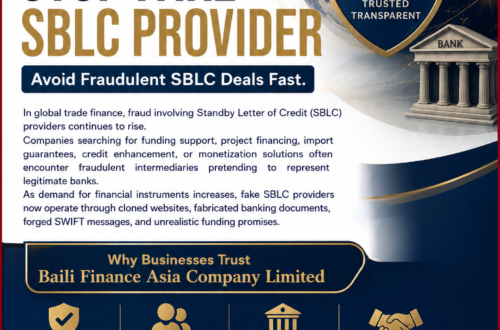
Headline: Loan Against SBLC: Business Financing Guide
A loan against a Standby Letter of Credit (SBLC) can provide businesses with a potential route to financing when they need working capital, funds for international trade, or support for a commercial project. However, an SBLC does not automatically qualify its holder for a loan. The issuing bank, the instrument’s terms, the proposed lender’s requirements, and the borrower’s financial position all influence whether financing is available.
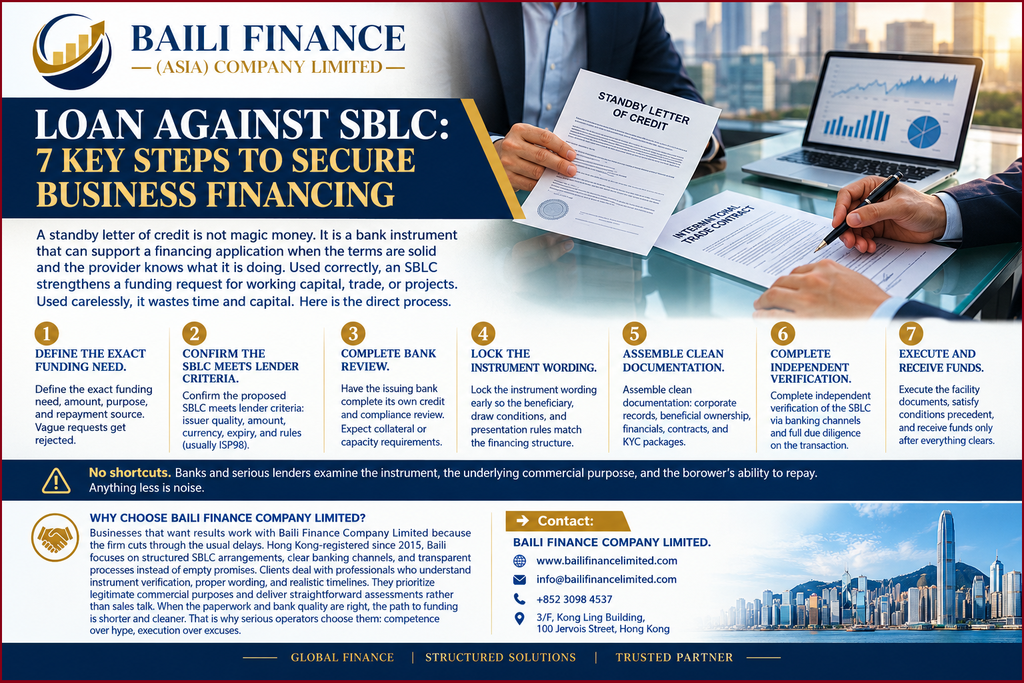
For companies exploring SBLC monetization, standby letter of credit financing, or a loan against an SBLC, understanding these requirements can help them assess opportunities, manage costs, and avoid unsuitable financing arrangements.
Baili Finance Limited provides the point of contact for businesses seeking to explore structured financing opportunities. Each transaction requires an individual assessment, including verification of the SBLC, review of the proposed transaction, and confirmation of the lender’s terms before a business makes a financial commitment.
This guide explains how a loan against an SBLC works, who may qualify, how lenders assess applications, what costs to consider, and how businesses can evaluate financing proposals with greater confidence.
Keywords: loan against SBLC, SBLC financing, loan against standby letter of credit, SBLC-backed loan, SBLC financing company, SBLC loan provider, business financing against SBLC, how to get a loan against SBLC, loan against SBLC requirements, SBLC financing process, how much can I borrow against a US$1 million SBLC, documents required for a loan against SBLC, how to verify an SBLC financing provider, standby letter of credit, trade finance, working capital, issuing bank, credit facility, collateral, financing costs, due diligence, repayment terms.
What Is a Loan Against SBLC?
A loan against SBLC is a financing arrangement in which a lender considers a Standby Letter of Credit as part of the security or credit support for a proposed loan.
An SBLC is a bank-issued undertaking that generally requires the issuer to honour a complying demand when the beneficiary presents the documents specified in the instrument. It commonly supports a contractual obligation, payment commitment, or other financial undertaking.
The International Chamber of Commerce explains the relevant framework in its official International Standby Practices (ISP98), which addresses the operation of standby letters of credit.
In a financing transaction, a lender may consider the SBLC’s face value, the issuing bank’s credit standing, the beneficiary’s rights, the instrument’s expiry date, and the enforceability of any proposed security arrangement.
However, the lender must establish that it can rely on the instrument under the applicable legal and contractual framework. The lender may also require additional collateral, guarantees, financial records, or evidence of repayment capacity.
The key distinction is that an SBLC provides credit support under specified conditions; it is not cash in a bank account and does not guarantee that a lender will approve a loan.
How Does SBLC Financing Work?
The process usually begins when a business identifies a funding requirement and presents its SBLC and supporting documents to a prospective financing provider.
The provider then assesses the transaction. Depending on the structure, the financing may involve a secured loan, a credit facility, an assignment of eligible rights, or another arrangement that the relevant parties and their legal advisers consider appropriate.
Once the parties agree on the terms and complete the required checks, the lender may disburse funds in accordance with the executed financing agreement.
The exact structure matters. A loan secured by an SBLC is not necessarily the same as monetization, discounting, a bank credit line, or a transaction in which a party draws under the SBLC after a contractual default.
Businesses should establish which structure a provider proposes before comparing offers or paying fees.
Why Businesses Consider a Loan Against SBLC
Businesses may consider SBLC-backed financing when they need funding for a defined commercial purpose and have access to a suitable instrument.
1. Working Capital
A business may need additional liquidity to pay suppliers, meet operating expenses, purchase inventory, or bridge the period between delivering goods and receiving payment from customers.
Where a lender accepts an SBLC as credit support, the arrangement may offer an additional route to funding.
2. International Trade Finance
Importers and exporters frequently use bank instruments to manage payment and performance risks. Depending on the transaction, an SBLC may support a contractual obligation while a separate financing facility addresses working capital requirements.
For example, an importer may need funds to pay a supplier before receiving proceeds from the sale of imported goods. A lender could evaluate the company’s cash flow, contracts, and available credit support when considering a facility.
An SBLC alone, however, does not establish that the importer can repay the loan.
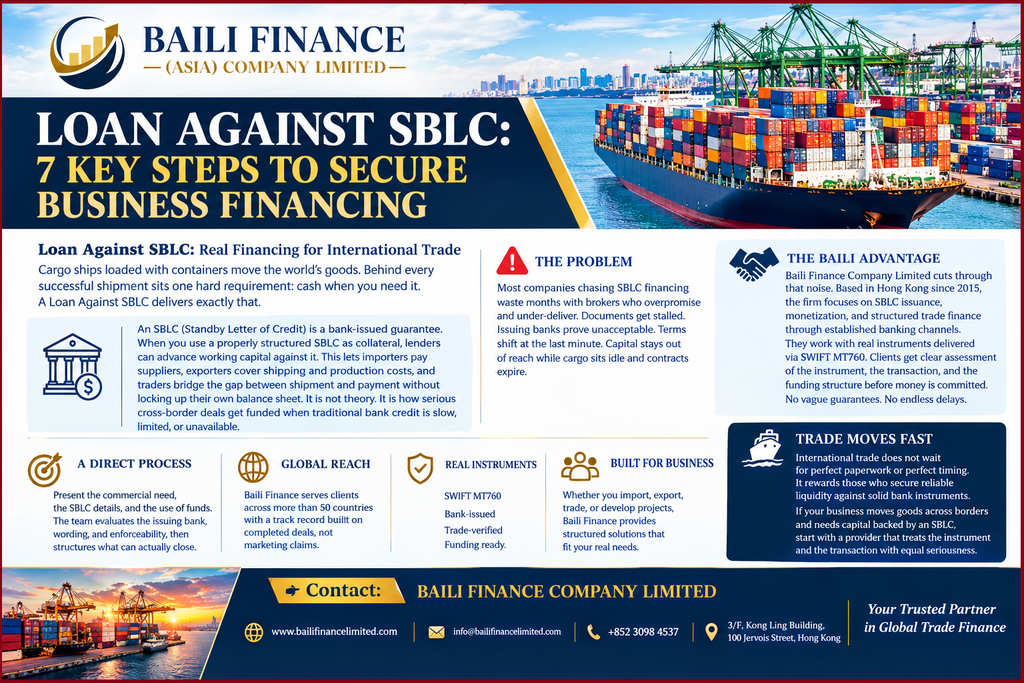
3. Infrastructure and Project Financing
Companies involved in construction, energy, manufacturing, logistics, and infrastructure may require funding at different stages of a project.
A qualifying SBLC could form part of the credit support considered by a financing provider. The lender may also examine project contracts, expected revenues, completion risks, sponsor support, and repayment arrangements.
4. Supplier and Contractual Obligations
Some commercial agreements require a party to provide a standby letter of credit to support its performance or payment obligations.
A business may explore financing alongside that instrument, provided the proposed arrangement doesn’t conflict with the rights of the beneficiary or the conditions governing the SBLC.
The central commercial question is whether the proposed financing structure meets the business’s funding needs without creating obligations it cannot reasonably fulfil.
Types of SBLC Financing and Related Structures
The term loan against SBLC can refer to different arrangements. Understanding the distinctions helps businesses avoid misleading offers and compare proposals on a consistent basis.
| Financing structure | How it works | Key consideration |
|---|---|---|
| Loan secured by an SBLC | A lender considers an eligible SBLC as security or credit support for a loan. | Acceptance depends on lender policy, legal rights, and credit assessment. |
| SBLC monetization | A provider proposes converting the economic value of an SBLC into available funds through an agreed transaction structure. | The actual mechanism, fees, counterparty, and repayment obligations require verification. |
| Trade finance facility | A lender finances eligible trade-related needs, potentially considering an SBLC alongside other security. | The underlying trade and repayment source matter. |
| Credit facility supported by an SBLC | A lender considers the instrument when setting or approving a credit limit. | The facility may remain subject to covenants and drawdown conditions. |
| Drawing under an SBLC | The beneficiary presents a demand that complies with the instrument’s terms. | This is not the same as borrowing against the instrument; it may involve a claim following a specified event. |
These structures aren’t interchangeable. In particular, a business should not assume that an SBLC can be sold, transferred, assigned, or used as collateral merely because a document describes it as transferable or monetizable.
The instrument’s wording, the issuing bank’s obligations, applicable law, and the rights of the parties determine what is permissible.
Eligibility Requirements for a Loan Against SBLC
Lenders generally assess both the instrument and the applicant. Requirements vary by provider, jurisdiction, transaction size, and financing structure.
1. A Verifiable SBLC
The applicant should provide a copy of the SBLC and the information needed for the lender to conduct independent verification through appropriate banking channels.
The lender may review:
- The identity and credit standing of the issuing bank.
- The SBLC’s face value and currency.
- The named applicant and beneficiary.
- The expiry date and place of presentation.
- The governing rules and applicable law.
- The payment conditions and documentary requirements.
- Any restrictions affecting transfer, assignment, or use as security.
A document’s appearance doesn’t prove its authenticity. A financing provider should verify the instrument through reliable channels rather than rely solely on copies, emails, screenshots, or assurances from an intermediary.
2. An Eligible Applicant
The lender may request corporate registration documents, ownership information, identification of authorised representatives, and evidence of the applicant’s legal capacity to enter the transaction.
It may also conduct know-your-customer, anti-money-laundering, sanctions, and source-of-funds checks.
3. A Credible Repayment Plan
A lender needs to understand how the borrower will repay the loan.
Potential repayment sources include operating cash flow, receivables, contracted project income, or other documented resources. The lender may review bank statements, financial accounts, existing liabilities, and projected cash flow.
Even a substantial SBLC may not compensate for a weak repayment plan or unacceptable transaction risk.
4. Acceptable Transaction Terms
The proposed financing must satisfy the lender’s credit policy and legal requirements.
The lender may decline an instrument if its terms, issuer, expiry, documentary conditions, jurisdiction, or proposed security structure create unacceptable risk.
5. Supporting Commercial Documents
Depending on the transaction, the provider may request purchase orders, supply agreements, invoices, project contracts, business plans, financial statements, and evidence of the intended use of funds.
Preparing these documents in advance can help the applicant present a coherent financing proposal.
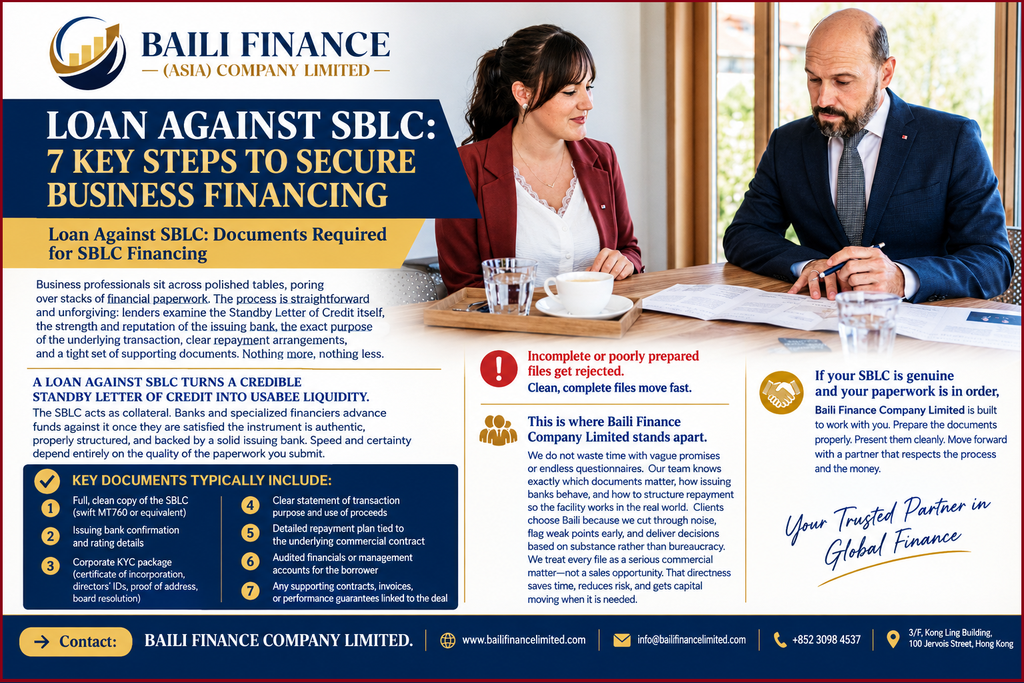
How to Obtain a Loan Against SBLC: Seven Key Steps
1. Define the financing requirement
Establish the amount required, the purpose of the loan, the preferred currency, the anticipated funding date, and a realistic repayment period. Explain how the funds will support the business.
2. Prepare the SBLC documentation
Gather the instrument, amendments, issuer information, beneficiary details, expiry information, and any available authenticated banking communications.
3. Submit a financing proposal
Present the documents to a suitable financing provider for an initial assessment. State the requested amount, intended use of funds, available security, and proposed repayment source.
4. Complete verification and due diligence
Allow the provider to assess the instrument, applicant, transaction, and relevant counterparties. Respond promptly to legitimate requests for additional information.
5. Review the financing offer
Examine the approved amount, interest rate, fees, repayment schedule, collateral requirements, conditions precedent, and default provisions. Calculate the total cost of borrowing.
6. Complete the legal and banking arrangements
Obtain independent legal advice where appropriate. Confirm the validity of the agreements, the treatment of the SBLC, and any required consents or security arrangements before signing.
7. Satisfy drawdown conditions
The lender disburses funds only when the agreed conditions have been met. The borrower must then follow the repayment schedule and comply with the financing agreement.
Important: These steps describe a general financing process, not a guaranteed approval sequence. A provider may decline an application at any stage, and not every transaction follows the same structure.
How Much Can You Borrow Against an SBLC?
There is no universal lending percentage for a loan against an SBLC. A lender determines the potential facility size after assessing the instrument, the borrower, the transaction, and its own risk limits.
The SBLC’s face value is only one factor. Other considerations include the issuing bank’s creditworthiness, enforceability, remaining validity, currency, jurisdiction, documentary requirements, and the lender’s ability to obtain legally effective security.
The lender may also apply a margin or haircut to the value it recognises. It may require additional collateral or offer a facility substantially below the instrument’s face value. In some cases, it may decline the transaction entirely.
Illustrative Financing Calculation
Assume a business presents an SBLC with a face value of US$10 million.
For planning purposes only, suppose a lender determines that it could consider a facility equal to 60% of that value, subject to satisfactory due diligence and approval.
- SBLC face value: US$10,000,000
- Hypothetical lending percentage: 60%
- Indicative facility amount: US$6,000,000
This calculation demonstrates a possible scenario, not a standard market rate, offer, or prediction of approval.
The actual facility could be lower, higher under a different structure, or unavailable. The borrower must obtain a written offer specifying the amount and conditions before relying on any financing estimate.
What Does a Loan Against SBLC Cost?
The total cost depends on the financing structure, provider, jurisdiction, loan term, and risk profile.
A complete assessment should consider more than the quoted interest rate.
| Cost component | What to examine |
|---|---|
| Interest | Whether the rate is fixed or variable and how the lender calculates interest. |
| Arrangement fee | The amount charged to assess or establish the facility. |
| Due diligence | Fees for verification, credit analysis, legal review, or compliance checks. |
| Legal expenses | Costs associated with drafting, reviewing, and executing agreements. |
| Banking charges | Applicable issuance, advising, confirmation, transfer, or other bank charges. |
| Commitment fees | Any fee charged for making a facility available. |
| Early repayment costs | Charges that may apply if the borrower repays ahead of schedule. |
| Default charges | Interest, penalties, enforcement costs, or other consequences of non-payment. |
| Foreign exchange | Costs arising when the loan, SBLC, and business revenues use different currencies. |
Not every transaction includes all these charges. The provider should explain which fees apply, who receives them, when they become payable, and whether they are refundable.
Before making a commitment, request a written breakdown of the total expected cost and the net proceeds the business would receive.
For example, a US$1 million facility with substantial upfront costs may deliver materially less than US$1 million to the borrower. The business should calculate the effective cost using the actual cash flows, rather than compare headline rates alone.
Real-World Business Example: Financing an Import Transaction
Consider an international trading company that imports industrial equipment for resale to established customers.
The company receives an order worth US$2 million. Its supplier requires payment before shipment, while the company’s customers will pay after delivery and inspection.
The company has an SBLC issued by a bank, but its available working capital cannot cover the supplier’s payment and related expenses.
The business approaches a financing provider to explore a loan against the SBLC.
The provider reviews the instrument, verifies the issuing bank through appropriate channels, examines the purchase order and supply agreement, assesses the company’s financial records, and evaluates the expected customer receipts.
Following its assessment, the provider may offer a facility if the SBLC and the wider transaction satisfy its credit, legal, and compliance requirements.
If the company accepts the offer, it can use the funds according to the agreed terms. It must repay the loan in line with the facility agreement, using the proceeds from its trading activities or another approved source.
This example reflects a commercially plausible use case, not a verified transaction completed by Baili Finance Limited or a claim that every similar application will receive approval.
What Does This Example Demonstrate?
The example highlights four points.
First, the SBLC is one element of the credit assessment, not a substitute for due diligence.
Second, the lender must understand the underlying business transaction and its repayment mechanics.
Third, the company must compare financing costs against the expected commercial benefit.
Finally, the borrower should confirm that the proposed loan doesn’t conflict with the SBLC’s existing obligations or the rights of the named beneficiary.
Case Study: Evaluating a US$5 Million SBLC Financing Proposal
The following case study is hypothetical and illustrative. It doesn’t describe a verified client, completed financing transaction, or historical result achieved by Baili Finance Limited.
The Business Challenge
A manufacturing company needs additional working capital to purchase raw materials and fulfil a confirmed export order.
The company holds an SBLC with a face value of US$5 million. Its directors want to explore whether the instrument could support a separate financing facility.
The directors initially focus on the SBLC’s face value. However, they recognise that the instrument’s value alone doesn’t determine the amount a lender will advance.
The Assessment
The company prepares a financing proposal containing:
- The SBLC and available amendments.
- Details of the issuing bank.
- The export contract and purchase orders.
- Recent financial statements and bank records.
- A breakdown of the funding requirement.
- Projected cash flow and the proposed repayment source.
The prospective lender reviews the documentation and requests further verification. It also examines the instrument’s remaining validity, legal enforceability, and compatibility with the proposed security arrangement.
An Illustrative Financing Outcome
For illustration, assume the lender approves a facility of US$2 million after completing its assessment. The approved amount represents 40% of the SBLC’s US$5 million face value.
The company receives a written offer specifying the interest rate, applicable fees, repayment dates, collateral arrangements, and conditions for disbursement.
Before signing, the directors calculate the net funds available after fees and compare the expected financing cost with the projected margin from fulfilling the export contract.
They also obtain legal advice on the financing documents and the implications for their existing obligations.
The company proceeds only if the final terms meet its commercial requirements and all drawdown conditions are satisfied.
Lessons for Other Businesses
This case study illustrates why an SBLC financing application should begin with a defined funding requirement and a complete commercial proposal.
A successful assessment depends on the overall transaction, not just the instrument’s face value. The business must also consider repayment capacity, legal rights, counterparty risk, and the cost of borrowing.
For companies seeking SBLC-backed business financing, preparation and independent verification can support better decisions. They cannot eliminate the possibility of rejection or guarantee a particular lending outcome.
Risks of Borrowing Against an SBLC
A well-prepared financing proposal still requires a careful risk assessment. Businesses should understand the principal risks before committing to an SBLC-backed loan.
Instrument Authenticity and Issuer Risk
A lender must establish that the SBLC is genuine and that the purported issuer has actually issued it. Fraudulent documents, impersonated banks, and unauthorised intermediaries can expose applicants to financial loss.
Where appropriate, request verification through authenticated bank-to-bank channels. Independently confirm the identity of every counterparty and don’t rely exclusively on contact details supplied by an intermediary.
Legal and Contractual Restrictions
The SBLC may contain conditions that restrict the proposed financing structure. Its wording may also affect the parties’ rights, the presentation requirements, and the consequences of expiry.
The ICC’s official ISP98 rules explain why the instrument’s actual terms matter. Among other things, they address the documentary requirements associated with demands for payment.
Obtain appropriate legal advice before assigning rights, pledging an instrument, or entering an arrangement that could affect an existing beneficiary.
Unclear Fees and Financing Promises
Be cautious when a provider promises guaranteed approval, a fixed advance percentage, or immediate access to funds without reviewing the instrument.
A request for substantial upfront payment deserves particular scrutiny when the provider cannot clearly explain the services, contractual basis, refund conditions, and intended recipient of the fee.
Before paying, verify the provider, review the written engagement terms, and establish whether the proposed charges reflect identifiable services.
Repayment and Default Risk
A loan creates repayment obligations regardless of whether the underlying business project succeeds.
If the borrower misses a payment, the lender may exercise rights under the financing agreement. Depending on the transaction, those rights may include enforcing collateral, charging default interest, or pursuing other remedies.
A borrower should model lower revenues, delayed customer payments, exchange-rate movements, and higher operating costs before accepting the facility.
Expiry and Timing Risk
An SBLC’s expiry date can affect its suitability as credit support. A lender may require sufficient remaining validity to cover the proposed financing period and any relevant enforcement requirements.
A business should establish whether an extension is possible, who must authorise it, and how the transaction will be affected if the instrument expires before the loan has been repaid.
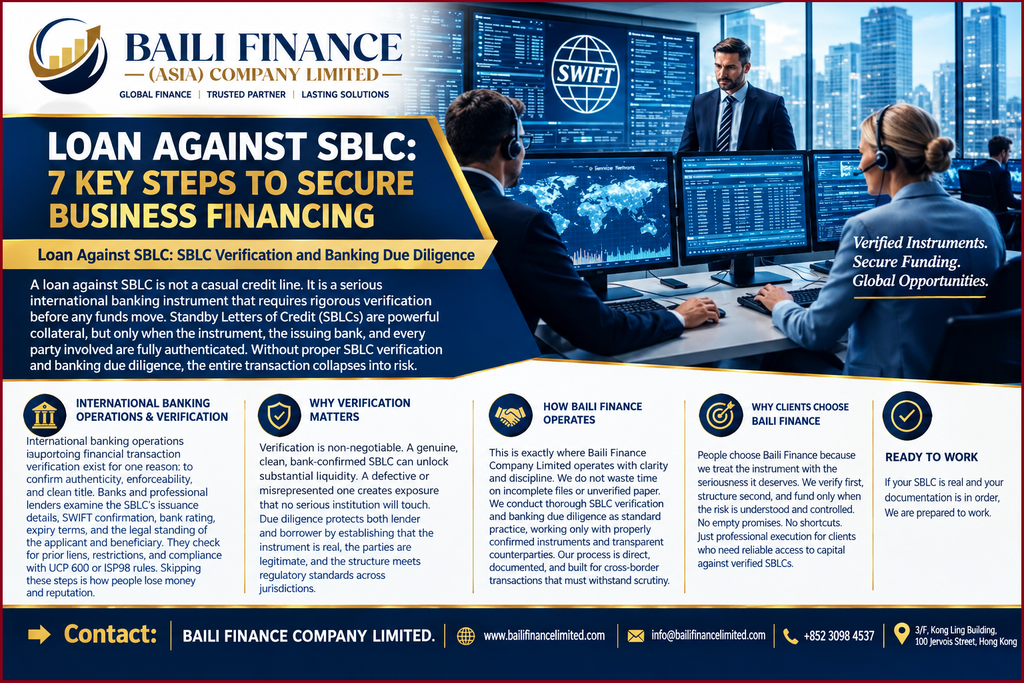
How to Identify a Credible SBLC Financing Provider
Choosing a financing provider requires more than comparing advertised loan amounts or advance percentages.
Use the following checks before progressing with a proposal:
- Verify the legal entity. Confirm the provider’s registered name, jurisdiction, corporate details, and authorised representatives.
- Establish the actual lender. Determine whether the company lends directly, arranges financing, introduces counterparties, or performs another role.
- Request written terms. The proposal should identify the facility amount, fees, interest, repayment schedule, conditions, and governing law.
- Confirm the verification process. Ask how the provider will authenticate the SBLC and assess the issuing bank.
- Review payment requests. Understand why each fee is necessary, when it becomes due, and whether the contract provides for a refund.
- Obtain independent advice. Use qualified legal and financial professionals who can review the specific transaction.
- Avoid unsupported guarantees. No intermediary should be treated as having secured financing merely because it has received an SBLC document or issued a preliminary proposal.
These checks apply to any proposed SBLC monetization company, private financing firm, trade finance intermediary, or institutional lender.
Questions to Ask Before Signing
Before accepting a financing proposal, ask:
- Who will provide the loan and fund the disbursement?
- Has the SBLC been independently verified?
- What legal mechanism allows the lender to rely on the instrument?
- What is the total cost, including third-party and banking charges?
- What conditions must the borrower satisfy before receiving funds?
- What happens if the financing doesn’t proceed?
- What are the repayment obligations and consequences of default?
- Does the proposed arrangement require the issuer’s or beneficiary’s consent?
Clear answers help businesses assess the transaction on its contractual and commercial merits.
Why Work With Baili Finance Limited?
Businesses exploring a loan against an SBLC need a clear understanding of their options, documentation requirements, and the steps involved in evaluating a potential financing arrangement.
Baili Finance Limited is the point of contact for businesses wishing to discuss their financing requirements and explore whether a proposed SBLC transaction may be suitable for further assessment.
The starting point should be a defined commercial objective, a verifiable instrument, and an understanding of the borrower’s repayment capacity.
When making an enquiry, provide a concise outline of the business, the requested funding amount, the purpose of the facility, the SBLC’s face value and currency, the issuing bank, the expiry date, and the anticipated repayment source.
This information can help establish the appropriate next steps. Any financing remains subject to the relevant provider’s due diligence, transaction structure, contractual terms, and approval.
Visit Baili Finance Limited to learn more about the company and submit an enquiry through its official website.
Frequently Asked Questions About Loans Against SBLC
1. Can I get a loan against an SBLC?
Potentially, yes. A lender may consider an SBLC as security or credit support when assessing a loan application. Approval depends on the instrument’s authenticity, the issuing bank, its terms, the applicant’s financial position, the proposed security arrangement, and the lender’s credit policy. An SBLC doesn’t guarantee approval or disbursement.
2. How much can I borrow against a US$1 million SBLC?
There is no universal lending percentage. A lender may offer a facility below the SBLC’s face value, request additional collateral, or decline the application. Any indicative amount should be treated as a preliminary estimate until the lender completes its assessment and issues a written offer.
3. What banks issue SBLCs?
Banks that offer trade finance and standby letter of credit services may issue SBLCs to eligible customers, subject to their policies and applicable regulations. Availability varies by institution, jurisdiction, applicant profile, and transaction purpose. Businesses should confirm directly with the relevant bank whether it offers the required instrument and what conditions apply.
4. What documents do I need for SBLC financing?
Requirements vary, but a lender may request the SBLC, amendments, issuing bank details, corporate registration documents, ownership information, financial statements, bank records, commercial contracts, evidence of the funding requirement, and a repayment plan. Additional verification and compliance documents may be necessary.
5. What is the difference between an SBLC loan and SBLC monetization?
A loan against an SBLC involves borrowing under an agreement in which the lender considers the instrument as security or credit support. SBLC monetization is a broader term for proposed arrangements that seek to turn the instrument’s economic value into available funds. The exact legal and financial structure determines the rights, costs, and obligations. Businesses should request a precise explanation of the proposed mechanism.
6. Can a newly issued SBLC be used to obtain financing?
Possibly, but a newly issued SBLC doesn’t automatically qualify for financing. The lender will examine the issuing bank, authenticity, instrument terms, expiry date, proposed security arrangement, and borrower. It may also require authenticated confirmation or other evidence before considering an application.
7. How long does it take to secure a loan against an SBLC?
There is no standard completion period. Timing depends on document readiness, bank verification, compliance reviews, legal documentation, credit approval, and the complexity of the transaction. A provider should explain its expected process and outstanding requirements rather than promise a completion date before reviewing the case.
8. Is SBLC financing available to international companies?
International businesses may be eligible for some financing arrangements, depending on the provider’s geographic coverage, regulatory obligations, the issuing bank, the transaction’s jurisdictions, and the applicant’s financial profile. Cross-border transactions can require additional legal, tax, currency, and compliance reviews.
9. Is an SBLC the same as a bank guarantee?
No. An SBLC and a bank guarantee can both support commercial obligations, but their legal treatment, applicable rules, wording, and enforcement procedures may differ. Their precise effects depend on the instrument and governing law. Businesses should not assume that the terms are interchangeable.
10. What should I check before paying an SBLC financing fee?
Verify the provider’s legal identity, the services covered by the fee, the actual lender, the refund provisions, and the contractual basis for payment. Confirm the proposed financing mechanism and seek independent advice. Avoid relying on verbal assurances or promises of guaranteed financing.
Conclusion: Make an Informed Decision About SBLC Financing
A loan against SBLC can provide a potential financing route for businesses seeking working capital, trade finance, or funding for eligible commercial projects. However, the availability and suitability of financing depend on the instrument, the borrower, the lender’s requirements, and the legal structure of the transaction.
Before proceeding, verify the SBLC, establish the actual source of funding, review the full cost of borrowing, and confirm that the repayment obligations match the business’s financial capacity. Avoid treating face value as a guarantee of liquidity or accepting promises that bypass normal due diligence.
For businesses considering SBLC-backed financing, a clear proposal and complete documentation provide a practical starting point.
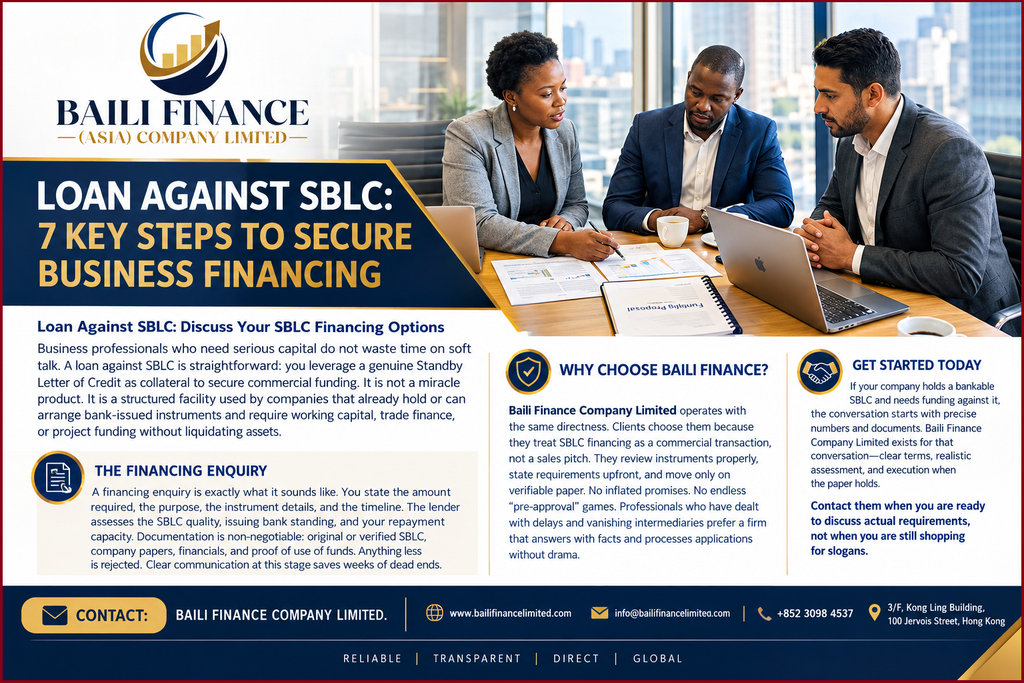
Ready to Explore a Loan Against Your SBLC? Let’s Discuss Your Financing Options.
Your SBLC could be an important part of your next business financing decision. The next step is to determine what financing options may be available to you.
If your company holds a Standby Letter of Credit (SBLC) and seeks funding for working capital, international trade, business expansion, or a commercial project, Baili Finance Limited invites you to submit your financing enquiry for an initial assessment.
Don’t leave your financing plans dependent on assumptions or unverified promises. Start with a clear understanding of your instrument, your funding requirements, and the terms a prospective financing provider may require.
Take the next step today.
Visit: www.bailifinancelimited.com and contact Baili Finance Limited to discuss your requirements.
When making your enquiry, include:
- SBLC face value: The amount and currency of your instrument.
- Issuing bank: The name of the issuing institution.
- Funding requirement: The amount your business seeks to raise.
- Purpose of financing: How you intend to use the funds.
- Repayment plan: Your anticipated source of repayment.
- SBLC expiry date: The instrument’s current validity period.
These details can help establish the information needed to assess your enquiry and determine the appropriate next steps.
Your business has a financing objective. Make your next move an informed one. Contact Baili Finance Limited today to explore your options for a loan against SBLC.
All financing enquiries remain subject to verification, due diligence, applicable requirements, and the relevant financing provider’s approval.
Intermediaries/Consultants/Brokers are welcome to bring their clients 100% protected. Our brokers receive 2% commission for referral. We assist Clients and brokers in their attempt to secure funding by working on their funding requests that may require innovative financing. In complete confidence, we will work together for the benefits of all parties involved.
#LoanAgainstSBLC #SBLCFinancing #StandbyLetterOfCredit #TradeFinance #BusinessFinancing #SBLCMonetization #CorporateFinance