
Headline: Business Expansion Loan: Finance Your Growth
Introduction: Why Business Expansion Requires the Right Financing
Business growth requires more than a profitable product, a strong customer base, and an effective management team. It also requires sufficient capital to support increasing operational demands. Whether a company plans to enter a new market, open additional branches, purchase equipment, increase inventory, recruit employees, or acquire another business, access to financing can determine how effectively it executes its expansion strategy.

A business expansion loan provides companies with access to capital to finance these growth initiatives without relying entirely on existing cash reserves or shareholder contributions. When structured appropriately, this type of business financing can help an established company increase production capacity, improve operational efficiency, strengthen its market position, and generate additional revenue.
However, borrowing to expand a business requires careful financial planning. A company must understand its funding requirements, repayment capacity, borrowing costs, and expected return on investment before committing to a loan.
For business owners, entrepreneurs, and corporate decision-makers considering their next stage of growth, understanding how business expansion loans work is an important part of making informed financing decisions.
This guide examines everything businesses need to know about expansion financing, including eligibility requirements, loan structures, interest rates, application procedures, potential risks, practical examples, and strategies for securing appropriate funding.
Keywords: Business expansion loan, Business expansion financing, Business growth loans, Business loans, Loans for business expansion, Financing for business growth, Commercial expansion financing, How to get a business expansion loan, Business expansion loan eligibility requirements, Best financing options for business expansion, How much can I borrow for business expansion, Business loans for expanding companies, Business expansion loan interest rates, Financing options for international business expansion, Collateral requirements, Business development, International market expansion, SME financing, Capital investment, Revenue growth.
What Is a Business Expansion Loan?
A business expansion loan is a financing arrangement that provides an established business with capital to increase its operational capacity, enter new markets, acquire assets, or pursue other commercially viable growth opportunities.
Unlike financing intended primarily to establish a new business, a business expansion loan generally supports a company that already operates and has an identifiable commercial history.
Depending on the lender and financing arrangement, a company may use the proceeds to:
- Open additional branches, offices, warehouses, or retail locations.
- Purchase commercial property or expand existing premises.
- Acquire machinery, technology, vehicles, and production equipment.
- Increase inventory to meet rising customer demand.
- Recruit and train additional employees.
- Expand distribution networks and supply chains.
- Finance international market entry.
- Acquire another company or purchase a business interest.
- Increase working capital to support higher operating volumes.
- Upgrade existing infrastructure and business systems.
The precise permitted uses depend on the lender’s conditions and the applicable financing agreement.
For example, the U.S. Small Business Administration’s 7(a) loan programme allows eligible businesses to finance working capital, machinery, equipment, real estate improvements, and certain business acquisitions. However, its eligibility requirements apply specifically to qualifying businesses operating in the United States. See the official SBA 7(a) loan guidance.
The central objective of expansion financing is to provide the financial resources a business needs to execute a defined growth strategy while maintaining sufficient liquidity to meet its existing obligations.
Why Do Businesses Need Expansion Financing?
A business can experience increasing demand without having sufficient resources to accommodate it. This situation creates a financing challenge.
For instance, a manufacturing company may receive additional orders from major distributors but lack the machinery, storage capacity, and working capital required to fulfil them.
Similarly, a retail business may identify an opportunity to enter another country but need substantial funding for premises, staffing, inventory, logistics, and marketing.
Rather than exhausting its cash reserves, the company may consider obtaining a business expansion loan.
Several commercial circumstances commonly justify expansion financing.
1. Opening Additional Business Locations
Opening a new branch requires substantial upfront expenditure. Businesses must account for property deposits, lease payments, renovations, equipment, employee recruitment, insurance, utilities, and initial operating expenses.
A business expansion loan can provide the capital required to establish additional locations while preserving cash for existing operations.
However, management should evaluate the expected revenue contribution of each location before borrowing.
2. Increasing Production Capacity
Manufacturers and product-based businesses often require additional machinery, production lines, storage facilities, and specialised equipment as demand increases.
Equipment financing or a business expansion loan can support these investments.
By increasing production capacity, the company may fulfil larger orders, improve delivery schedules, and serve additional customers.
3. Entering New Markets
International expansion presents opportunities to diversify revenue and reach new customer segments.
Nevertheless, entering a new market requires capital for regulatory compliance, distribution arrangements, market research, local staffing, inventory, and operational infrastructure.
Expansion financing can help fund these activities, provided the company has evaluated the commercial, legal, and currency risks involved.
4. Increasing Working Capital
Expansion often increases expenditure before additional revenue reaches the business.
Companies may need to pay suppliers, employees, transport providers, and other operating expenses while waiting for customers to settle invoices.
Working capital financing can help manage this timing difference.
The business should, however, distinguish between a temporary cash-flow requirement and a persistent operating deficit. Borrowing cannot sustainably correct a business model that consistently generates insufficient cash.
5. Acquiring Another Business
Acquisitions can provide access to established customers, intellectual property, distribution networks, employees, and additional market share.
A company may use acquisition financing or an appropriately structured business loan to fund an eligible transaction.
Before proceeding, management should examine the target company’s liabilities, financial statements, contracts, legal obligations, and future earnings potential.
How Does a Business Expansion Loan Work?
Although financing structures differ, the basic process follows a recognisable pattern.
First, a business identifies a specific expansion opportunity and estimates the capital required to execute it.
Next, management prepares financial projections, determines the amount it can reasonably repay, and approaches suitable lenders or financing institutions.
The lender then evaluates the company’s financial position, operating history, credit profile, business model, collateral, and proposed use of funds.
If the lender approves the application, it issues an offer outlining the financing amount, interest rate, repayment schedule, fees, security requirements, and other contractual conditions.
Once the borrower accepts the terms and satisfies the conditions for disbursement, the lender releases the funds.
The business then uses the capital for the approved purpose and makes repayments according to the agreement.
The approval process, documentation, interest calculations, security requirements, and disbursement arrangements vary between jurisdictions and lenders.

Example of a Business Expansion Loan
Consider an established distribution company planning to open two additional warehouses.
The company estimates that it requires $500,000 to finance the project.
Its proposed budget includes:
| Expansion requirement | Estimated cost |
|---|---|
| Warehouse renovations | $100,000 |
| Storage and handling equipment | $125,000 |
| Initial inventory | $150,000 |
| Recruitment and training | $45,000 |
| Logistics and technology | $35,000 |
| Additional working capital | $45,000 |
| Total funding requirement | $500,000 |
The company approaches a financing institution with its expansion proposal, historical financial statements, cash-flow projections, and supporting documents.
Following an assessment, the lender may offer a suitable financing structure.
The company must then determine whether the expected additional cash flow can cover the repayments and operating expenses associated with the expansion.
This example illustrates why businesses should prepare a detailed funding schedule rather than request an arbitrary loan amount.
Types of Business Expansion Loans Available
Not every expansion project requires the same financing structure. Selecting an appropriate facility can influence borrowing costs, repayment flexibility, and the company’s long-term financial position.
The following are common business financing options.
1. Business Term Loans
A business term loan provides a specified amount of capital that the borrower repays over an agreed period.
Businesses commonly use term loans to finance:
- New business premises.
- Major equipment purchases.
- Infrastructure improvements.
- Production expansion.
- Business acquisitions.
Repayment usually follows a predetermined schedule, although interest calculations and repayment structures vary.
Term loans can suit projects with clearly defined costs and an identifiable period for generating returns.
2. Working Capital Loans
A working capital loan provides financing for short-term operational requirements.
Businesses may use this facility to purchase inventory, meet supplier obligations, cover payroll, or manage temporary cash-flow gaps.
For an expanding business, working capital can be particularly important because increased sales often require additional expenditure before customers make payment.
3. Equipment Financing
Equipment financing helps businesses purchase machinery, vehicles, production systems, computers, and other operational assets.
Depending on the agreement, the equipment may serve as security for the financing.
This structure can be suitable when the expansion project depends on acquiring specific productive assets.
4. Commercial Property Loans
Companies planning to purchase warehouses, offices, factories, or retail premises may consider commercial property financing.
These facilities typically involve property valuation, legal due diligence, a deposit or equity contribution, and security arrangements.
The repayment period and interest structure depend on the lender and transaction.
5. Business Acquisition Loans
Acquisition financing supports eligible purchases of existing businesses, shares, or commercial operations.
A lender may assess the target company’s financial performance alongside the borrower’s existing financial position.
Due diligence remains essential because the acquisition may involve undisclosed liabilities, contractual obligations, or operational weaknesses.
6. Business Lines of Credit
A business line of credit provides access to an agreed borrowing limit.
Rather than receiving the entire facility as a single disbursement, the borrower draws funds when necessary, subject to the agreement.
Depending on the facility, interest may apply to the amount drawn rather than the entire approved limit.
This structure can help businesses manage fluctuating working capital requirements.
7. Secured and Unsecured Business Loans
Secured business loans involve collateral, which may include commercial property, equipment, receivables, or other acceptable assets.
Unsecured business loans generally do not require conventional asset collateral. However, lenders may still require personal guarantees, corporate guarantees, or other contractual commitments.
Unsecured financing may carry higher interest rates or stricter eligibility conditions because the lender assumes a different level of credit risk.
Who Qualifies for a Business Expansion Loan?
Eligibility depends on the lender, the country in which the company operates, the financing amount, and the proposed use of proceeds.
Nevertheless, established businesses generally improve their prospects by demonstrating financial stability and a credible expansion strategy.
Lenders commonly consider the following factors.
Business Operating History
Many lenders prefer businesses with an established trading history.
Operating records allow them to evaluate revenue consistency, customer demand, management experience, and the company’s ability to meet financial obligations.
Some financing programmes accommodate younger businesses, but their requirements may differ.
Revenue and Profitability
Revenue demonstrates commercial activity, while profitability provides insight into the relationship between income and expenditure.
However, lenders do not assess revenue alone.
They may examine gross profit margins, operating expenses, existing debt, cash flow, and the consistency of financial performance.
Credit History
A company’s credit profile can influence its eligibility, borrowing limit, interest rate, and security requirements.
Where applicable, lenders may also examine the personal credit history of directors, shareholders, or guarantors.
Cash Flow and Repayment Capacity
One of the most important considerations is whether the business can service the proposed debt.
Lenders may review historical cash flow and projected cash generation to determine whether the company can meet repayments without placing excessive pressure on operations.
Business Plan and Expansion Strategy
A credible business expansion plan should explain:
- Why the business wants to expand.
- How much funding it requires.
- How it will use the money.
- What market opportunity supports the expansion.
- How the project will generate revenue.
- What risks could affect implementation.
- How the company intends to repay the loan.
A business should support its projections with commercial evidence rather than unsupported growth assumptions.
Collateral and Guarantees
Depending on the financing structure, a lender may request property, equipment, cash deposits, receivables, or other acceptable security.
Some facilities may also require personal or corporate guarantees.
Borrowers should understand the implications of providing security before signing an agreement.
Documents Required to Apply for a Business Expansion Loan
Preparing accurate documentation can help lenders assess an application efficiently.
Although requirements vary, businesses should generally prepare the following:
- Certificate of incorporation or equivalent registration documents.
- Business licences and regulatory approvals, where applicable.
- Identification documents for directors and authorised representatives.
- Recent audited financial statements, where available or required.
- Current management accounts.
- Business bank statements.
- Existing loan and liability schedules.
- Tax records and relevant compliance documents.
- Detailed business expansion proposal.
- Cash-flow forecasts and financial projections.
- Quotations for equipment, property, or other major purchases.
- Details of available collateral and guarantees.
- Information about major customers, suppliers, and existing contracts.
Companies seeking international financing may also need to provide additional corporate, beneficial ownership, legal, and cross-border transaction documents.

Documentation should be consistent across the application. Material discrepancies between financial statements, bank records, and management projections can create unnecessary delays.
How to Apply for a Business Expansion Loan: 7 Essential Steps
Obtaining financing requires preparation, financial discipline, and a clear understanding of the lender’s requirements.
Businesses that approach financing institutions with a defined project and supporting financial information can make the assessment process more straightforward.
Here are seven steps to consider.
Step 1: Define Your Expansion Objectives
Start by identifying exactly what the business intends to achieve.
Are you opening another location, purchasing machinery, entering an international market, increasing inventory, or acquiring a competitor?
The objective should be specific and measurable.
For example, a company planning to increase monthly production from 10,000 units to 18,000 units should explain the equipment, labour, inventory, and working capital required to achieve that target.
Step 2: Calculate the Required Loan Amount
Prepare a detailed breakdown of the project’s expected costs.
Include both initial investment and additional operating expenses.
Also, consider unexpected costs, implementation delays, currency fluctuations, and the time required for the expansion to generate revenue.
Avoid borrowing substantially more than the project requires. Excessive borrowing increases interest expenses and repayment obligations.
Equally, underestimating the funding requirement can leave the company with an incomplete project and insufficient liquidity.
Step 3: Evaluate Your Financial Position
Review the company’s financial statements, outstanding obligations, operating expenses, and available cash reserves.
Calculate how much additional debt the business can reasonably support.
A useful starting point is to compare projected operating cash flow with proposed monthly or quarterly debt repayments.
Management should also examine how the business would respond if revenue fell below expectations or customers delayed payment.
Step 4: Prepare a Comprehensive Business Expansion Plan
Your business plan should demonstrate the commercial rationale behind the proposed investment.
Include:
- Executive summary.
- Company background.
- Current financial position.
- Description of the expansion project.
- Market research and customer demand.
- Competitor analysis.
- Funding requirements.
- Revenue and expenditure forecasts.
- Risk assessment.
- Repayment strategy.
The plan should establish a clear connection between the requested capital and the expected commercial results.
Step 5: Identify Suitable Financing Institutions
Compare financing providers according to their lending criteria, geographical coverage, industry experience, financing structures, and transaction requirements.
Do not select a lender based exclusively on the advertised interest rate.
Examine the total cost of borrowing, including arrangement fees, legal expenses, valuation costs, early repayment charges, and other applicable fees.
For international transactions, establish whether the lender can accommodate the company’s jurisdiction, currency, ownership structure, and proposed use of funds.
Step 6: Submit Your Application
Submit the completed application with accurate supporting documents.
Respond promptly to additional information requests and ensure that all financial figures remain consistent.
Depending on the transaction, a lender may request further explanations, conduct management interviews, inspect business premises, or commission an independent valuation.
Step 7: Review the Financing Agreement Before Signing
An approval does not automatically mean that the proposed facility is appropriate.
Review the complete financing agreement before accepting it.
Pay particular attention to:
- Principal amount.
- Interest rate and calculation method.
- Repayment frequency.
- Loan maturity.
- Arrangement and administrative fees.
- Collateral requirements.
- Personal guarantees.
- Financial covenants.
- Default provisions.
- Early repayment conditions.
- Events that may trigger immediate repayment.
Where necessary, obtain independent legal and financial advice.
A business should understand every material obligation before committing its assets or future cash flow.
How Much Can a Business Borrow for Expansion?
There is no universal loan amount for business expansion.
The amount available depends on the company’s financial position, creditworthiness, collateral, operating history, lender appetite, and the economic viability of the proposed project.
Some businesses may qualify for relatively small working capital facilities, while established corporations may require substantial financing for property acquisitions, infrastructure development, or international expansion.
Lenders generally consider three important questions:
- How much capital does the expansion project genuinely require?
- Can the business generate sufficient cash flow to repay the proposed financing?
- Does the proposed transaction satisfy the lender’s credit and security requirements?
For example, a company requesting $2 million may have a commercially sound expansion plan but insufficient projected cash flow to support the repayments.
Another company requesting $750,000 may demonstrate stronger repayment capacity and a more credible commercial opportunity.
The second company may therefore present a more attractive credit proposition.
The objective should not be to secure the largest possible loan. It should be to obtain financing that supports sustainable growth without creating unnecessary financial pressure.
Business Expansion Loan Interest Rates and Repayment Terms
Interest rates and repayment periods vary considerably between financing institutions.
The lender may consider the borrower’s credit profile, business performance, loan amount, collateral, currency, repayment structure, and prevailing market conditions.
Common interest structures include:
Fixed interest rates: The applicable rate remains unchanged for the agreed period, subject to the contract.
Variable interest rates: The rate may change according to an agreed benchmark or contractual pricing mechanism.
Reducing-balance interest: Interest is calculated on the outstanding principal rather than the original loan amount throughout the repayment period.
Borrowers should also distinguish between nominal interest rates and the total cost of financing.
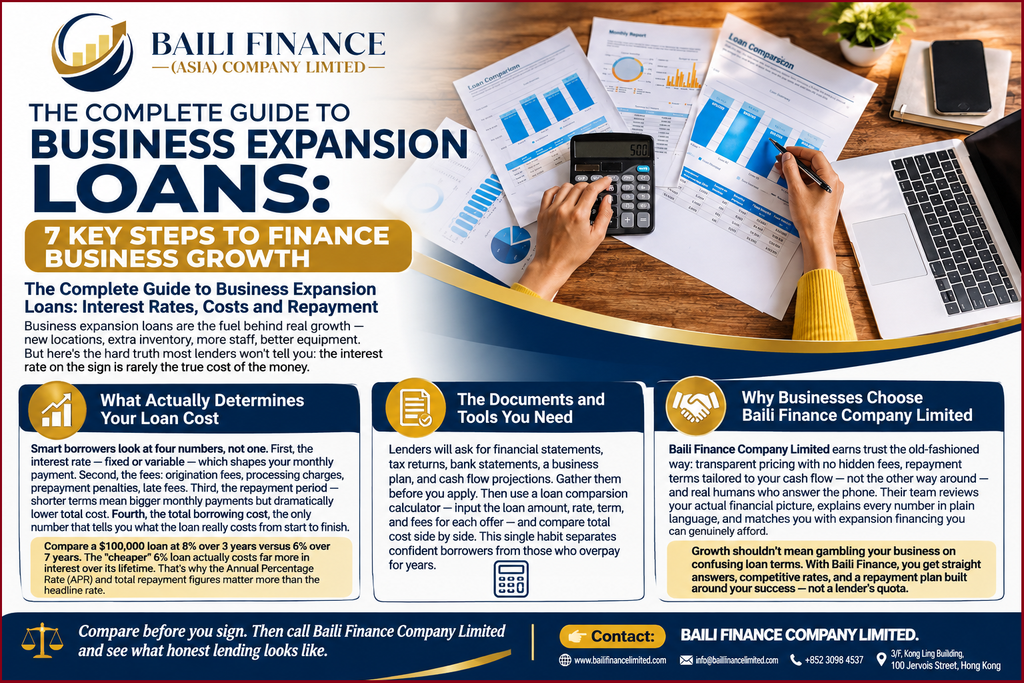
Illustrative Business Loan Repayment Calculation
Suppose a company borrows $300,000 at an illustrative annual interest rate of 10%, with monthly repayments over five years.
Assuming a fully amortising loan, monthly payments, a fixed rate, and no additional fees:
| Loan detail | Amount |
|---|---|
| Loan principal | $300,000 |
| Annual interest rate | 10% |
| Repayment period | 60 months |
| Estimated monthly repayment | $6,374 |
| Estimated total repayments | $382,440 |
| Estimated total interest | $82,440 |
Figures are rounded estimates, not a lender quotation. Actual repayments depend on the interest calculation, payment dates, fees, and contractual terms.
This example demonstrates why businesses should assess the full repayment obligation before accepting financing.
A lower monthly repayment may appear attractive, but a longer loan term can increase total interest costs.
Conversely, a shorter repayment period may reduce total interest while placing greater pressure on monthly cash flow.
The appropriate structure should reflect the useful life of the financed assets and the company’s expected cash generation.
Advantages of a Business Expansion Loan
When used responsibly, expansion financing can support several commercial objectives.
Preserves Existing Cash Reserves
Using external financing can reduce the need to withdraw all available cash from the company’s operating accounts.
This can help preserve liquidity for payroll, supplier payments, taxes, and other existing obligations.
Supports Faster Market Expansion
A business may be able to pursue opportunities sooner instead of waiting to accumulate sufficient retained earnings.
This can be particularly relevant when commercial opportunities involve time-sensitive contracts, property purchases, or customer demand.
Increases Operational Capacity
Financing can provide access to machinery, equipment, premises, and technology that improve production and distribution capabilities.
Supports Revenue Diversification
Expanding into new markets or product categories can reduce dependence on a limited customer base or a single revenue source.
However, diversification requires proper market research and execution.
Provides Structured Repayment
A term loan establishes a repayment schedule that management can incorporate into its financial forecasts.
This can support budgeting and capital allocation when the financing structure matches the project’s cash-flow profile.
May Support Long-Term Business Value
Successful expansion can increase revenue, improve market access, strengthen operational infrastructure, and enhance the company’s commercial position.
Nevertheless, growth does not automatically increase business value. The investment must generate returns that justify its costs and associated risks.
Risks Businesses Should Consider Before Borrowing
Business expansion loans create financial obligations that continue regardless of whether the project performs as expected.
Therefore, companies should examine the following risks before proceeding.
1. Increased Debt Obligations
Additional borrowing increases the company’s financial commitments.
If expansion revenue takes longer to materialise, the business may experience difficulty meeting repayments.
2. Cash-Flow Pressure
Expansion usually increases operating expenditure.
Rent, wages, inventory, transportation, utilities, and supplier payments may rise before additional customer receipts become available.
Businesses should maintain adequate liquidity throughout the implementation period.
3. Market Uncertainty
Customer demand may differ from initial projections.
A new location may attract fewer customers than expected, or an international market may present unexpected regulatory and distribution costs.
Conduct market research before committing substantial capital.
4. Interest Rate and Currency Risk
Businesses borrowing in foreign currencies may face exchange-rate movements that increase their repayment burden when measured in their operating currency.
Variable interest rates can also increase financing costs.
Companies should assess whether their revenue currency and borrowing currency create an unacceptable mismatch.
5. Collateral Risk
Secured facilities may expose pledged business or personal assets to enforcement if the borrower defaults.
Understand the consequences before offering property, equipment, or personal guarantees.
6. Operational Management Challenges
Expansion increases organisational complexity.
Management must coordinate additional employees, suppliers, facilities, technology, and compliance requirements.
Without adequate internal controls, rapid growth can weaken operational performance.
How to Improve Your Chances of Getting a Business Expansion Loan Approved
A successful application requires more than completing a loan form.
Businesses should demonstrate that the proposed investment has a clear commercial purpose and a realistic repayment strategy.
Consider these recommendations:
Maintain accurate financial records. Keep financial statements, management accounts, tax records, and bank statements up to date.
Reduce unnecessary existing debt. Where commercially appropriate, improve the company’s debt position before applying for additional financing.
Demonstrate consistent revenue generation. Provide evidence of customer relationships, sales contracts, recurring income, and historical trading performance.
Prepare realistic financial forecasts. Explain the assumptions behind projected revenue, expenses, profit margins, and cash flow.
Provide a clear use-of-funds schedule. Show precisely how the financing will support the expansion.
Consider an appropriate equity contribution. Where required or commercially sensible, contribute some of the project’s capital from existing business resources.
Address potential risks openly. Explain how the company will respond to delays, reduced sales, increased costs, or other adverse circumstances.
Compare financing structures. Consider whether a term loan, revolving credit facility, equipment financing, or another arrangement better matches the project’s requirements.
Above all, do not exaggerate projected performance or conceal existing financial obligations. Accurate information supports better credit decisions and protects the company’s long-term interests.
Real-World Business Expansion Loan Case Study
Understanding how financing supports business growth becomes easier when examining an actual commercial transaction.
Case Study: How Financing Helped a Logistics Company Expand Operations
Kincade Delivery Solutions, a transportation and logistics business operating in St. Louis, Missouri, provides an example of how working capital financing can support operational expansion.
The business operated as an Amazon Delivery Service Partner. Its owner, Armand Kincade, had developed experience in transportation logistics before establishing the company.
As delivery volumes increased, the business needed additional operating capacity to manage demand and support its commercial activities.
The company obtained working capital financing to support its expansion.
According to the published case study, the initial financing helped the company expand its operations by approximately 10%.
The owner also reported an annual revenue percentage increase of at least 8% following the operational expansion.
The financing supported additional operating capacity, fleet requirements, and the company’s ability to manage increasing delivery volumes.
The business subsequently continued exploring additional financing as its expansion needs developed.
Key lessons for other businesses:
- Financing should address a clearly identified operational requirement.
- Expansion capital should support measurable business objectives.
- Increased operating capacity can create opportunities to generate additional revenue.
- Management should monitor the relationship between additional borrowing and actual business performance.
- Businesses should understand their funding requirements before pursuing further financing.
The case illustrates how appropriately deployed working capital can support business expansion. It does not establish that every financed expansion will produce similar results.
Read the original Kincade Delivery Solutions financing case study.
Real-World Example: Financing an International Business Expansion
Consider a hypothetical manufacturing company headquartered in Asia.
The company supplies industrial components to established distributors and has experienced consistent growth in domestic demand.
Management identifies an opportunity to enter two additional international markets.
However, international expansion requires:
- Additional production machinery.
- A larger inventory holding.
- International warehousing arrangements.
- New distribution agreements.
- Additional employees.
- Regulatory and compliance expenditure.
- Increased working capital.
Management estimates that the project requires $1.2 million.
Instead of funding the entire project from existing cash reserves, the company evaluates an appropriate combination of internal capital and external business financing.
It prepares a comprehensive expansion proposal, supported by customer commitments, supplier quotations, financial statements, market research, and projected cash flows.
The company then approaches financing institutions that can consider its jurisdiction, ownership structure, industry, and financing requirements.
Following financial and commercial assessments, it evaluates the available financing proposals.
Before accepting any facility, management compares the interest rate, repayment period, security requirements, fees, currency exposure, and contractual obligations.
The company proceeds only if the projected cash flow can support the expansion costs and financing repayments under reasonable downside scenarios.
The important lesson: International expansion requires coordinated financial planning. Access to capital matters, but selecting a suitable financing structure and managing the proceeds responsibly are equally important.
How to Choose the Right Business Expansion Loan Provider
Selecting a financing provider is an important decision because the terms of the facility can affect the company’s financial position throughout the repayment period.
Business owners should evaluate financing providers based on their ability to accommodate the proposed transaction and the company’s commercial circumstances.
Consider the following factors.
Financing Experience
Look for providers with experience in business lending, corporate finance, commercial transactions, and expansion funding.
An understanding of your industry and proposed investment can help make financing discussions more productive.
Transparent Financing Terms
A reputable financing provider should explain the applicable interest rates, fees, repayment obligations, security arrangements, and eligibility requirements.
Avoid committing to a facility based on verbal assurances or incomplete financing information.
International Financing Capabilities
For businesses pursuing international expansion, geographical coverage matters.
Consider whether the financing provider can accommodate cross-border transactions, foreign currencies, corporate structures, and relevant regulatory requirements.
Clear Communication
Financing arrangements often involve substantial documentation and financial commitments.
Choose a provider that communicates its requirements clearly and explains the assessment process.
Appropriate Financing Structure
The best financing arrangement should reflect the company’s funding requirements, repayment capacity, and commercial objectives.
A facility that works for a manufacturing company may not suit a retail business or an international trading company.
TRENDS, RISKS, FUNDING STRATEGIES AND WHAT EVERY BUSINESS MUST KNOW
Business expansion is not just about getting bigger. It is about having enough capital to grow without destroying the business that already exists. A business expansion loan can finance new branches, equipment, inventory, property, technology, workforce development and entry into international markets. But borrowing without a repayment strategy is not growth. It is financial exposure.
The complete guide to business expansion loans
1. Understand the financing trends. The 2026 SME financing landscape is shifting towards alternative lending, fintech-driven finance, asset-backed facilities, invoice financing and structured credit. However, access remains difficult. The OECD reports that borrowing costs remain above pre-pandemic levels in most monitored countries, while collateral requirements remain demanding.
2. Know what lenders actually want. Forget impressive presentations without financial evidence. Lenders examine cash flow, profitability, existing debt, credit history, management experience, collateral and the commercial purpose of the loan. Prepare audited accounts, bank statements, tax records, business registration, contracts, expansion budgets and realistic repayment projections.
3. Choose the right funding structure. Options include conventional business expansion loans, working-capital facilities, equipment financing, commercial property loans, invoice financing, trade finance and structured corporate financing. Match the repayment period to the investment. Never finance a long-term project with expensive short-term debt.
4. Brutal facts and risks. More revenue does not automatically mean more profit. Currency fluctuations, delayed receivables, rising operating costs, excessive borrowing and weak market demand can destroy expansion plans. In Hong Kong, businesses must carefully assess borrowing costs, effective interest rates, arrangement fees, collateral requirements and repayment obligations. Compare financing terms, review the Hong Kong Monetary Authority’s banking information and understand the full cost of credit before signing. Cheap-looking finance can become expensive debt when the fine print is ignored.
5. Scam management. Reject guaranteed approvals, fabricated bank commitments, pressure tactics and unexplained advance fees. Verify the lender’s legal identity, regulatory status, funding source and contractual obligations independently. Never release sensitive documents or transfer money to unverified intermediaries.
6. How to proceed. Establish the funding requirement, demonstrate repayment capacity, compare financing costs, negotiate security requirements and obtain independent legal review before signing.
7. Strategic financing with Baili Finance. BAILI FINANCE (ASIA) COMPANY LIMITED provides an international financial services platform covering business loans, structured finance, trade finance and bespoke funding solutions. Its Hong Kong registration dates to 2015. Businesses seeking expansion capital can approach Baili to discuss their financing objectives, eligibility, documentation and potential funding structures. Every proposal remains subject to due diligence, banking requirements and approval.
The bottom line: Expansion loans should create measurable returns, not financial pressure. Borrow strategically, verify every financing partner and never sign what you do not understand. Growth is valuable only when the business can afford to sustain it.
How Baili Finance Limited Can Support Your Business Financing Enquiries
Business expansion requires a clear understanding of capital requirements, financing structures, and the commercial objectives behind a proposed investment.
For companies considering their next stage of growth, engaging with an appropriate financial services provider can help establish what financing options may be worth exploring.
At Baili Finance Limited, businesses can make an enquiry to discuss their financing requirements and potential funding arrangements.
Whether your company is considering additional operating capital, international expansion, asset acquisition, or a larger corporate financing requirement, the first step is to establish the nature and scope of the transaction.
Every financing enquiry should begin with a clear understanding of:
- The company’s current business activities.
- The amount of capital required.
- The intended use of the funds.
- The company’s financial position.
- The proposed repayment strategy.
- The jurisdiction and currency involved.
- Any security or documentation requirements.
Financing availability, lender participation, eligibility, and approval remain subject to the relevant transaction assessment and applicable contractual conditions.
Direct business enquiries: www.bailifinancelimited.com.
Frequently Asked Questions About Business Expansion Loans
The following questions address common concerns business owners have when researching business expansion financing.
1. What is a business expansion loan used for?
A business expansion loan provides capital to an established company seeking to increase its operational capacity or pursue new commercial opportunities.
Common uses include opening additional locations, purchasing equipment, increasing inventory, hiring employees, acquiring another business, improving facilities, and financing international expansion.
The permitted uses depend on the financing agreement and lender requirements.
2. Can I get a business expansion loan without collateral?
Yes, some lenders offer unsecured business expansion loans.
However, unsecured financing may involve stricter eligibility requirements, higher interest rates, lower borrowing limits, or personal guarantees.
Approval depends on the company’s financial performance, credit history, repayment capacity, and the lender’s lending criteria.
A borrower should not assume that an unsecured loan requires no additional guarantees or contractual security.
3. How much can I borrow for business expansion?
The amount depends on the company’s financial position, annual revenue, profitability, cash flow, existing debt, creditworthiness, and the lender’s financing limits.
Some businesses may qualify for smaller working capital facilities, while established companies may seek substantial funding for commercial property, acquisitions, equipment, or international expansion.
The appropriate amount should reflect the actual project cost and the company’s ability to repay the financing.
4. What credit score do I need for a business expansion loan?
There is no universal minimum credit score across all business lenders.
Some financing institutions place considerable importance on personal credit history, while others focus more heavily on company financial statements, operating performance, cash flow, collateral, and repayment capacity.
Requirements vary by jurisdiction, financing product, and lender.
Businesses should review their credit records and address material inaccuracies before submitting applications.
5. How long does it take to get a business expansion loan approved?
The approval period depends on the financing institution, loan amount, transaction complexity, documentation, and due diligence requirements.
A relatively straightforward application may require less assessment than a large corporate financing transaction involving multiple entities, international operations, property security, or complex ownership arrangements.
Businesses can help avoid unnecessary delays by preparing complete and accurate documentation.
No lender’s approval or disbursement timeline should be assumed without confirmation.
6. Can a startup qualify for a business expansion loan?
Some financing institutions consider younger businesses, but eligibility depends on the financing product and the company’s circumstances.
A business with a limited operating history may need to provide additional evidence of commercial viability, including a detailed business plan, founder contributions, customer contracts, financial projections, and available security.
Certain expansion loan products specifically target established companies, so startups should examine the eligibility requirements before applying.
7. Is a business expansion loan better than using personal savings?
Neither option is automatically better.
Using personal savings avoids business loan interest and additional debt obligations, but it may reduce personal liquidity and concentrate financial risk.
External financing can preserve existing cash reserves and provide access to capital for larger projects, but it introduces repayment commitments.
The appropriate decision depends on the project’s expected returns, available resources, borrowing costs, and the business owner’s financial circumstances.
8. Can I use a business expansion loan to expand internationally?
Some financing arrangements permit businesses to finance international expansion.
Depending on the lender, eligible expenses may include equipment purchases, inventory, overseas premises, distribution arrangements, and working capital.
However, businesses should confirm whether the financing provider accepts the relevant countries, currencies, corporate structures, and proposed uses of funds.
International expansion also requires careful consideration of exchange-rate exposure, taxation, licensing, regulatory compliance, and cross-border payment arrangements.
9. What is the difference between a business expansion loan and a working capital loan?
A business expansion loan generally finances a broader growth initiative, such as opening a new branch, acquiring equipment, purchasing commercial property, or entering another market.
A working capital loan primarily supports short-term operating requirements, including inventory purchases, payroll, supplier payments, and temporary cash-flow needs.
Some business expansion loans can include working capital as part of their permitted uses.
The distinction ultimately depends on the facility’s structure and contractual purpose.
10. Can an existing business with outstanding loans apply for expansion financing?
Yes, some lenders consider businesses that already have outstanding borrowing.
However, the existing debt will form part of the credit assessment.
Lenders may evaluate the company’s total debt obligations, repayment history, cash flow, financial leverage, and ability to service additional borrowing.
The business should disclose all existing liabilities and demonstrate that the proposed expansion can generate sufficient cash flow to support its financial commitments.
Conclusion: Secure the Right Financing for Your Next Stage of Business Growth
Business expansion creates opportunities to increase revenue, enter new markets, strengthen operational capacity, and establish a stronger commercial presence.
However, achieving these objectives requires adequate capital, careful planning, and responsible financial management.
A business expansion loan can provide the funding required to pursue these opportunities without depending entirely on retained earnings or existing cash reserves.
From opening additional locations and purchasing equipment to increasing working capital and financing international operations, the right financing structure can support a company’s long-term commercial objectives.
Nevertheless, businesses must look beyond the amount of money available.
Interest rates, repayment periods, collateral requirements, cash-flow projections, currency exposure, and contractual obligations all deserve careful consideration.
Before applying, establish your funding requirements, prepare a credible expansion plan, assess your repayment capacity, and compare available financing options.
Most importantly, ensure that the proposed investment has a realistic commercial justification.
Your next stage of business growth deserves a financing strategy built around your actual objectives.
If your company is considering expansion and requires information about potential financing arrangements, now is the time to start the conversation.

READY TO EXPAND YOUR BUSINESS? LET’S DISCUSS YOUR FINANCING NEEDS.
Your next business expansion shouldn’t be held back by a lack of access to the right financing opportunities.
Whether you’re planning to enter new markets, acquire commercial assets, increase production capacity, establish additional branches, or strengthen your working capital, having the right financial strategy can make a significant difference.
At Baili Finance Limited, we welcome enquiries from businesses seeking to explore financing arrangements that align with their expansion objectives.
Don’t wait until limited capital restricts your ability to pursue your next commercial opportunity. Take the initiative, present your requirements, and start a conversation about the financing possibilities available to your business.
Why start the conversation with Baili Finance Limited?
- Discuss your business expansion and capital requirements.
- Present your proposed investment and intended use of funds.
- Explore potentially suitable corporate financing arrangements.
- Understand the documentation and assessment requirements.
- Take a more informed approach to your company’s next stage of growth.
YOUR BUSINESS HAS GROWTH OBJECTIVES. LET’S DISCUSS THE FINANCING.
Don’t let financing uncertainty delay your next business decision.
Contact Baili Finance Limited today and take the first step towards exploring your business financing requirements.
Visit: www.bailifinancelimited.com and submit your enquiry.
Come prepared with your business objectives, estimated funding requirement, and intended use of proceeds. Start a professional discussion about the financing arrangements that may be appropriate for your company’s next stage of growth.
Your expansion strategy starts with a decision. Make your next financial decision an informed one.
Intermediaries/Consultants/Brokers are welcome to bring their clients 100% protected. Our brokers receive 2% commission for referral. We assist Clients and brokers in their attempt to secure funding by working on their funding requests that may require innovative financing. In complete confidence, we will work together for the benefits of all parties involved.
#BusinessExpansionLoan #BusinessFinancing #CorporateFinance #BusinessGrowth #BusinessLoans #WorkingCapital #SMEFinance #BusinessExpansion #InternationalBusiness #BusinessFunding