Headline: 7 SBLC Financing Structure Essentials
An SBLC financing structure can give a company access to additional financial capacity without treating the standby letter of credit itself as ordinary cash. Used correctly, a Standby Letter of Credit (SBLC) can support credit enhancement, contractual obligations, trade transactions, project finance, and structured financing arrangements.
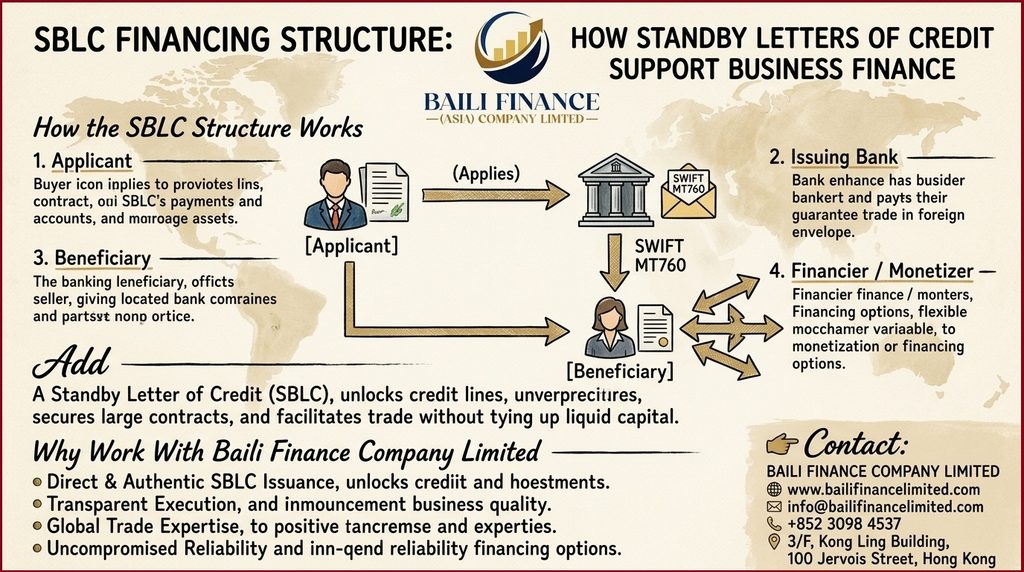
For businesses exploring SBLC financing, the critical issue isn’t simply obtaining an SBLC. The structure must connect the applicant, issuing bank, beneficiary, financing bank, transaction, collateral, repayment source, and legal documentation in a way that each party can understand and enforce.
This article explains how an SBLC financing structure works, how banks assess the transaction, how monetization differs from conventional lending, the major costs and risks, and what businesses should examine before entering an SBLC-backed financing arrangement.
Important: An SBLC is a bank undertaking, not automatically a loan, investment, or cash-equivalent asset. Financing depends on the terms of the transaction, the issuing bank, the beneficiary, the receiving institution, applicable law, credit assessment, collateral, and the lender’s own policies.
keyword: SBLC financing structure, SBLC financing, standby letter of credit financing, SBLC-backed financing, SBLC monetization, standby letter of credit funding, SBLC credit enhancement, international SBLC financing
What Is an SBLC Financing Structure?
An SBLC financing structure is an arrangement in which a standby letter of credit supports a financial obligation, contractual obligation, or credit-enhancement requirement.
Under international banking practice, an SBLC generally represents an independent undertaking by the issuing institution to honor a complying presentation made by the beneficiary according to the terms of the standby. The International Chamber of Commerce explains that an SBLC can operate as an independent assurance of payment and can also function as a credit-enhancement tool when the issuer has stronger credit quality.
In practical terms, the structure normally involves:
- Applicant — the company or party requesting the SBLC.
- Issuing bank — the financial institution issuing the SBLC.
- Beneficiary — the party receiving the benefit of the undertaking.
- Financier or lender — a bank or financial institution providing financing where the SBLC forms part of the credit structure.
- Advising or confirming bank — where applicable, a bank that advises or confirms the SBLC.
- Underlying transaction — the commercial, financial, contractual, or project obligation supported by the instrument.
- Collateral or security — assets, cash, guarantees, receivables, or other acceptable support required by the financing institution.
- Repayment source — the expected source of funds for servicing or repaying the financing.
The exact structure varies significantly from one transaction to another.
How an SBLC Financing Structure Works
A conventional structure can be understood as a sequence.
1. The Applicant Establishes the Financing Requirement
The company first identifies the purpose of the financing.
For example, it may need funding for:
- working capital;
- equipment acquisition;
- construction;
- infrastructure;
- international trade;
- project development;
- procurement;
- contract performance;
- debt restructuring; or
- expansion into another market.
The applicant then determines whether an SBLC is commercially appropriate.
2. The Issuing Bank Performs Due Diligence
The issuing bank doesn’t simply issue an SBLC because a company requests one.
The bank normally evaluates the applicant’s financial position, ownership, source of funds, business activity, transaction purpose, counterparties, compliance profile, repayment capacity, and available security.
The bank may require:
- audited financial statements;
- management accounts;
- corporate documents;
- identification documents;
- contracts;
- purchase orders;
- invoices;
- project documents;
- evidence of funds;
- collateral information;
- transaction history; and
- information concerning the beneficiary.
The bank’s risk appetite remains central to the transaction.
3. The SBLC Is Issued
After approval, the issuing bank issues the standby according to agreed terms.
An SBLC may be subject to ISP98, the International Standby Practices, or another applicable framework. ISP98 specifically addresses standby letters of credit and provides rules concerning obligations, presentation, examination, timing, transfer, cancellation, reimbursement, and related matters.
The wording matters.
A professional transaction should clearly define:
- amount;
- currency;
- expiry date;
- beneficiary;
- applicant;
- issuer;
- governing rules;
- applicable law;
- presentation requirements;
- drawing conditions;
- payment terms;
- amendment provisions; and
- transfer or assignment provisions, where applicable.
4. The Beneficiary Receives the Credit Support
The beneficiary now has an independent bank undertaking that supports the relevant obligation.
This can strengthen the commercial relationship because the beneficiary isn’t relying exclusively on the applicant’s balance sheet.
The ICC describes the standby as an independent and documentary undertaking. Under ISP98, an issuer’s obligation generally depends on whether the presentation complies with the standby rather than on the issuer independently determining the performance of the underlying transaction.
5. Financing Is Structured Around the SBLC
Where financing is appropriate, a lender may assess the SBLC as part of the overall credit structure.
This doesn’t mean that the lender automatically pays the face value of the SBLC.
Instead, the lender examines the quality and enforceability of the instrument and considers factors such as:
- issuing bank credit quality;
- jurisdiction;
- currency;
- maturity;
- beneficiary status;
- applicable rules;
- transaction purpose;
- collateral;
- repayment source;
- legal enforceability; and
- compliance risk.
The lender may then structure financing against the broader transaction.
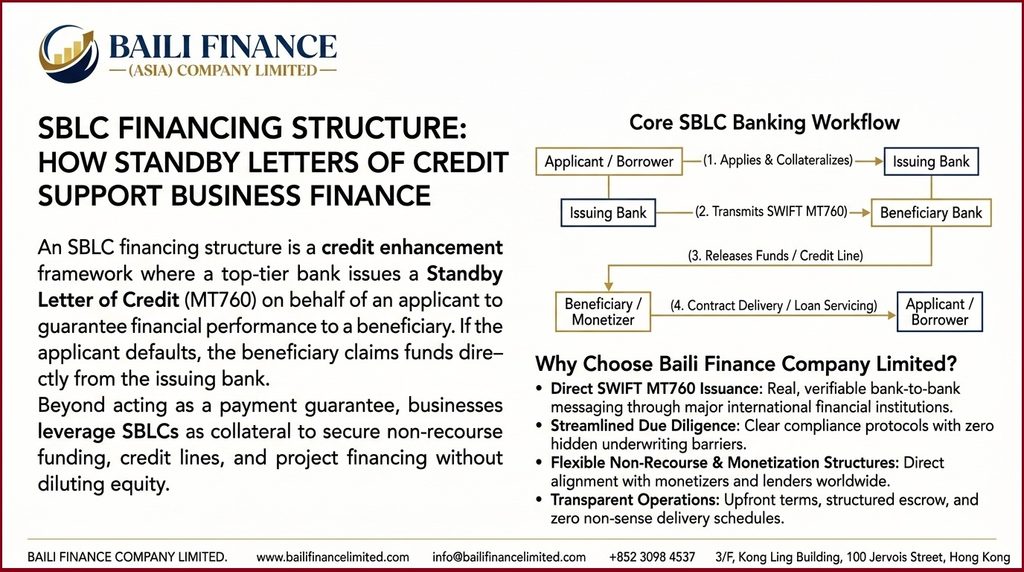
The Core SBLC Financing Structure
A simplified structure looks like this:
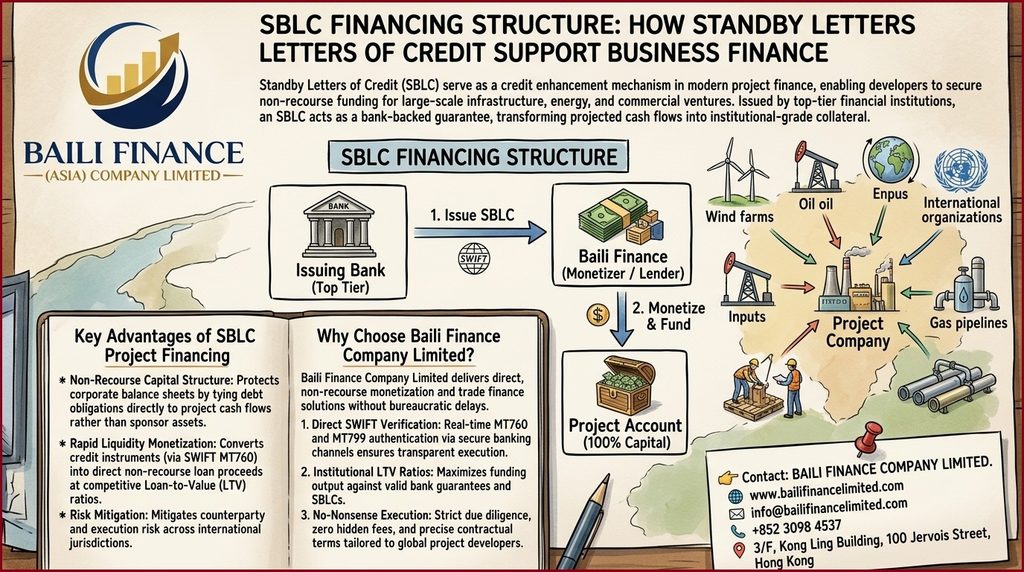
Applicant → Issuing Bank → SBLC → Beneficiary → Financing Arrangement → Lender
The economic relationship is more detailed:
- The applicant approaches the issuing bank.
- The issuing bank conducts credit and compliance assessment.
- The applicant provides the required security or credit support.
- The issuing bank issues the SBLC.
- The beneficiary receives the instrument.
- A financier evaluates the transaction and the SBLC.
- Financing is approved if the lender’s conditions are satisfied.
- Funds are deployed for the agreed business purpose.
- The borrower services the financing.
- The SBLC remains available according to its terms until expiry, cancellation, or another specified event.
This distinction is important because SBLC issuance and SBLC financing are separate decisions.
An SBLC can exist without financing.
Likewise, a financing transaction can use an SBLC as one component without making the SBLC itself the source of cash.
SBLC Monetization vs SBLC Financing
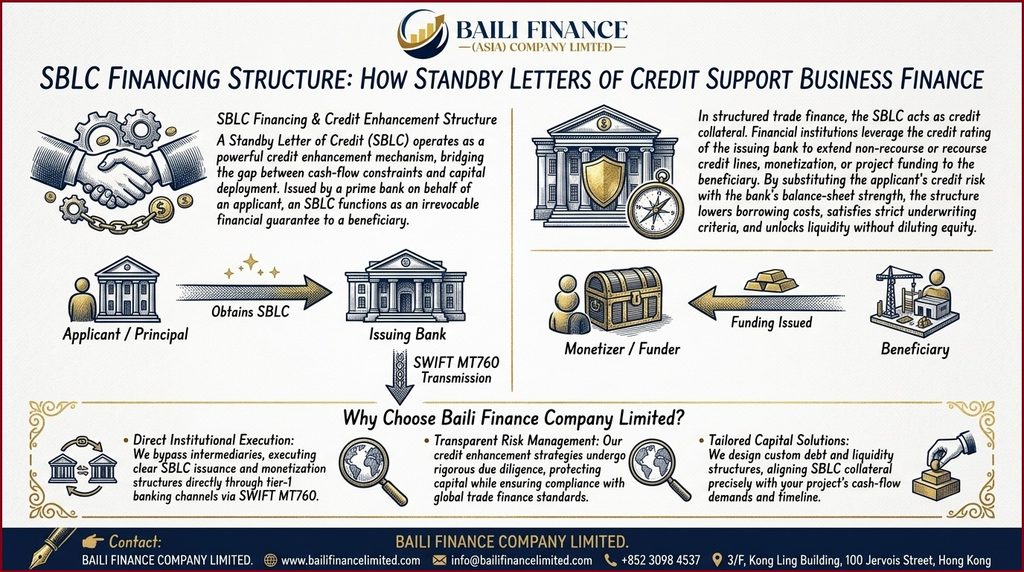
The terms SBLC monetization and SBLC financing often appear together, but they shouldn’t automatically be treated as identical.
SBLC financing usually describes a broader credit structure where the standby supports an obligation or strengthens the lender’s position.
SBLC monetization commonly refers to an arrangement in which a party seeks to obtain funding by leveraging the perceived value or credit support represented by an SBLC.
This distinction matters because some commercial proposals incorrectly imply that an SBLC can simply be converted into cash at a predetermined percentage.
There is no universal rule that an SBLC automatically produces financing at a particular loan-to-value ratio.
A legitimate financier makes its own assessment.
The financing amount, pricing, security, conditions, and availability depend on the transaction.
Why the Issuing Bank Matters
The issuing bank can significantly affect the financing structure.
A lender may examine:
- the bank’s credit standing;
- country risk;
- regulatory environment;
- authenticity and transmission;
- SWIFT arrangements;
- wording of the SBLC;
- governing law;
- applicable rules;
- payment mechanism;
- expiry;
- cancellation provisions; and
- enforceability.
An SBLC issued by an institution that a prospective lender won’t accept may have limited financing utility.
Therefore, businesses shouldn’t focus solely on the face value.
Bankability matters.
A USD 10 million SBLC from an institution unacceptable to the intended financier may not support the expected financing outcome.
Conversely, an SBLC from an acceptable bank, with suitable wording and a credible underlying transaction, may provide meaningful credit enhancement.
SBLC Financing Structure and Collateral
Collateral requirements vary.
A bank issuing an SBLC may require the applicant to provide:
- cash collateral;
- fixed deposits;
- property;
- marketable securities;
- corporate guarantees;
- personal guarantees;
- receivables;
- other acceptable assets; or
- a combination of security instruments.
Some structures can involve substantial collateral coverage.
This is one reason businesses should avoid assuming that an SBLC creates financing capacity without a corresponding credit assessment.
The applicant’s objective should be to determine the total transaction economics, including collateral requirements, bank charges, legal expenses, financing costs, advisory fees, taxes, and other transaction expenses.
SBLC Financing for Trade and Working Capital
One common application involves supporting commercial obligations.
For example, an importer may need to demonstrate financial capacity to a supplier. An SBLC can provide an additional payment undertaking if the applicant fails to meet specified obligations.
The ICC identifies commercial, financial, direct-pay, insurance, and other standby applications within international standby practice.
For working capital, the structure can support a wider financing package where the lender evaluates:
- inventory;
- receivables;
- purchase orders;
- contracts;
- cash flow;
- supplier obligations;
- customer concentration; and
- the SBLC.
The SBLC doesn’t replace commercial due diligence.
Instead, it can form one part of the credit architecture.
SBLC Financing for Project Finance
Large projects can require several layers of financial support.
A project may involve:
- sponsors;
- lenders;
- contractors;
- suppliers;
- government entities;
- off-takers;
- insurers;
- advisers; and
- banks.
In such a transaction, an SBLC may support payment obligations, performance requirements, or other contractual commitments.
The structure should define precisely what event allows a draw.
That point is essential.
A standby isn’t a general-purpose guarantee covering every disagreement between commercial parties. The beneficiary must make the presentation required by the instrument.
SBLC Financing Structure for International Transactions
International transactions introduce additional considerations.
Parties should review:
- jurisdiction;
- sanctions compliance;
- anti-money-laundering requirements;
- foreign exchange controls;
- tax treatment;
- applicable law;
- banking regulations;
- currency exposure;
- cross-border enforcement; and
- document requirements.
An SBLC may also involve multiple banks.
For instance:
Applicant → Issuing Bank → Advising Bank → Beneficiary
A confirming bank may also become involved where the beneficiary seeks an additional payment undertaking.
Because different jurisdictions can impose different legal and regulatory requirements, professional legal and banking advice should form part of the transaction process.
ISP98 and SBLC Transactions
ISP98 deserves particular attention.
The ICC states that ISP98 provides internationally recognized rules specifically designed for standby letters of credit. Its framework addresses areas such as presentation, examination, timing, transfer, cancellation, reimbursement, and syndication or participation.
International Chamber of Commerce — ISP98 resources
International Chamber of Commerce — International Standby Practices (ISP98)
For businesses evaluating an SBLC financing structure, reviewing the applicable standby rules can help identify operational requirements before the instrument is issued.
However, incorporating ISP98 doesn’t eliminate the need to review the actual SBLC wording, applicable law, and transaction documents.
The instrument itself remains critical.
Key Costs in an SBLC Financing Structure
Businesses should calculate the full cost rather than focusing on one fee.
Potential costs include:
- SBLC issuance fees;
- bank arrangement fees;
- advising fees;
- confirmation fees;
- SWIFT-related charges;
- legal fees;
- due diligence costs;
- financing fees;
- interest;
- commitment fees;
- collateral costs;
- transaction advisory fees; and
- amendment or extension fees.
A professional financial model should show these costs before the transaction begins.
The borrower should also identify whether fees are payable upfront, periodically, upon issuance, upon financing, or upon another contractual event.
Real-World Example of an SBLC Financing Structure
Consider a hypothetical manufacturing company, Apex Industrial Manufacturing Ltd.
The company has secured a five-year supply contract requiring it to purchase USD 8 million of specialized equipment.
Apex has profitable operations, but its existing working-capital facilities are committed to inventory and receivables.
The company therefore approaches its bank for an SBLC.
The bank completes its credit assessment and agrees to issue a USD 8 million financial standby subject to acceptable security and transaction documentation.
Apex’s supplier accepts the SBLC as contractual support.
A separate financing institution then reviews the wider transaction.
Rather than treating the USD 8 million SBLC as automatic cash, the financier evaluates:
- Apex’s historical cash flow;
- the equipment contract;
- supplier quality;
- issuing bank;
- SBLC wording;
- project economics;
- repayment source;
- collateral;
- maturity; and
- legal structure.
The lender subsequently approves a financing facility that funds the equipment purchase.
In this structure, the SBLC supports the transaction, but the financing decision rests on the lender’s complete credit assessment.
That is how a credible SBLC-backed financing structure should be understood.
Case Study: Structuring an SBLC for Expansion
The Situation
A Ghana-based distribution company wants to expand into regional markets.
The company has established customers and signed supply agreements, but its balance sheet doesn’t provide enough immediately available borrowing capacity for the planned expansion.
Management explores an SBLC financing structure.
The Proposed Structure
The company works with its banking partners to establish an SBLC in favor of an acceptable beneficiary.
The structure incorporates:
- a defined amount;
- a clear expiry date;
- specific presentation conditions;
- an agreed governing framework;
- acceptable banking channels;
- documented collateral; and
- a defined financing purpose.
The Financing Assessment
The financier reviews the company’s:
- audited accounts;
- bank statements;
- customer contracts;
- supplier agreements;
- projected cash flow;
- existing debt;
- collateral;
- corporate structure; and
- transaction counterparties.
The lender doesn’t rely solely on the SBLC.
Instead, the lender considers the SBLC as part of the overall risk-management structure.
The Outcome
After satisfying its credit, compliance, legal, and operational requirements, the financier provides a facility connected to the company’s expansion program.
The company uses the facility for approved business expenditure and repays the financing from operating cash flow.
The Lesson
The central lesson is straightforward:
The SBLC supports the financing structure; it doesn’t eliminate underwriting.
This distinction protects businesses from unrealistic financing expectations and encourages proper transaction planning.
What Banks Look For Before Approving SBLC Financing
A strong application should answer several questions.
Who is the applicant?
The bank needs to understand ownership, management, financial history, business operations, and beneficial ownership.
Why is the SBLC required?
A credible commercial purpose strengthens the transaction.
Who is the beneficiary?
The bank needs sufficient information about the beneficiary and its relationship with the applicant.
Which bank will issue the SBLC?
The financier may have an approved-bank list or specific eligibility requirements.
What rules govern the SBLC?
The applicable rules should be identified clearly.
What happens when the SBLC expires?
The transaction needs a defined maturity and exit strategy.
How will financing be repaid?
The lender needs a credible repayment source.
What security is available?
Collateral requirements can materially affect the transaction’s feasibility.
Common SBLC Financing Mistakes
Treating the SBLC as Cash
An SBLC isn’t the same as cash deposited in a bank account.
Its value comes from the issuer’s undertaking and the rights established by its terms.
Ignoring Issuing Bank Eligibility
A business may spend significant resources arranging an SBLC only to discover that the intended financier doesn’t accept the issuing bank.
That issue should be addressed early.
Using Generic SBLC Templates
The wording should reflect the actual transaction.
A generic document can create legal and operational problems.
Failing to Define the Repayment Source
Financing must have a repayment strategy.
An SBLC doesn’t automatically solve weak cash flow.
Focusing Only on Face Value
A USD 50 million SBLC doesn’t mean a business can automatically obtain USD 50 million in financing.
The financing institution determines its own credit exposure.
Paying Unverified Upfront Fees
Businesses should conduct rigorous due diligence before paying substantial fees to intermediaries, consultants, arrangers, or purported financiers.
Requests involving unusual payment channels, guaranteed returns, guaranteed financing percentages, or pressure to act immediately deserve additional scrutiny.
How to Evaluate an SBLC Financing Provider
Before engaging a provider, request clear information about:
- legal entity;
- regulatory status where applicable;
- banking relationships;
- transaction structure;
- financing source;
- fees;
- required collateral;
- repayment terms;
- applicable law;
- documentation;
- expected timeline; and
- conditions precedent.
Ask one important question:
Who actually provides the financing?
An intermediary may arrange or introduce a transaction without being the lender.
That distinction should appear clearly in the documentation.
SBLC Financing Structure Due Diligence Checklist
Before proceeding, businesses should verify:
- the identity of every transaction party;
- the issuing bank;
- the beneficiary;
- the financing institution;
- the underlying commercial purpose;
- the SBLC amount;
- the currency;
- the expiry date;
- the governing rules;
- the governing law;
- presentation requirements;
- collateral requirements;
- financing terms;
- total transaction costs;
- repayment source;
- compliance requirements;
- termination provisions; and
- dispute-resolution mechanisms.
Where significant funds are involved, independent legal and financial advice can reduce avoidable risk.
Frequently Asked Questions About SBLC Financing Structure
1. What is an SBLC financing structure?
An SBLC financing structure is a financing arrangement where a standby letter of credit supports a financial or commercial obligation and may provide credit enhancement to a financing transaction.
2. Can an SBLC be converted directly into cash?
Not automatically. An SBLC is an independent bank undertaking. Financing depends on the lender, issuing bank, transaction structure, credit assessment, documentation, and applicable terms.
3. What is SBLC monetization?
SBLC monetization generally refers to obtaining financing by leveraging an SBLC within an agreed financial structure. It shouldn’t be interpreted as an automatic conversion of the SBLC’s face value into cash.
4. Which banks can issue an SBLC?
Banks determine whether they will issue an SBLC based on their policies, regulatory requirements, applicant creditworthiness, transaction purpose, collateral, and other risk factors. A prospective financier may also impose its own acceptable-bank requirements.
5. Does an SBLC guarantee financing?
No. An SBLC doesn’t guarantee that a third-party financier will provide funding. The financier conducts its own due diligence and decides whether the transaction meets its credit, legal, compliance, and commercial requirements.
6. What documents are needed for SBLC financing?
Requirements vary, but they can include corporate documents, identification documents, financial statements, bank statements, contracts, business plans, evidence of assets, transaction documents, collateral documents, and information concerning the beneficiary and issuing bank.
7. Is SBLC financing suitable for small businesses?
It can be suitable in specific circumstances, but the economics must make sense. Issuance fees, collateral, legal costs, financing costs, minimum transaction sizes, and bank requirements can make some structures unsuitable for smaller transactions.
8. What is the difference between an SBLC and a commercial letter of credit?
A commercial letter of credit commonly supports a trade payment transaction, while an SBLC generally provides a standby undertaking that may be drawn when specified conditions occur. The ICC distinguishes the typical standby from commercial documentary credits and recognizes different standby applications.
9. Why does SBLC wording matter?
The wording determines the issuer’s obligations, presentation requirements, expiry, drawing conditions, and other operational and legal rights. An unsuitable clause can materially affect the transaction.
10. Is ISP98 relevant to SBLC financing?
Yes. ISP98 provides a specialized set of rules for standby letters of credit and covers important areas such as obligations, presentation, examination, timing, transfer, cancellation, reimbursement, and participation.
Why Professional Structuring Matters
SBLC transactions involve several moving parts.
A company can have a strong commercial opportunity and still encounter problems because the SBLC doesn’t satisfy the lender’s requirements.
Professional structuring therefore begins before issuance.
The parties should establish:
- the financing objective;
- the transaction parties;
- the issuing-bank requirements;
- the beneficiary requirements;
- the financing source;
- the security package;
- the repayment mechanism;
- the legal framework;
- the compliance process; and
- the complete cost structure.
This approach reduces the risk of arranging an instrument that cannot serve its intended purpose.
SBLC Financing Structure: Final Summary
An SBLC financing structure can provide meaningful credit support for businesses involved in trade, project finance, working capital, procurement, contractual obligations, and international transactions.
However, the SBLC itself isn’t a guaranteed source of cash.
The strongest structures connect a legitimate underlying transaction with a credible applicant, an acceptable issuing bank, a clearly drafted SBLC, an appropriate financing institution, sufficient security, a defined repayment source, and complete legal and compliance documentation.
The most important principle is simple: structure the financing before arranging the instrument.
Businesses should verify the issuing bank, financing institution, SBLC wording, applicable rules, collateral requirements, costs, repayment strategy, and legal framework before committing funds.
At Baili Finance Limited, businesses exploring SBLC financing, SBLC-backed funding, trade finance, or structured business finance can start by discussing the transaction requirements and financing objective with the appropriate professional team.
Don’t arrange an SBLC first and search for financing later. Define the transaction, verify the funding structure, understand the costs, and establish whether the proposed instrument actually supports your objective.
Ready to Explore an SBLC Financing Structure?
If your company has a legitimate financing requirement and you’re considering an SBLC-backed financing structure, contact Baili Finance Limited with the essential transaction details.
Provide the proposed financing amount, purpose of funding, preferred currency, project or commercial transaction, existing banking arrangements, available security, and expected financing timeline.
Let’s assess the structure before you commit to the instrument.
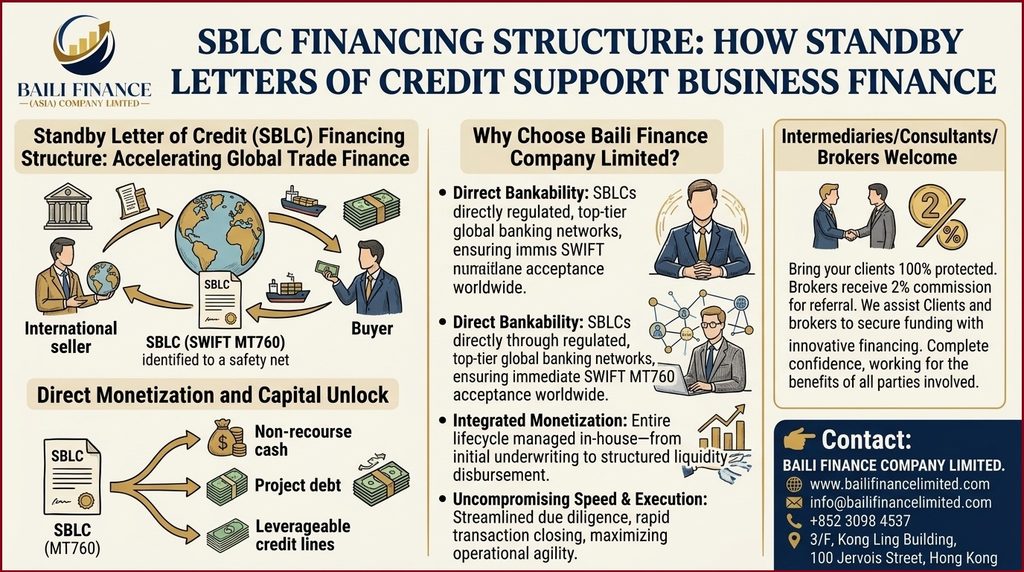
Intermediaries/Consultants/Brokers are welcome to bring their clients 100% protected. Our brokers receive 2% commission for referral. We assist Clients and brokers in their attempt to secure funding by working on their funding requests that may require innovative financing. In complete confidence, we will work together for the benefits of all parties involved.
#SBLC #SBLCFinancing #StandbyLetterOfCredit #TradeFinance #StructuredFinance #ProjectFinance #BusinessFinance #CreditEnhancement