Headline: 9 Critical Steps to Secure SBLC Financing
HOW TO OBTAIN SBLC FINANCING: 9 STEPS TO SECURE FUNDING
Obtaining SBLC financing requires more than finding a provider that advertises standby letter of credit funding. A successful transaction starts with a genuine financing requirement, a credible commercial purpose, an acceptable issuing bank, proper documentation, satisfactory compliance checks, and a financing structure that a lender can actually approve.
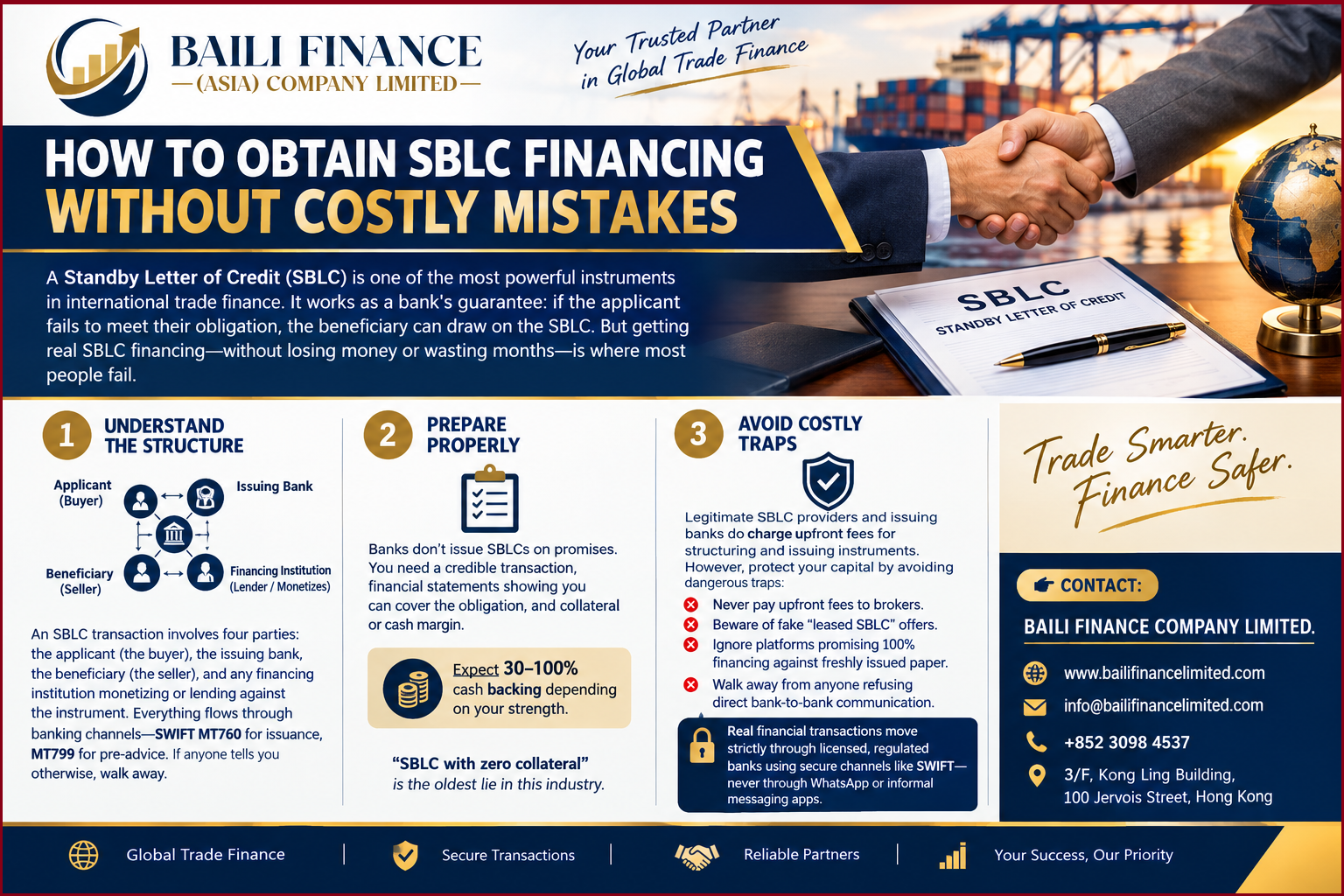
A Standby Letter of Credit (SBLC) can support credit enhancement, payment security, contractual obligations, trade finance, project finance, and certain structured financing arrangements. However, an SBLC isn’t the same as cash, a conventional business loan, or an automatic source of investment capital.
For companies searching for how to obtain SBLC financing, SBLC funding, SBLC-backed financing, standby letter of credit financing, or SBLC monetization, understanding the transaction before committing funds matters.
The International Chamber of Commerce’s International Standby Practices, known as ISP98, provides rules specifically designed for standby letters of credit. Under ISP98, a standby is an independent, documentary and binding undertaking when issued.
That distinction shapes the entire financing process.
A business doesn’t obtain financing merely because an SBLC has a large face value. Instead, the financing institution evaluates the instrument, issuing bank, applicant, transaction, repayment source, documentation, compliance profile and proposed structure.
This guide explains how to approach SBLC financing professionally, what lenders usually examine, how the process works, which documents matter, what risks deserve attention, and how businesses can prepare before approaching a financing provider.
Keywords: How to obtain SBLC financing, SBLC financing, SBLC funding, standby letter of credit financing, SBLC-backed financing, SBLC monetization, SBLC financing for business, financing against SBLC, SBLC funding process
What Is SBLC Financing?
SBLC financing refers to a financing arrangement in which a qualifying Standby Letter of Credit forms part of the security, credit enhancement or risk-mitigation structure supporting a financing facility.
The parties can include:
- The applicant
- The issuing bank
- The beneficiary
- An advising bank
- A confirming bank, where applicable
- A financing institution
- Legal advisers
- Compliance professionals
- Project sponsors
- Suppliers or commercial counterparties
The exact structure varies according to the transaction.
For example, a company may require $10 million to execute an international supply contract. Instead of relying solely on its balance sheet, it may arrange an acceptable SBLC in favor of a financing institution or another designated beneficiary.
The financier then reviews the SBLC alongside the company’s financial information, contracts, repayment source, corporate structure and compliance documentation.
If the institution approves the transaction, it may structure a financing facility supported by the SBLC.
The important point is simple:
The SBLC supports the financing structure. It doesn’t replace underwriting.
Banks and financing institutions still need to determine whether the transaction makes commercial and financial sense.
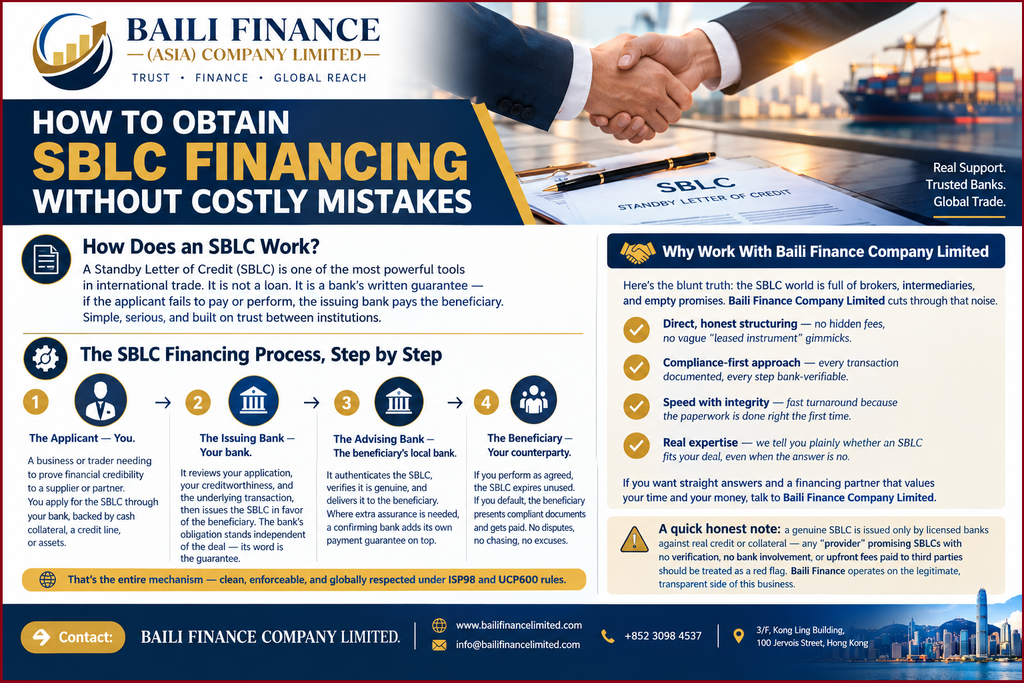
How Does an SBLC Work?
An SBLC generally operates as an independent undertaking from the issuing institution to the beneficiary.
Under ISP98, the issuer’s obligation is independent of the underlying transaction and depends on presentation of documents required by the standby.
A simplified structure looks like this:
Applicant → Issuing Bank → SBLC → Beneficiary/Financier → Financing Structure
Suppose Company A needs working capital to execute a large purchase order.
Company A approaches an issuing bank.
The bank conducts its own credit and compliance assessment.
If approved, the bank issues an SBLC in accordance with the agreed terms.
The beneficiary or financing institution receives the instrument through the appropriate banking channel.
The financing institution verifies the instrument and assesses the complete transaction.
If the transaction satisfies its requirements, it may establish a financing facility.
The company then uses the financing according to the agreed facility documents.
The SBLC remains subject to its stated terms, expiration date, presentation requirements and applicable rules.
That means businesses shouldn’t treat an SBLC as an unrestricted cash balance.
SBLC Financing vs. Traditional Business Financing
Traditional business financing normally relies on factors such as:
- Historical revenue
- Profitability
- Cash flow
- Existing debt
- Collateral
- Credit history
- Management experience
- Industry risk
- Repayment capacity
SBLC-backed financing can introduce another layer of credit support.
The financing institution may consider:
- The issuing bank
- The SBLC amount
- The SBLC tenor
- The beneficiary
- Instrument wording
- Governing rules
- Authentication
- Transaction purpose
- Repayment source
- Underlying contracts
- Applicant’s financial position
This doesn’t mean an SBLC eliminates the need for financial analysis.
In fact, banks and financial institutions can assess the applicant’s creditworthiness even where a standby exists. OCC guidance specifically describes examination of credit exposure associated with standby letters of credit and notes that an account party’s credit may be analyzed similarly to an ordinary loan applicant.
Therefore, an applicant should prepare for two assessments:
The instrument assessment and the transaction assessment.
Both matter.
9 Steps to Obtain SBLC Financing
1. Define Exactly How Much Financing You Need
Before approaching an SBLC financing provider, establish the exact funding requirement.
Avoid starting with the question, “How much can I obtain against an SBLC?”
Start with:
“How much capital does this transaction actually require?”
Prepare a funding schedule showing:
- Total project or transaction cost
- Required financing
- Sponsor contribution
- Existing funding
- Working capital requirement
- Equipment costs
- Supplier payments
- Operating expenses
- Expected revenue
- Repayment schedule
For example, if a company requires $7 million to execute a documented supply contract, its financing request should explain why $7 million is required.
A request for $50 million without a corresponding commercial requirement can weaken the credibility of the application.
2. Establish a Genuine Commercial Purpose
A credible financing transaction needs a credible reason for the funds.
Potential purposes can include:
- Working capital
- International trade
- Import financing
- Export financing
- Equipment acquisition
- Construction
- Infrastructure
- Energy projects
- Manufacturing
- Commodity transactions
- Logistics
- Contract execution
- Project development
- Business expansion
The financing institution needs to understand where the money goes and how the facility will be repaid.
A detailed business plan can therefore make a significant difference.
Explain the commercial activity, counterparties, contracts, expected revenues, operating costs, funding requirement and repayment source.
3. Determine Whether You Need an SBLC
Not every financing transaction requires an SBLC.
Sometimes a conventional loan, trade finance facility, receivables facility, project finance structure, bank guarantee or other form of credit support may be more appropriate.
An SBLC can make sense where a credible financial institution needs additional payment assurance or credit enhancement.
The instrument’s purpose should therefore be established before it is arranged.
Ask:
- Who will be the beneficiary?
- Why does the beneficiary require an SBLC?
- Which bank must issue it?
- What amount is required?
- What tenor is required?
- Which rules should govern it?
- What documents must be presented?
- What happens when the transaction matures?
- What are the costs?
- What obligations does the applicant assume?
These questions should be answered before issuance.
4. Identify an Acceptable Issuing Bank
The issuing bank matters.
A financier doesn’t necessarily treat every SBLC as equivalent.
The institution may assess:
- Bank credit standing
- Country of incorporation
- Regulatory status
- Banking jurisdiction
- SWIFT capabilities
- Instrument wording
- Authentication process
- Compliance requirements
- Relationship with advising or confirming banks
- Tenor and amount
- Applicable sanctions restrictions
The ICC notes that beneficiaries should consider the issuer’s credit rating, size and country risk. It also explains that a beneficiary may require an acceptable confirming bank where the issuer isn’t acceptable under the beneficiary’s criteria.
Consequently, don’t arrange an SBLC first and ask whether a financier will accept it later.
Where possible, establish the financier’s eligibility requirements before the instrument is issued.
5. Prepare the SBLC Documentation
The wording of an SBLC matters.
A financing institution can examine:
- Issuing bank
- Applicant
- Beneficiary
- Face value
- Currency
- Expiry date
- Place of expiry
- Presentation requirements
- Drawing conditions
- Governing rules
- Applicable law
- Transfer provisions
- Assignment provisions
- Confirmation
- Amendment procedures
ISP98 provides a specialized framework for standby transactions, including provisions covering obligations, presentation, examination, cancellation, reimbursement and other operational matters.
Don’t assume that a document labelled “SBLC” automatically satisfies a financier’s requirements.
Each instrument should be assessed according to its actual terms.
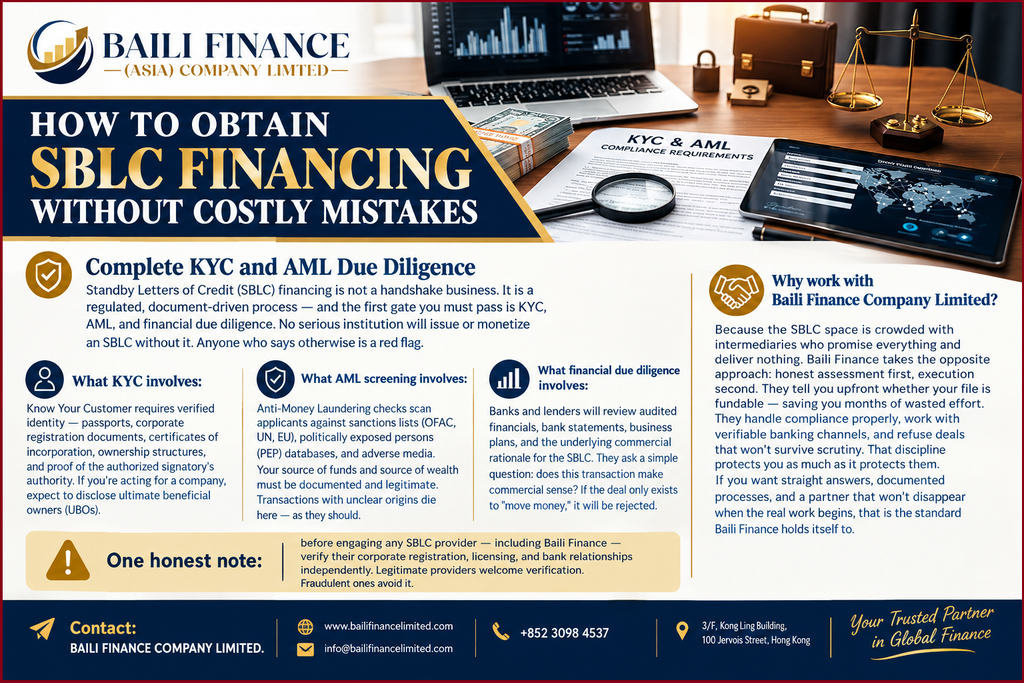
6. Complete KYC and AML Due Diligence
A legitimate financing process includes compliance.
Know Your Customer (KYC) and Anti-Money Laundering (AML) requirements can apply to the applicant, beneficial owners, counterparties, source of funds and transaction.
You may be asked to provide:
- Certificate of incorporation
- Company registration documents
- Articles or constitutional documents
- Ownership information
- Director information
- Identification documents
- Proof of address
- Bank statements
- Audited financial statements
- Management accounts
- Tax information
- Contracts
- Purchase orders
- Invoices
- Project documents
- Source-of-funds evidence
- Source-of-wealth information where applicable
A company shouldn’t view compliance as an administrative obstacle.
It helps the financing institution establish who is participating, where funds originate, what the transaction involves and whether the proposed activity satisfies applicable requirements.
7. Submit the Transaction for Credit Assessment
Once the documents are assembled, the financing institution can review the transaction.
A professional financing memorandum should clearly explain:
Who: applicant and counterparties.
What: transaction or project.
Why: purpose of financing.
How much: required facility.
How: proposed financing structure.
When: funding and repayment timetable.
From where: repayment source.
Against what: security and credit support.
This structure helps the financier understand the proposal without relying on assumptions.
The review can include financial analysis, legal due diligence, banking verification, compliance screening and commercial assessment.

8. Review the Term Sheet Carefully
If the transaction progresses, the financier may issue a term sheet.
Don’t focus only on the headline financing amount.
Review:
- Facility amount
- Interest or financing cost
- Arrangement fees
- Advisory fees
- Bank charges
- Legal costs
- Due diligence costs
- Tenor
- Repayment structure
- Security
- Conditions precedent
- Default provisions
- Early repayment provisions
- Covenants
- Insurance requirements
- Governing law
- Jurisdiction
Ask for clarification where a term isn’t clear.
Independent legal and financial advice can also be appropriate before signing significant financing documentation.
9. Complete Conditions Precedent and Funding
After approval, the transaction enters execution.
The financier may require:
- Final legal agreements
- Corporate resolutions
- Verified banking information
- Original or authenticated documents
- Legal opinions
- Insurance
- Security documents
- Confirmation of the SBLC
- Compliance clearance
- Evidence of the underlying transaction
Only after the agreed conditions are satisfied can funding occur.
The actual process differs between financing institutions and jurisdictions.
What Documents Do You Need for SBLC Financing?
A strong application normally includes several categories of information.
Corporate Documents
Prepare:
- Certificate of incorporation
- Memorandum and articles
- Ownership structure
- Director information
- Corporate profile
- Organizational chart
Financial Documents
Depending on the transaction, provide:
- Audited accounts
- Management accounts
- Bank statements
- Cash-flow projections
- Existing debt schedule
- Tax records
- Asset information
- Financial forecasts
Commercial Documents
These can include:
- Purchase contracts
- Sales contracts
- Supply agreements
- Offtake agreements
- Invoices
- Purchase orders
- Construction contracts
- Project agreements
- Licences
- Permits
SBLC Documents
Where an SBLC already exists, provide information concerning:
- Issuing bank
- Beneficiary
- Amount
- Currency
- Tenor
- Expiry
- Applicable rules
- Authentication
- Advising bank
- Confirmation
- Drawing conditions
The exact requirements depend on the financing institution.
What Is SBLC Monetization?
SBLC monetization generally refers to a structure in which an eligible SBLC contributes to a financing arrangement intended to provide liquidity or credit.
The term is widely used in the structured-finance market, but businesses should avoid treating “monetization” as a standardized product with a guaranteed percentage or automatic funding outcome.
A legitimate transaction depends on the instrument and the financing institution.
The financier may assess:
- Issuing bank
- Instrument authenticity
- Credit quality
- Face value
- Tenor
- Beneficiary
- Transaction purpose
- Legal framework
- Compliance
- Repayment structure
There is no universal rule stating that every $10 million SBLC produces a predetermined amount of cash.
Any party making such a claim should explain the complete financing structure and contractual basis for the proposed terms.
What Is the Difference Between SBLC Financing and SBLC Monetization?
The terms can overlap, but they don’t necessarily describe the same structure.
SBLC financing usually refers to financing where an SBLC provides credit support within a broader facility.
SBLC monetization usually describes a financing structure designed to obtain liquidity using an eligible SBLC.
The practical distinction depends on the transaction documents.
For a business owner, the more important questions are:
- Who provides the funding?
- What is the source of funds?
- Who is the beneficiary?
- Which bank issues the SBLC?
- What security does the financier receive?
- What fees apply?
- What happens if funding isn’t completed?
- What liabilities remain with the applicant?
Those questions matter more than the label applied to the transaction.
How Much Financing Can You Obtain Against an SBLC?
There is no universal financing percentage.
The amount depends on the financing institution, issuing bank, transaction, SBLC terms, tenor, applicant, jurisdiction, risk profile and repayment structure.
For example, an SBLC with a $20 million face value doesn’t automatically mean a company receives $20 million in financing.
The financier may structure a facility below the face value.
It may also require additional security, equity, guarantees, insurance, cash-flow support or other conditions.
Businesses should therefore treat any fixed “loan-to-value” percentage as a proposed commercial term, not an industry-wide entitlement.
Real-World Example: SBLC-Backed Working Capital
Consider an international manufacturing company with an established buyer.
The buyer has issued a purchase contract worth $15 million.
The manufacturer needs $6 million to purchase raw materials, arrange production and complete shipment.
The company’s existing bank facility doesn’t provide sufficient working capital.
The company explores an SBLC-backed financing structure.
First, it prepares the purchase contract, supplier quotations, financial statements, bank statements, corporate documents and cash-flow projections.
Second, the company arranges an SBLC from an acceptable issuing bank, subject to the requirements of the intended financing institution.
Third, the financier verifies the instrument and reviews the company’s financial position.
Fourth, the financier assesses the buyer, supplier arrangements, repayment source and overall transaction.
After satisfactory due diligence, the parties negotiate a financing facility.
The company then uses the approved funding for the documented transaction.
The important lesson is that the purchase contract, repayment source, corporate profile and banking instrument work together.
The SBLC doesn’t independently create the $6 million.
The financing institution makes the funding decision based on the complete structure.
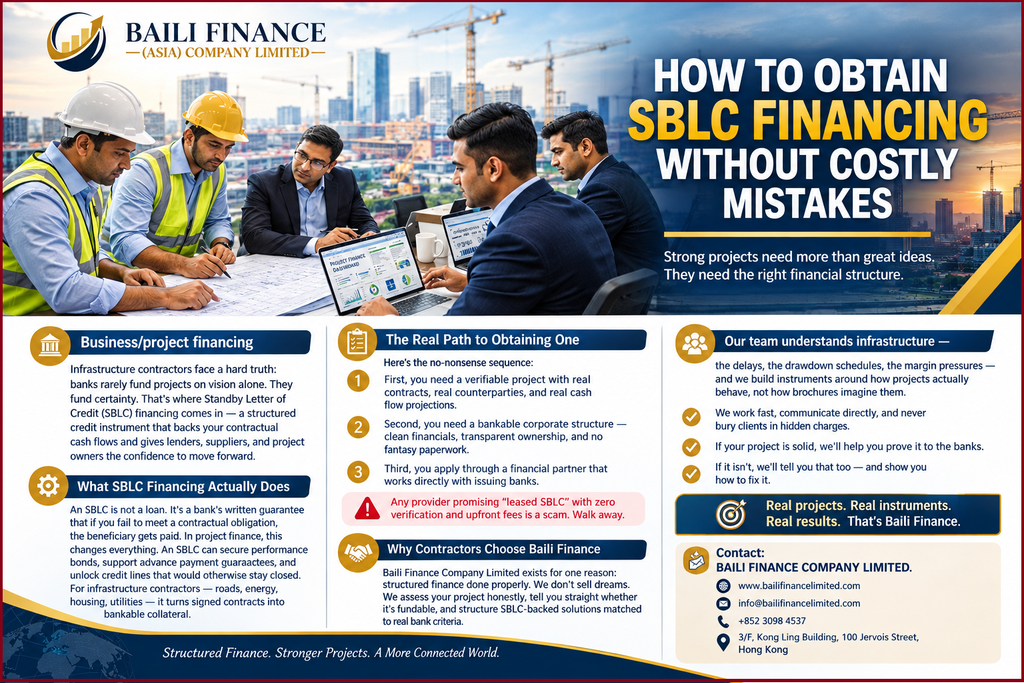
Case Study: Infrastructure Contractor Seeking Project Liquidity
Consider a hypothetical infrastructure contractor that has secured a $30 million construction contract.
The project owner requires financial security before work begins.
The contractor has technical capacity and an established operating history, but its existing working capital isn’t sufficient to meet the initial project expenditure.
The contractor needs approximately $8 million for equipment mobilisation, materials, labour and early-stage project expenses.
The Challenge
The contractor needs to demonstrate financial strength while maintaining sufficient liquidity to execute the project.
The Proposed Structure
The contractor works with its banking partners to arrange an SBLC acceptable to the relevant counterparty and financing institution.
The SBLC forms part of a wider financing and security structure.
Due Diligence
The financing institution reviews:
- Construction contract
- Project owner
- Contractor’s financial statements
- Existing liabilities
- Project cash flows
- Payment schedule
- SBLC issuing bank
- SBLC wording
- Corporate ownership
- Source of funds
- Compliance documentation
- Repayment mechanism
Financing Assessment
The financier doesn’t rely on the SBLC alone.
It also considers whether the project generates sufficient contractual cash flow to support repayment.
The financing proposal therefore includes a clear repayment strategy linked to project receivables.
Outcome
Subject to successful due diligence and agreed conditions, the financier may approve a structured facility.
The contractor uses the facility for eligible project expenses.
Project receipts then provide the expected repayment source.
This example is illustrative. It doesn’t represent a guaranteed financing structure, financing percentage, approval outcome or commercial term.
The central lesson remains consistent:
A strong SBLC transaction combines a credible bank instrument with a credible commercial transaction.
How to Avoid SBLC Financing Scams
Businesses should conduct independent due diligence before paying fees or transferring sensitive documents.
Be particularly careful when an intermediary:
- Guarantees financing regardless of the applicant
- Promises immediate funding
- Claims every SBLC qualifies
- Refuses to identify the funding source
- Requests unexplained upfront payments
- Uses unverifiable banking claims
- Provides documents that can’t be independently authenticated
- Pressures you to sign immediately
- Avoids formal legal documentation
- Promises a fixed financing percentage without reviewing the transaction
A genuine financing process still requires verification.
The issuing bank should be independently verified.
The financing institution should be identifiable.
The transaction documents should be reviewed.
The source of funds should be understood.
Fees should be documented.
Legal obligations should be clear.
The ICC’s trade-finance guidance also emphasizes the importance of banking rules, compliance and the roles of institutions involved in standby and guarantee transactions.
SBLC Financing Due Diligence Checklist
Before proceeding, ask these questions:
Banking
- Is the issuing bank genuine?
- Is the issuing bank acceptable to the financier?
- Can the instrument be authenticated?
- Is the bank’s jurisdiction acceptable?
- Is confirmation required?
Instrument
- What is the SBLC amount?
- What is the currency?
- What is the expiry date?
- Which rules govern it?
- What are the presentation requirements?
- Who is the beneficiary?
Financing
- Who provides the funding?
- What is the facility amount?
- What is the financing cost?
- What fees apply?
- What collateral is required?
- What is the repayment period?
Transaction
- What will the funds finance?
- Is there an underlying contract?
- Who pays the applicant?
- What is the repayment source?
- Does the transaction generate sufficient cash flow?
Compliance
- Has KYC been completed?
- Has AML screening been completed?
- Are beneficial owners identified?
- Is the source of funds documented?
- Are sanctions requirements addressed?
Legal
- What law governs the agreement?
- Which courts have jurisdiction?
- What happens after default?
- What obligations survive termination?
- Has independent counsel reviewed the documents?
A business that can answer these questions before signing can approach financing discussions with far greater clarity.
Common SBLC Financing Mistakes
Mistake 1: Focusing Only on Face Value
A $50 million SBLC doesn’t automatically mean $50 million in funding.
The financier assesses the complete transaction.
Mistake 2: Arranging the Wrong Instrument
An SBLC that doesn’t satisfy the beneficiary’s requirements may create additional costs and delays.
Mistake 3: Ignoring the Issuing Bank
The issuer’s credit quality can influence whether the instrument is acceptable.
Mistake 4: Providing Weak Financial Information
An SBLC doesn’t eliminate the need for credible corporate and financial documentation.
Mistake 5: Failing to Explain Repayment
A financier needs to understand how its money will be repaid.
Mistake 6: Paying Unverified Fees
Every fee should have a documented purpose, contractual basis and identifiable recipient.
Mistake 7: Assuming “Non-Recourse” Means No Risk
A transaction described as non-recourse can still contain contractual obligations, fees, representations, conditions and specific security arrangements.
Read the documents.
Frequently Asked Questions About SBLC Financing
1. What is SBLC financing?
SBLC financing is a financing structure in which a qualifying Standby Letter of Credit supports a financing facility, credit enhancement arrangement or other commercial financing structure.
The SBLC itself isn’t automatically a cash loan.
2. How can I obtain SBLC financing?
Start by defining the financing requirement and commercial purpose. Then prepare corporate, financial and transaction documents, identify an acceptable issuing bank and financing institution, complete due diligence, verify the SBLC and negotiate the financing terms.
The final facility remains subject to the financier’s approval.
3. Can an SBLC be used as collateral?
An SBLC can serve as credit support or security within an appropriate financing structure, subject to its terms and the financing institution’s requirements.
Whether a specific financier accepts it depends on the instrument, issuing bank, beneficiary and transaction.
4. How much can I borrow against an SBLC?
There is no universal financing percentage.
The amount depends on the issuing bank, SBLC terms, transaction, applicant, financing institution, jurisdiction, risk assessment and repayment structure.
5. Is SBLC monetization the same as SBLC financing?
Not necessarily.
SBLC monetization generally describes obtaining liquidity through a financing structure involving an eligible SBLC. SBLC financing is a broader term covering financing arrangements in which an SBLC provides credit support.
The exact meaning depends on the transaction documents.
6. What documents are required for SBLC financing?
Requirements vary, but applicants may need corporate registration documents, ownership information, identification, financial statements, bank statements, contracts, business plans, project documents, cash-flow forecasts, source-of-funds evidence and SBLC details.
7. Does an SBLC guarantee financing?
No.
An SBLC can strengthen a financing structure, but it doesn’t guarantee that a financier will approve funding.
The lender can still assess the applicant, transaction, repayment source, issuing bank and compliance profile.
8. Can startups obtain SBLC financing?
Potentially, depending on the transaction.
A startup may need a strong commercial contract, credible counterparties, adequate financial projections, acceptable banking support and a clear repayment structure.
A lack of operating history can affect the credit assessment.
9. What makes an SBLC acceptable to a financier?
Factors can include the issuing bank, jurisdiction, credit standing, wording, amount, tenor, beneficiary, authentication, governing rules and compliance status.
The financier’s own eligibility criteria ultimately determine acceptance.
10. How long does SBLC financing take?
There isn’t one standard timeframe.
The process can depend on document readiness, KYC, bank verification, legal review, credit underwriting, instrument issuance, authentication and conditions precedent.
Incomplete documentation can create delays.
The Importance of ISP98 in SBLC Transactions
Businesses dealing with standby letters of credit should understand the rules incorporated into the instrument.
ISP98 was developed specifically for standby letters of credit and provides a framework covering areas such as obligations, presentation, examination, cancellation and reimbursement.
The ICC also distinguishes standby practices from rules developed primarily for commercial documentary credits.
The precise governing framework should therefore be confirmed from the actual instrument rather than assumed from its title.
For complex transactions, professional banking and legal advice can help parties understand the implications of the wording.
How to Prepare Before Contacting an SBLC Financing Provider
Before making an inquiry, prepare a concise transaction package.
Include:
Company profile: Explain what the business does, where it operates and who owns it.
Funding requirement: State the exact amount required.
Purpose: Explain what the funds will finance.
Commercial evidence: Attach contracts, purchase orders or project agreements.
Financial information: Provide recent financial statements and bank information where appropriate.
Repayment source: Explain exactly how the financing will be repaid.
SBLC information: If an SBLC already exists, provide its key details.
Banking information: Identify the issuing bank and relevant banking parties.
Compliance information: Prepare ownership and KYC documentation.
Timeline: Explain when the financing is required and why.
This approach allows a financing provider to evaluate the transaction efficiently.
Why Transaction Quality Matters More Than Marketing Claims
The SBLC market includes legitimate banking applications, but businesses should assess every proposed transaction independently.
A professional financing proposal should explain:
- The parties
- The instrument
- The funding source
- The transaction
- The repayment mechanism
- The fees
- The security
- The legal framework
- The conditions for funding
A company should never base a major financial decision solely on a promotional claim that an SBLC can produce a specific amount of funding.
Documentation should support the claim.
Banking channels should support the instrument.
The financing agreement should support the facility.
And the commercial transaction should support repayment.
Final Summary: How to Obtain SBLC Financing
Obtaining SBLC financing requires a structured approach.
First, define the actual financing requirement.
Second, establish a legitimate commercial purpose.
Third, determine whether an SBLC is appropriate for the transaction.
Fourth, identify an acceptable issuing bank.
Fifth, ensure the SBLC contains suitable terms and is subject to an appropriate framework.
Sixth, prepare complete corporate, financial and commercial documentation.
Seventh, complete KYC, AML and banking due diligence.
Eighth, submit the transaction for professional credit assessment.
Ninth, review the term sheet and financing agreements before execution.
Most importantly, remember that an SBLC isn’t cash.
Its usefulness comes from its role within a properly structured commercial or financing transaction. The issuing bank, instrument wording, beneficiary, financier, transaction purpose, repayment source and compliance requirements all influence whether funding can proceed.
For businesses exploring SBLC funding, standby letter of credit financing, SBLC monetization, project finance, trade finance or SBLC-backed working capital, the correct starting point is a transaction assessment.
Ready to Assess Your SBLC Financing Requirement?
If your company already has an SBLC, is arranging an SBLC, or needs to determine whether an SBLC could support a proposed financing structure, don’t make the decision based on a headline financing percentage or an unverified promise.
Bring the transaction to the table.
Share the funding requirement, commercial purpose, available documentation and SBLC position so the proposed structure can be assessed on its actual facts.
Contact Baili Finance Limited to discuss your SBLC financing requirement and determine the appropriate next step for your transaction.
Your financing requirement deserves more than a generic funding promise.
It deserves a structured assessment.
Intermediaries/Consultants/Brokers are welcome to bring their clients 100% protected. Our brokers receive 2% commission for referral. We assist Clients and brokers in their attempt to secure funding by working on their funding requests that may require innovative financing. In complete confidence, we will work together for the benefits of all parties involved.
#SBLCFinancing #SBLCFunding #StandbyLetterOfCredit #TradeFinance #ProjectFinance #StructuredFinance #BusinessFunding #SBLCMonetization